Child Violence against School Age Children in the Family and School Contexts and Children Cognitive and Social Development in Southeast Nigeria: Evidence for Policy and Sustainable Development Goals agenda among Developing Nations
Titolo Rivista MALTRATTAMENTO E ABUSO ALL’INFANZIA
Autori/Curatori Henry Ajuzie, Samuel O. Okafor, Okezi Obara, Andrew N. Ogbochie, Onyinyechi E. Okoye, Jane O. Okafor
Anno di pubblicazione 2026 Fascicolo 2025/3
Lingua Inglese Numero pagine 22 P. 77-98 Dimensione file 141 KB
DOI 10.3280/MAL2025-003005
Il DOI è il codice a barre della proprietà intellettuale: per saperne di più
clicca qui
Qui sotto puoi vedere in anteprima la prima pagina di questo articolo.
Se questo articolo ti interessa, lo puoi acquistare (e scaricare in formato pdf) seguendo le facili indicazioni per acquistare il download credit. Acquista Download Credits per scaricare questo Articolo in formato PDF
FrancoAngeli è membro della Publishers International Linking Association, Inc (PILA), associazione indipendente e non profit per facilitare (attraverso i servizi tecnologici implementati da CrossRef.org) l’accesso degli studiosi ai contenuti digitali nelle pubblicazioni professionali e scientifiche.
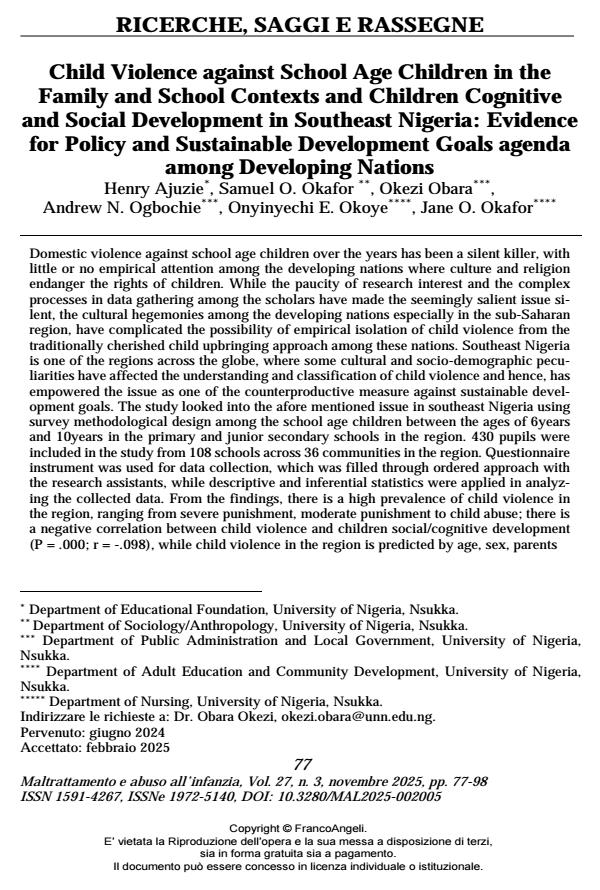
Domestic violence against school age children over the years has been a silent killer, with little or no empirical attention among the developing nations where culture and religion endanger the rights of children. While the paucity of research interest and the complex processes in data gathering among the scholars have made the seemingly salient issue silent, the cultural hegemonies among the developing nations especially in the sub-Saharan region, have complicated the possibility of empirical isolation of child violence from the traditionally cherished child upbringing approach among these nations. Southeast Nigeria is one of the regions across the globe, where some cultural and socio-demographic peculiarities have affected the understanding and classification of child violence and hence, has empowered the issue as one of the counterproductive measure against sustainable development goals. The study looked into the afore mentioned issue in southeast Nigeria using survey methodological design among the school age children between the ages of 6years and 10years in the primary and junior secondary schools in the region. 430 pupils were included in the study from 108 schools across 36 communities in the region. Questionnaire instrument was used for data collection, which was filled through ordered approach with the research assistants, while descriptive and inferential statistics were applied in analyzing the collected data. From the findings, there is a high prevalence of child violence in the region, ranging from severe punishment, moderate punishment to child abuse; there is a negative correlation between child violence and children social/cognitive development (P = .000; r = -.098), while child violence in the region is predicted by age, sex, parents occupation and complaining about violence among the children; the overall impact of child violence was found to be anti-sustainable development in the region (P = .000; R2 = 69.2).
Parole chiave:child violence, cognitive development, family, severe punishment, school counselling.
- Akpodiete, H. M. (2020). The synergy between culture and society in the eradication of child molestation in Nigeria. International Journal of Humanities Social Sciences and Education, 7(10), 88-93.
- Almuneef, M. A., Alghamdi, L. A., & Saleheen, H. N. (2016). Family profile of victims of child abuse and neglect in the Kingdom of Saudi Arabia. Saudi Medical Journal, 37(8), 882-888.
- Alonzo, D., Popescu, M., & Zubaroglu, P. (2022). Ioannides2Mental health impact of the Covid-19 pandemic on parents in high-risk, low income communities. International Journal of Social Psychiatry, 68(3), 575-581.
- Anazonwu, N. P. (2019). Socio-cultural factors associated with perception of child abuse among women in Nsukka LGA: Implications for social work practice in Nigeria. Journal of Social Work in Developing Societies, 1(3), 59-74.
- Antai, D., Braithwaite, P., & Clerk, G. (2016). Social determinants of child abuse: Evidence of factors associated with maternal abuse from the Egypt demographic and health survey. Journal of Injury & Violence Research, 8(1), 25-34.
- Baggett, K., Davis, B., Feil, E., Sheeber, L., Landry, S., Leve, C., & Johnson, U. (2017). A randomized controlled trial examination of a remote parenting intervention: Engagement and effects on parenting behavior and child abuse potential. Child Maltreatment, 22(4), 315-323. DOI: 10.1177/1077559517712000
- Bahmani, T., Naseri, N. S., & Fariborzi, E. (2022). Relation of parenting child abuse based on attachment styles, parenting styles, and parental addictions. Current Psychology.
- Baker, T. L., Wise, J., Kelley, G., & Skiba, R. J. (2016). Identifying barriers: Creating solutions to improve family engagement. School Community Journal, 26(2), 161-184. http://www.schoolcommunitynetwork.org/SCJ.aspx.
- Bates, K. A., Marcos, S., Baylor, C. B., & Mencken, F. C. (2003). Family structure, power-control theory, and deviance: Extending power-control theory to include alternate family forms. Western Criminology Review, 4(3), 170-190.
- Blackwell, B. S., & Kane, K. (2015). Power-control theory. In W. G. Jennings (Ed.), The encyclopedia of crime and punishment.
- Bywaters, P., Scourfield, J., Webb, C., Morris, K., Featherstone, B., Brady, G., . . . Sparks, T. (2019). Paradoxical evidence on ethnic inequities in child welfare: Towards a research agenda. Children and Youth Services Review, 96, 145-154.
- Calheiros, M. M. (2013). Parents’ beliefs on the causes of child maltreatment. International Journal of Psychology & Psychological Therapy, 13(1), 1-14.
- Cannon, C., Ferreira, R. J., & Buttell, F. (2018). Critical race theory, parenting, and intimate partner violence: Analyzing race and gender. Research on Social Work Practice, 1-13. DOI: 10.1177/1049731518784181
- Carter, B. (2003). Ducks might quack... Children and domestic violence in rural areas. Journal of Child Health Care, 7(4), 226-229. DOI: 10.1177/13674935030074008
- Chieh, A. Y., Liu, Y., Gower, B. A., Shelton, R. C., & Li, L. (2020). Effect of race on the relationship between child maltreatment and obesity in Whites and Blacks. Stress, 23(1), 19-25. DOI: 10.1080/10253890.2019.1625883
- Danielson, C. K., & Phelps, C. R. (2003). The assessment of children’s social skills through self-report: A potential screening instrument for classroom use. Measurement and Evaluation in Counseling and Development, 35, 218-229.
- Devries, K. (2016). Violence against children and education. International Health, 8, 1-2.
- Eriksson, L., & Mazerolle, P. (2015). A cycle of violence? Examining family-of-origin violence, attitudes, and intimate partner violence perpetration. Journal of Interpersonal Violence, 30(6), 945-964. DOI: 10.1177/0886260514539759
- Erozkan, A. (2016). The link between types of attachment and childhood trauma. Universal Journal of Educational Research, 4(5), 1071-1079.
- Ferrara, P., Franceschini, G., Villani, A., & Giovanni, C. (2019). Physical, psychological and social impact of school violence on children. Italian Journal of Pediatrics, 45, 7.
- Fuller, J. (2011). Corporal punishment and child development. Akron Law Review, 44(1), 2. Retrieved from http://ideaexchange.uakron.edu/akronlawreview/vol44/iss1/2.
- Gershoff, E. T. (2002). Corporal punishment by parents and associated child behaviors and experiences: A meta-analytic and theoretical review. Psychological Bulletin, 128(4), 539-579.
- Goel, V. (2009). Children’s human rights in underdeveloped country: A study in Ethiopian perspective. African Journal of Political Science and International Relations, 3(4), 142-155.
- Griffith, A. K. (2022). Parental burnout and child maltreatment during the COVID-19 pandemic. Journal of Family, 37, 725-731.
- Groundwater-Smith, S., Dockett, S., & Bottrell, D. (2015). Developing new methodological understandings of social research with children and young people. SAGE Publications Ltd. DOI: 10.4135/9781473910751
- Guedes, A., Bott, S., Garcia-Moreno, C., & Colombini, M. (2016). Bridging the gaps: A global review of intersections of violence against women and violence against children. Global Health Action, 9(1).
- Gunay, G., & Oguz, A. (2012). Sustainable development from the family to the society. Mediterranean Journal of Social Sciences, 3(5), 113-120.
- Higgins, D. J., & McCabe, M. P. (2001). The development of the comprehensive child maltreatment scale. Journal of Family Studies, 7(1), 7-28.
- Hurcombe, R., Redmond, T., Rodger, H., & King, S. (2022). Institutional responses to child sexual abuse in ethnic minority communities. In A. K. Gill & H. Begum (Eds.), Child sexual abuse in Black and minoritised communities. Palgrave Macmillan. DOI: 10.1007/978-3-031-06337
- Johnson, A. K., & Sloth-Nielsen, J. (2020). Safeguarding children in the developing world - Beyond intra-organisational policy and self-regulation. Soc. Sci., 9(6), 98.
- Keddell, [Initial Missing], & Hyslop, I. (2019). Ethnic inequalities in child welfare: The role of practitioner risk perceptions. Child & Family Social Work, 1-12.
- Kempe, C. H., Silverman, F. N., Steele, B. F., Droegemueller, W., & Silver, H. K. (1962). The battered-child syndrome. JAMA, 181(1), 17-24.
- Klevens, J., & Whitaker, D. J. (2007). Primary prevention of child physical abuse and neglect: Gaps and promising directions. Child Maltreatment, 12(4), 364-377. DOI: 10.1177/1077559507305995
- Lawson, M., Piel, M. H., & Simon, M. (2020). Child maltreatment during the COVID-19 pandemic: Consequences of parental job loss on psychological and physical abuse towards children. Child Abuse & Neglect, 110(Pt 1), 104709.
- Lilleston, P. S., Goldmann, L., Verma, R. K., & McCleary-Sills, J. (2017). Understanding social norms and violence in childhood: Theoretical underpinnings and strategies for intervention. Psychology, Health & Medicine, 22(sup1), 122-134. DOI: 10.1080/13548506.2016.1271954
- Lloyd, M. (2018). Domestic violence and education: Examining the impact of domestic violence on young children, children, and young people and the potential role of schools. Frontiers in Psychology, 9, 2094.
- Lourdes, M., & de Vera, A. (2019). Long term effects of abuse and violence on children’s behavior. American Journal of Biomedical Science & Research, 4(5), 000832. DOI: 10.34297/AJBSR.2019.04.000832
- Luken, A., Nair, R., & Fix, R. L. (2021). On racial disparities in child abuse reports: Exploratory mapping the 2018 NCANDS. Child Maltreatment, 26(3), 267-281. DOI: 10.1177/10775595211001926
- Makhubele, J. C., Chimbera, A. P., Mutema, E. T., & Mabvurira, E. (2016). Religious beliefs and practices contributing towards child abuse and neglect: The case of Johanne MasoweYechishanu Apostolic sect, Harare, Zimbabwe. Child Abuse Research in South Africa, 17(2).
- Martín, A. M., De la Fuente, L., Hernández, A., Zaldívar, F., Ortega-Campos, E., & García-García, J. (2022). Psychosocial profile of juvenile and adult offenders who acknowledge having committed child-to-parent violence. International Journal of Environmental Research and Public Health, 19(1), 601.
- Mason, C., Taggart, D., & Broadhurst, K. (2020). Parental non-engagement within child protection services - How can understandings of complex trauma and epistemic trust help?. Societies, 10(4), 93.
- Maydell, E. (2018). It just seemed like your normal domestic violence: Ethnic stereotypes in print media coverage of child abuse in New Zealand. Media, Culture & Society, 40(5), 707-724. DOI: 10.1177/0163443717737610
- McGoron, L., Riley, M. R., & Scaramella, L. V. (2020). Cumulative socio-contextual risk and child abuse potential in parents of young children: Can social support buffer the impact?. Child & Family Social Work, 1-10.
- Moody, G., Cannings-John, R., Hood, K., Kemp, A., & Robling, M. (2018). Establishing the international prevalence of self-reported child maltreatment: A systematic review by maltreatment type and gender. BMC Public Health, 18, 1164.
- Musonda, M., Matafwali, M., & Makasa, I. (2020). The impact of exposure to domestic violence on mental health and well-being of children in Lusaka district Zambia. American Research Journal of Humanities & Social Science, 3(8), 39-51.
- Nwabunike, C., & Tenkorang, E. Y. (2015). Domestic and marital violence among three ethnic groups in Nigeria. Journal of Interpersonal Violence, 1-26. DOI: 10.1177/0886260515596147
- Ojebiyi, W. G., & Ashimolowo, O. R. (2015). Child abuse: The child’s rights act and sustainable development in Nigeria. Journal of Sustainable Development in Africa, 17(3), 16-27.
- Okafor, S. O., Onu, J. C., & Nweze, V. C. (2021). Rural small-scale farmers and preference for family size in South-East Nigeria. Comparative Population Studies, 46, 35-68.
- Okonya, R. (2018). The role of family structure in the abuse of children (Doctoral dissertation, Walden University). Walden Dissertations and Doctoral Studies Collection at ScholarWorks.
- Olufemi, A., & Okebukola, A. (2012). Synopsis of religion and child abuse: The Nigerian experience. Mediterranean Journal of Social Sciences, 3(15), 147-151.
- Ongah, Y., Soetikno, N., Dewi, I. R., Batobara-Yap, M., & Balila, J. S. (2021). The role of child maltreatment and tendency to juvenile delinquency in late adolescents. Advances in Health Sciences Research, 41, 296-301.
- Osofsky, J. D. (2003). Prevalence of children's exposure to domestic violence and child maltreatment: Implications for prevention and intervention. Clinical Child and Family Psychology Review, 6, 161-170. DOI: 10.1023/A:1024958332093
- Pan American Health Organization, & World Health Organization. (2020). Preventing and responding to violence against children in the Americas: Regional status report 2020. World Health Organization.
- Pulido, C. M., Vidu, A., de Mello, R. R., & Oliver, E. (2021). Zero tolerance of children’s sexual abuse from interreligious dialogue. Religions, 12(7), 549.
- Riggs, S. A. (2010). Childhood emotional abuse and the attachment system across the life cycle: What theory and research tell us. Journal of Aggression, Maltreatment & Trauma, 19(1), 5-51. DOI: 10.1080/10926770903475968
- Rodriguez, C. M., Lee, S. J., & Ward, K. P. (2021). Underlying mechanisms for racial disparities in parent-child physical and psychological aggression and child abuse risk. Child Abuse & Neglect, 117, 105089.
- Rodriguez, C. M., & Henderson, R. C. (2010). Who spares the rod? Religious orientation, social conformity, and child abuse potential. Child Abuse & Neglect, 34(2), 84-94.
- Sawrikar, P. (2019). Child protection, domestic violence, and ethnic minorities: Narrative results from a mixed methods study in Australia. PLOS ONE, 14(12), e0226031.
- Senol, F. B., & Üstündag, A. (2021). The effect of child neglect and abuse information studies on parents' awareness levels during the COVID-19 pandemic. Children and Youth Services Review, 131, 106271.
- Simon-Kumar, R. (2019). Ethnic perspectives on family violence in Aotearoa New Zealand (Issues Paper 14). New Zealand Family Violence Clearinghouse, University of Auckland.
- Siu, G. E., Wight, D., Seeley, J., Namutebi, C., Sekiwunga, R., Zalwango, F., & Kasule, S. (2017). Men’s involvement in a parenting programme to reduce child maltreatment and gender-based violence: Formative evaluation in Uganda. European Journal of Development Research, 29, 1017-1037.
- Smiley, A., Moussa, W., Ndamobissi, R., & Menkiti, A. (2021). The negative impact of violence on children’s education and well-being: Evidence from northern Nigeria. International Journal of Educational Development, 81, 102327.
- Steketee, M., Aussems, C., & Marshall, I. H. (2021). Exploring the impact of child maltreatment and interparental violence on violent delinquency in an international sample. Journal of Interpersonal Violence, 36(13-14), NP7319–NP7349. DOI: 10.1177/0886260518823291
- Sun, Y. (2023). Long term violence in children’s family lead to potential harm in children’s early development: A family investigation. ASSEHR, 675, 256-265. DOI: 10.2991/978-2-494069-05-3_33
- United Nations Children’s Fund, U.S. Centers for Disease Control and Prevention, Muhimbili University of Health and Allied Sciences, & United Republic of Tanzania. (2011). Violence against children in Tanzania findings from a national survey. Muhimbili University of Health and Allied Sciences & United Republic of Tanzania.
- United Nations Children’s Fund (UNICEF), United Nations Entity for Gender Equality and the Empowerment of Women (UN Women), United Nations Population Fund (UNFPA), International Labour Organisation (ILO), & Office of the Special Representative of the Secretary-General on Violence against Children (OSRSG/VAC). (2013). Breaking the silence on violence against indigenous girls, adolescents and young women: A call to action based on an overview of existing evidence from Africa, Asia Pacific and Latin America. UNICEF.
- United Nations Children’s Fund (2020). Research on violence against children during the COVID-19 pandemic: Guidance to inform ethical data collection and evidence generation. UNICEF.
- United Nations (2006). The right of the child to protection from corporal punishment and other cruel or degrading forms of punishment. United Nations.
- United Nations General Assembly. (2015). Transforming our world: The 2030 Agenda for Sustainable Development. United Nations.
- Uzodimma, C. C., Ogundeyi, M. M., Dedeke, F. I., & Owolabi, O. (2013). Child maltreatment, abuse and neglect in a Nigerian adolescent boy, the common but unheard menace: A case report from southwest, Nigeria. Open Journal of Pediatrics, 3, 377-380.
- Whiteley, K. M. (2014). Power control theory. In J. S. Albanese (Ed.), The encyclopedia of criminology and criminal justice.
- Wilkinson, A., Lantos, H., & McDaniel, T. (2019). Disrupting the link between maltreatment and delinquency: How school, family, and community factors can be protective. BMC Public Health, 19, 588.
- World Health Organization. (1999). Report of the consultation on child abuse prevention, 29-31 March 1999. Geneva, Switzerland: Author.
- World Health Organization. (2017). Policy brief: Gender & corporal punishment. United Nations.
- World Health Organization. (2020). Global status report on preventing violence against children. World Health Organization.
- Zanou, L. C., Gbaguidi, C., & Kpavodé, H. (2018). The male child syndrome in Chimamanda Ngozi Adichie’s fiction. International Journal on Studies in English Language and Literature, 6(11), 22-30.
Henry Ajuzie, Samuel O. Okafor, Okezi Obara, Andrew N. Ogbochie, Onyinyechi E. Okoye, Jane O. Okafor, Child Violence against School Age Children in the Family and School Contexts and Children Cognitive and Social Development in Southeast Nigeria: Evidence for Policy and Sustainable Development Goals agenda among Developing Nations in "MALTRATTAMENTO E ABUSO ALL’INFANZIA" 3/2025, pp 77-98, DOI: 10.3280/MAL2025-003005