Processi di decoupling nella pratica del lavoro agile emergenziale: il caso del settore metalmeccanico
Titolo Rivista SOCIOLOGIA DEL LAVORO
Autori/Curatori Francesco Seghezzi, Ivana Pais
Anno di pubblicazione 2026 Fascicolo 2025/173
Lingua Italiano Numero pagine 19 P. 195-213 Dimensione file 261 KB
DOI 10.3280/SL2025-173010
Il DOI è il codice a barre della proprietà intellettuale: per saperne di più
clicca qui
Qui sotto puoi vedere in anteprima la prima pagina di questo articolo.
Se questo articolo ti interessa, lo puoi acquistare (e scaricare in formato pdf) seguendo le facili indicazioni per acquistare il download credit. Acquista Download Credits per scaricare questo Articolo in formato PDF
FrancoAngeli è membro della Publishers International Linking Association, Inc (PILA), associazione indipendente e non profit per facilitare (attraverso i servizi tecnologici implementati da CrossRef.org) l’accesso degli studiosi ai contenuti digitali nelle pubblicazioni professionali e scientifiche.
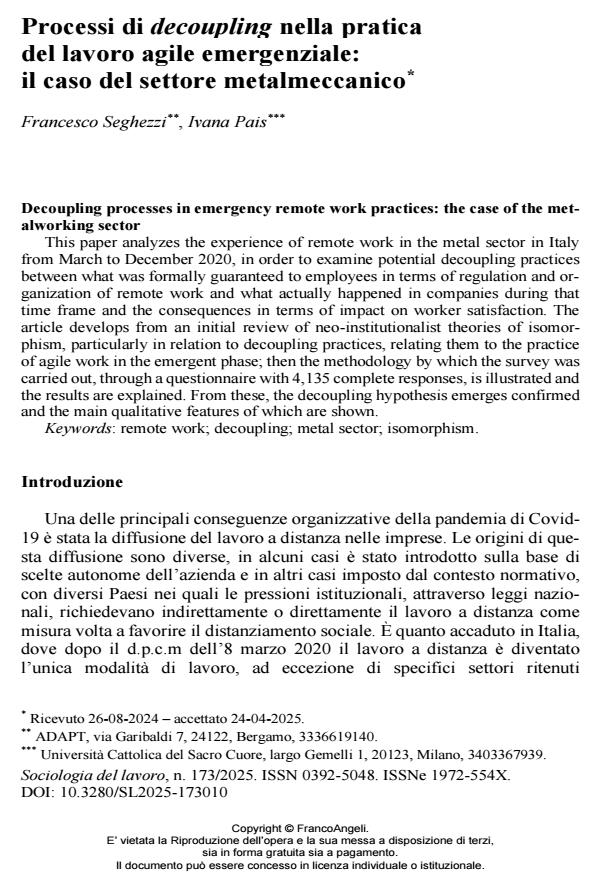
This paper analyzes the experience of remote work in the metal sector in Italy from March to December 2020, in order to examine potential decoupling practices between what was formally guaranteed to employees in terms of regulation and or-ganization of remote work and what actually happened in companies during that time frame and the consequences in terms of impact on worker satisfaction. The article develops from an initial review of neo-institutionalist theories of isomor-phism, particularly in relation to decoupling practices, relating them to the practice of agile work in the emergent phase; then the methodology by which the survey was carried out, through a questionnaire with 4,135 complete responses, is illustrated and the results are explained. From these, the decoupling hypothesis emerges confirmed and the main qualitative features of which are shown.
Parole chiave:remote work; decoupling; metal sector; isomorphism.
- Amis, J. & Greenwood, R. (2020). Organisational change in a (post-) pandemic world: Re-discovering interests and values. Journal of Management Studies, 58(2): 582-586.
- Anderson, D., & Kelliher, C. (2020). Enforced remote working and the work-life interface during lockdown. Gender in Management, 35(7/8): 677-683. DOI: 10.1108/GM-07-2020-022
- Azzolari D., Fullin G, Modica E., Pacetti V., Tosi S., (2021). A casa tutto bene? Le condizioni fisiche e psicologiche dei lavoratori “in smart”. In: Peruzzi M. e Sacchetto D. (a cura di), Il lavoro da remoto. Aspetti giuridici e sociologici. Torino: Giappichelli.
- Azzolari, D., & Fullin, G. (2022). «Il mio ufficio è il mio divano»: Spazi, strumenti e tempi del lavoro da remoto. Meridiana, 104(2): 75–99.
- Bae, K. B., & Kim, D. (2016). The impact of decoupling of telework on job satisfaction in U.S. federal agencies: Does gender matter?. The American Review of Public Administra-tion, 46(3): 356-371. DOI: 10.1177/027507401663718
- Barley, S. R. (1986). Technology as an occasion for structuring: Evidence from observations of CT scanners and the social order of radiology departments. Administrative Science Quarterly, 31(1): 78–108.
- Bergamante, F., Canal, T., Mandrone, E., & Zucaro, R. (2022). Il lavoro da remoto: Le modalità attuative, gli strumenti e il punto di vista dei lavoratori. Inapp Policy Brief, 26. Roma: Inapp.
- Bertolini S., Goglio V., Vercelli M. (2021). Lavoro e produttività nella trasformazione digi-tale. In: Peruzzi M. e Sacchetto D. (a cura di), Il lavoro da remoto. Aspetti giuridici e sociologici. Torino: Giappichelli.
- Bertolini, S., Fullin, G., Goglio, V., Pacetti, V., Tosi, S., & Vercelli, M. (2021). Il lavoro da remoto alla prova dell’emergenza: Implicazioni sociali e organizzative. Cambio. Rivista sulle Trasformazioni Sociali, 11(22): 69-82.
- Biasi, M. (2020). Covid-19 and labour law in Italy. European Labour Law Journal, 11(3): 306-313. DOI: 10.1177/203195252093456
- Bolisani, E., Scarso, E., Ipsen, C., Kirchner, K., & Hansen, J. P. (2020). Working from home during COVID-19 pandemic: Lessons learned and issues. Management & Marketing, 15(s1): 458-476.
- Boxenbaum, E., & Jonsson, S. (2017). Isomorphism, diffusion and decoupling: Concept evo-lution and theoretical challenges. In: R. Greenwood, C. Oliver, T. B. Lawrence, & R. E. Meyer, a cura di, The SAGE handbook of organizational institutionalism (2nd ed., pp. 77-101). London: Sage Publications.
- Bromley, P., Powell, W W. (2012). From smoke and mirrors to walking the talk: Decoupling in the contemporary world. Academy of Management Annals, 6(1): 483-530.
- Butera, F. (2020). Le condizioni organizzative e professionali dello smart working dopo l’emergenza: Progettare il lavoro ubiquo fatto di ruoli aperti e di professioni a larga banda. Studi Organizzativi, 1: 142–166.
- Campolongo F., Iannuzzi F.E. (2021). Controllo manageriale e lavoro da remoto. Una ricerca nel contesto pandemico. In: Peruzzi M. e Sacchetto D. (a cura di), Il lavoro da remoto. Aspetti giuridici e sociologici, Torino: Giappichelli.
- Cappelli, P. (2021). The future of office. Philadelphia: Wharton School Press.
- Cetrulo A., Guarascio D. e Virgillito M. A. (2020). The Privilege of Working From Home at the Time of Social Distancing. Intereconomics, 3: 142-147.
- Chung, H. (2022). The flexibility paradox: Why flexible working leads to (self-) exploitation. London: Policy Press.
- Crusoe, J., Magnusson, J., & Eklund, J. (2024). Digital transformation decoupling: The impact of willful ignorance on public sector digital transformation. Government Information Quarterly, 41(3).
- De Palo D., Giorgi F. (2021). Il lavoro da remoto in Italia durante – la pandemia: i lavoratori del settore privato, Banca d’Italia, Note Covid-19, gennaio, 2021.
- DiMaggio, P. J., & Powell, W. W. (1983). The iron cage revisited: Institutional isomorphism and collective rationality in organizational fields. American Sociological Review, 48(2): 147-160. DOI: 10.2307/209510
- Dordoni, A. (2023). Lavorare da casa nel primo lockdown italiano: uno studio visuale su fles-sibilità spazio-temporale, classe e genere. Studi di Sociologia, 61(4): 345-361. Milano, Vita e Pensiero.
- Eller, R., Alford, P., Kallmünzer, A., & Peters, M. (2020). Antecedents, consequences, and challenges of small and medium-sized enterprise digitalization. Journal of Business Re-search, 112: 119-127.
- Eurofound (2020). Living, working and COVID-19, COVID-19 series, Luxembourg.
- Fana, M., Milasi, S., Napierala, J., Fernandez-Macias, E., & Gonzalez Vazquez, I. (2022). Autonomy and control in mass remote working during the COVID-19 pandemic: A cross-occupational comparison. Relations Industrielles / Industrial Relations, 77(3): 1-19.
- Federmeccanica (2021). Indagine congiunturale. Roma.
- Fenoglio, A. (2022). Lavoro agile e smart working emergenziale: gemelli diversi. Meridiana, 104(2).
- Fullin, G., Pacetti, V. (2021). Il lavoro da casa durante l’emergenza. Tecnologie, relazioni, controllo. In: L. Cigna, a cura di, Forza Lavoro! Ripensare il lavoro al tempo della pan-demia. Milano, Fondazione Giangiacomo Feltrinelli, 43-56.
- Gaddi, M. (2024). L’industria metalmeccanica. In: D. Di Nunzio, a cura di, Inchiesta sul la-voro. Condizioni e aspettative. Roma, Futura Editrice, 453-478.
- Garavaglia, E., Negrelli, S., & Pacetti, V. (2024). Le trasformazioni del lavoro impiegatizio nel manifatturiero avanzato: Una ricerca empirica. Sociologia del Lavoro, 168: 155-183. DOI: 10.3280/SL2024-168009
- Greineder, M., Blohm, I., & Leicht, N. (2020). Conceptualizing the Agile Work Organization: A systematic literature review, framework and research agenda. In: 33rd Bled Econfer-ence: Enabling Technology for a Sustainable Society, pp. 263–276.
- Guazzo, C., Gandini, A., & Garavaglia, E. (2024). Indietro non si torna: Un’analisi longitudi-nale delle esperienze di lavoro da remoto tra i knowledge worker in Italia durante e dopo la pandemia. Rassegna Italiana di Sociologia, 65(1): 153-176. DOI: 10.1423/112994
- Haveman, H. A. (1993). Follow the leader: Mimetic isomorphism and entry into new markets. Administrative Science Quarterly, 38: 593– 627.
- Huls, S. P. I., Sajjad, A., Kanters, T. A., Hakkaart-van Roijen, L., Brouwer, W. B. F., & van Exel, J. (2022). Productivity of working at home and time allocation between paid work, unpaid work and leisure activities during a pandemic. Pharmacoeconomics, 40(1): 77-90.
- Keller R, Ollig P, Fridgen G (2019). Decoupling, information technology, and the trade-of between organisational agility and reliability. Proceedings of the 27th European confer-ence on information systems (ECIS), Stockholm & Uppsala, Sweden.
- Kostova, T., Roth K. (2002). Adoption of an Organizational Practice by Subsidiaries of Mul-tinational Corporations: Institutional and Relational Effects. The Academy of Manage-ment Journal, 45 (1): 215–33.
- Meyer, J., & Rowan, B. (1977). Institutionalized organizations: Formal structure as myth and ceremony. American Journal of Sociology, 83(2): 340-363. DOI: 10.1086/22655
- Okhmatovskiy, I., David, R. J. (2012). Setting your own standards: Internal corporate gov-ernance codes as a response to institutional pressure. Organization Science, 23(1): 155-176.
- Oliver, C. (1991). Strategic responses to institutional processes. The Academy of Management Review, 16(1): 145-179. DOI: 10.2307/25861
- Romens, A.-I. (2021). Lavoro da remoto, conciliazione tra tempi di vita e lockdown: per una prospettiva di genere. Sociologia del Lavoro, 160: 224-243. DOI: 10.3280/SL2021-16001
- Ruef, M., & Scott, R. W. (1998). A multidimensional model of organizational legitimacy: Hospital survival in changing institutional environments. Administrative Science Quar-terly, 43(4): 877–904.
- Seidman, W. H. (1983). Goal ambiguity and organizational decoupling: The failure of ‘ra-tional systems’ program implementation. Educational evaluation and policy analysis, 5: 399– 413.
- Seva, R. R., Tejero, L. M. S., & Fadrilan-Camacho, V. F. F. (2021). Barriers and facilitators of productivity while working from home during pandemic. Journal of Occupational Health, 63(1), e12242. DOI: 10.1002/1348-9585.1224
- Solari, L., & Lupi, M. (2018). Valutare lo smart working. Cosa ci manca? In: F. Maiono, a cura di, Lavoro e lavoratori/trici “smart”. Milano, Fondazione Marco Vigorelli, pp. 33–45.
- Sutton, J. R., Dobbin, F., Meyer, J., Scott, R. W. (1994). The legalization of the workplace. American Journal of Sociology, 99: 944-971.
- Westphal, J. D., Zajac, E. J. (2001). Decoupling policy from practice: The case of stock re-purchase programs. Administrative Science Quarterly, 46(2): 202-228.
- Williamson, S., Colley, L., Hanna-Osborne, S. (2020). Will working from home become the ‘new normal’ in the public sector?. Australian Journal of Public Administration, 79(4): 601-607. DOI: 10.1111/1467-8500.1244
- Wolor, C. W., Nurkhin, A., & Citriadin, Y. (2021). Is working from home good for work-life balance, stress, and productivity, or does it cause problems?. Humanities and Social Sci-ences Letters, 9(3): 237-249.
- Wooten, M., & Hoffman, A. J. (2016). Organizational fields past, present and future. In: R. Greenwood, C. Oliver, K. Sahlin, & R. Suddaby, a cura di, The SAGE handbook of or-ganizational institutionalism. London, Sage Publications, pp. 130-148.
Francesco Seghezzi, Ivana Pais, Processi di decoupling nella pratica del lavoro agile emergenziale: il caso del settore metalmeccanico in "SOCIOLOGIA DEL LAVORO " 173/2025, pp 195-213, DOI: 10.3280/SL2025-173010