Philosophus et theologus simul. Roland of Cremona and the “Philosophical Turn” among Dominicans
Titolo Rivista RIVISTA DI STORIA DELLA FILOSOFIA
Autori/Curatori Luigi Valletta
Anno di pubblicazione 2026 Fascicolo 2025/4
Lingua Inglese Numero pagine 21 P. 545-565 Dimensione file 192 KB
DOI 10.3280/SF2025-004001
Il DOI è il codice a barre della proprietà intellettuale: per saperne di più
clicca qui
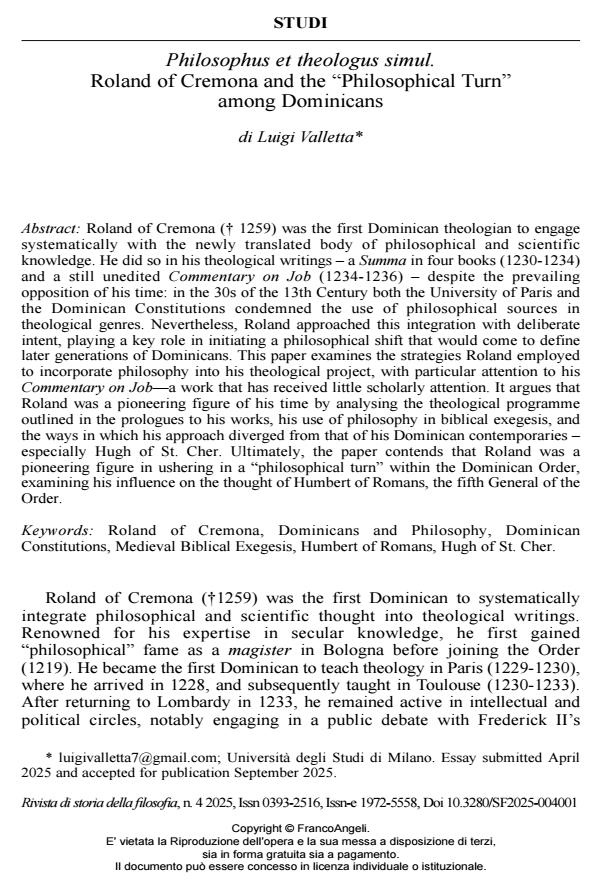
Qui sotto puoi vedere in anteprima la prima pagina di questo articolo.
Se questo articolo ti interessa, lo puoi acquistare (e scaricare in formato pdf) seguendo le facili indicazioni per acquistare il download credit. Acquista Download Credits per scaricare questo Articolo in formato PDF
FrancoAngeli è membro della Publishers International Linking Association, Inc (PILA), associazione indipendente e non profit per facilitare (attraverso i servizi tecnologici implementati da CrossRef.org) l’accesso degli studiosi ai contenuti digitali nelle pubblicazioni professionali e scientifiche.
Roland of Cremona († 1259) was the first Dominican theologian to engage systematically with the newly translated body of philosophical and scientific knowledge. He did so in his theological writings – a Summa in four books (1230--1234) and a still unedited Commentary on Job (1234--1236) – despite the prevailing opposition of his time: in the 30s of the 13th Century both the University of Paris and the Dominican Constitutions condemned the use of philosophical sources in theological genres. Nevertheless, Roland approached this integration with deliberate intent, playing a key role in initiating a philosophical shift that would come to define later generations of Dominicans. This paper examines the strategies Roland employed to incorporate philosophy into his theological project, with particular attention to his Commentary on Job—a work that has received little scholarly attention. It argues that Roland was a pioneering figure of his time by analysing the theological programme outlined in the prologues to his works, his use of philosophy in biblical exegesis, and the ways in which his approach diverged from that of his Dominican contemporaries – especially Hugh of St. Cher. Ultimately, the paper contends that Roland was a pioneering figure in ushering in a “philosophical turn” within the Dominican Order, examining his influence on the thought of Humbert of Romans, the fifth General of the Order.
Parole chiave:Roland of Cremona, Dominicans and Philosophy, Dominican Constitutions, Medieval Biblical Exegesis, Humbert of Romans, Hugh of St. Cher.
Luigi Valletta, Philosophus et theologus simul. Roland of Cremona and the “Philosophical Turn” among Dominicans in "RIVISTA DI STORIA DELLA FILOSOFIA" 4/2025, pp 545-565, DOI: 10.3280/SF2025-004001