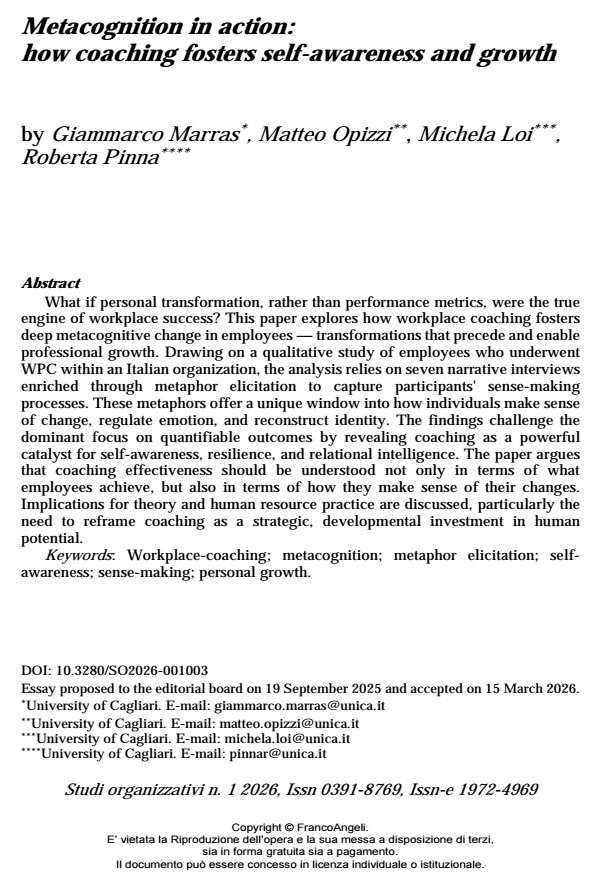
Metacognition in action: how coaching fosters self-awareness and growth
Titolo Rivista STUDI ORGANIZZATIVI
Autori/Curatori Giammarco Marras, Matteo Opizzi, Michela Loi, Roberta Pinna
Anno di pubblicazione 2026 Fascicolo 2026/1
Lingua Inglese Numero pagine 27 P. 69-95 Dimensione file 238 KB
DOI 10.3280/SO2026-001003
Il DOI è il codice a barre della proprietà intellettuale: per saperne di più
clicca qui
Qui sotto puoi vedere in anteprima la prima pagina di questo articolo.
Se questo articolo ti interessa, lo puoi acquistare (e scaricare in formato pdf) seguendo le facili indicazioni per acquistare il download credit. Acquista Download Credits per scaricare questo Articolo in formato PDF
FrancoAngeli è membro della Publishers International Linking Association, Inc (PILA), associazione indipendente e non profit per facilitare (attraverso i servizi tecnologici implementati da CrossRef.org) l’accesso degli studiosi ai contenuti digitali nelle pubblicazioni professionali e scientifiche.
What if personal transformation, rather than performance metrics, were the true engine of workplace success? This paper explores how workplace coaching fosters deep metacognitive change in employees — transformations that precede and enable professional growth. Drawing on a qualitative study of employees who underwent WPC within an Italian organization, the analysis relies on seven narrative interviews enriched through metaphor elicitation to capture participants' sense-making processes. These metaphors offer a unique window into how individuals make sense of change, regulate emotion, and reconstruct identity. The findings challenge the dominant focus on quantifiable outcomes by revealing coaching as a powerful catalyst for self-awareness, resilience, and relational intelligence. The paper argues that coaching effectiveness should be understood not only in terms of what employees achieve, but also in terms of how they make sense of their changes. Implications for theory and human resource practice are discussed, particularly the need to reframe coaching as a strategic, developmental investment in human potential.
E se fosse la trasformazione personale, piuttosto che gli indicatori di performance, il vero motore del successo organizzativo? Questo articolo esplora come il coaching sul luogo di lavoro favorisca profondi cambiamenti metacognitivi nei dipendenti, trasformazioni che precedono e rendono possibile la crescita professionale. Basandosi su uno studio qualitativo condotto con dipendenti che hanno partecipato a un percorso di Workplace Coaching (WPC) all'interno di un'organizzazione italiana, l'analisi si fonda su sette interviste narrative, arricchite mediante la tecnica della metaphor elicitation (elicitazione di metafore), al fine di cogliere i processi di costruzione di significato dei partecipanti. Tali metafore offrono una prospettiva privilegiata su come gli individui interpretano il cambiamento, regolano le proprie emozioni e ricostruiscono la propria identità. I risultati mettono in discussione l'enfasi predominante sugli esiti quantificabili, mostrando il coaching come un potente catalizzatore di consapevolezza di sé, resilienza e intelligenza relazionale. L'articolo sostiene che l'efficacia del coaching dovrebbe essere compresa non solo in termini di ciò che i dipendenti raggiungono, ma anche in relazione a come attribuiscono significato ai cambiamenti vissuti. Vengono infine discusse le implicazioni teoriche e per la pratica della gestione delle risorse umane, evidenziando la necessità di ripensare il coaching come un investimento strategico e di sviluppo del potenziale umano.
Parole chiave:coaching sul luogo di lavoro; metacognizione; elicitazione di metafore; consapevolezza di sé; costruzione di significato; crescita personale.
- Anderson, C., Kirkpatrick, S. (2016). “Narrative interviewing”. International Journal of Clinical Pharmacy, 38: 631–634.
- Anthonysamy, L. (2023). “Being learners with mental resilience as outcomes of metacognitive strategies in an academic context”. Cogent Education, 10. DOI: 10.1080/2331186X.2023.221949
- Athanasopoulou, A., and Dopson, S. (2018). “A systematic review of executive coaching outcomes: Is it the journey or the destination that matters the most?” The Leadership Quarterly, 29:70–88.
- Audet, J., Couteret, P. (2012). “Coaching the entrepreneur: features and success factors”. Journal of Small Business and Enterprise Development, 19: 515–531. DOI: 10.1108/1462600121125020
- Bachkirova, T., Cox, E. (2014). “A cognitive-developmental approach for coach development”. In Handbook of coaching psychology (pp. 325-350). Routledge.
- Bono, J. E., Purvanova, R. K., Towler, A. J., Peterson, D. B. (2009). “A survey of executive coaching practices”. Personnel psychology, 62: 361-404.
- Bozer, G., Delegach, M. (2019). “Bringing Context to Workplace Coaching: A Theoretical Framework Based on Uncertainty Avoidance and Regulatory Focus”. Human Resource Development Review, 18: 376–402. DOI: 10.1177/153448431985309
- Bozer, G., Jones, R. J. (2018). “Understanding the factors that determine workplace coaching effectiveness: A systematic literature review”. European Journal of Work and Organizational Psychology, 27: 342-361. DOI: 10.1080/1359432X.2018.144694
- Bozkus-Genc, G., Sani-Bozkurt, S. (2020). “The awareness of coaching in inclusive education”. In INTED2020 Proceedings (pp. 2060-2066). IATED.
- Brock, V. (2009). “From an Historical Perspective Professional challenges Facing the coaching Field From an Historical Perspective”. The International Journal of Coaching in Organizations, 7: 27–37.
- Cannon-Bowers, J. A., Bowers, C. A., Carlson, C. E., Doherty, S. L., Evans, J., Hall, J. (2023). “Workplace coaching: a meta-analysis and recommendations for advancing the science of coaching”. Frontiers in Psychology, 14: 1204166.
- Campbell, S., Greenwood, M., Prior, S., Shearer, T., Walkem, K., Young, S., ... Walker, K. (2020). “Purposive sampling: complex or simple? Research case examples”. Journal of research in Nursing, 25: 652-661.
- Cassell, C., Bishop, V. (2019). “Qualitative Data Analysis: Exploring Themes, Metaphors and Stories”. European Management Review, 16: 195–207.
- Cornelissen, J. P., Oswick, C., Christensen, L. T., Phillips, N. (2008). “Metaphor in organizational research: context, modalities and implications for research - Introduction.” Organization Studies, 29: 7–22. DOI: 10.1177/017084060708663
- Cornelissen, J. P., Holt, R., Zundel, M. (2011). “The role of analogy and metaphor in the framing and legitimization of strategic change.” Organization Studies, 32: 1701–1716. DOI: 10.1177/0170840611425729
- Cox, E., Clutterbuck, D. A., Bachkirova, T. (2023). The complete handbook of coaching.
- Crompton, Bernadette M., Smyrnios, K. X., Bi, R. (2012). “Measuring the influence of business coaching on fast-growth firms”. Small Enterprise Research, 19: 16–31.
- De-Haan, E., Culpin, V., Curd, J. (2011). “Executive coaching in practice: what determines helpfulness for clients of coaching?” Personnel Review, 40: 24-44. DOI: 10.1108/0048348111109550
- De-Haan, E., Nilsson, V. O. (2023). “What Can We Know About the Effectiveness of Coaching? a Meta-Analysis Based Only on Randomized Controlled Trials.” Academy of Management Learning and Education, 22: 641–661.
- Dobrea, M., Maiorescu, I. (2015). “Entrepreneurial Outcomes and Organisational Performance through Business Coaching.” Amfiteatru Economic Journal, 17: 247–260.
- Dust, S., Steed, L. B. (2025). “Put me in coach: A daily examination of automated coaching on need for self-knowledge and learning goal orientation through metacognitive activities”. Journal of Occupational and Organizational Psychology, 98: 12556.
- Fielden, S. L., Hunt, C. M. (2011). “Online coaching: An alternative source of social support for female entrepreneurs during venture creation”. International Small Business Journal, 29: 345-359. DOI: 10.1177/026624261036988
- Flavell, J. H. (1979). “Metacognition and cognitive monitoring: A new area of cognitive–developmental inquiry”. American psychologist, 34: 906.
- Ford, P. R., Yates, I., Williams, A. M. (2010). “An analysis of practice activities and instructional behaviours used by youth soccer coaches during practice: Exploring the link between science and application”. Journal of sports sciences, 28: 483-495.
- Gabriel, A. S., Moran, C. M., Gregory, J. B. (2014). “How can humanistic coaching affect employee well-being and performance? An application of self-determination theory”. Coaching: An International Journal of Theory, Research and Practice, 7: 56–73. DOI: 10.1080/17521882.2014.88918
- Gaylord, E.C. (1967) Modern coaching psychology. Dubuque (IA) USA: Wm. C. Brown.
- Gianecchini, M. (2017). Post-acquisition integration process: use a stick or a carrot?: a sensemaking-sensegiving perspective. Studi organizzativi: XIX, 2, 2017, 45-67. https://www.francoangeli.it/riviste/articolo/61158
- Gough, J. (2023). “Individual variations in information behavior of professional translators: towards a classification of translation-oriented research styles.” Translation Studies, 0:1–22. DOI: 10.1080/14781700.2023.223193
- Grant, A. M. (2003). “The impact of life coaching on goal attainment, metacognition and mental health”. Social Behavior and Personality: an International Journal, 31: 253–264.
- Grant, A. M. (2013). “The efficacy of coaching”. In The Wiley-Blackwell handbook of the psychology of coaching and mentoring, pp. 15-39. John Wiley and Sons.
- Grant, A. M. (2014). “The Efficacy of Executive Coaching in Times of Organisational Change”. Journal of Change Management, 14: 258–280. DOI: 10.1080/14697017.2013.80515
- Greif, S., Möller, H., Scholl, W., Passmore, J., Müller, F. (2022). “Coaching
- definitions and concepts”. In Greif, H. Möller, W. Scholl, J. Passmore and F. Müller (eds.). International handbook of evidence-based coaching: theory, research and practice. New York, US: Springer International Publishing.
- Guerrero, M., Pugh, R. (2022), “Entrepreneurial universities' metamorphosis: Encountering technological and emotional disruptions in the COVID-19 ERA”, Technovation, 118: 102584.
- Idris, M.M.B., Abu Bakar, S.B. (2020), “Perceived usefulness of business coaching on the relationship between entrepreneurial competencies and business success”, Journal of Asian Finance, Economics and Business, 7: 329-338.
- Jarosz, J. (2021). “The impact of coaching on well-being and performance of managers and their teams during pandemic.” International Journal of Evidence-Based Coaching and Mentoring, 19: 4-27.
- Jarosz, J., Cartor, R. (2025). “Coaching Effectiveness Framework”. International Journal of Evidence Based Coaching and Mentoring, 23: 49–66.
- Jones, R. J., Woods, S. A., Guillaume, Y. R. (2016). “The effectiveness of workplace coaching: A meta-analysis of learning and performance outcomes from coaching.” Journal of occupational and organizational psychology, 89: 249-277.
- Klofsten, M., Öberg, S. (2012). “Coaching versus mentoring: Are there any differences?” In New Technology Based Firms in the New Millennium (pp. 39–47).
- Kotte, S., Diermann, I., Rosing, K., Möller, H. (2021). “Entrepreneurial Coaching: A Two-Dimensional Framework in Context”. Applied Psychology: An International Review, 70: 518–555.
- Kruger, F., Terblanche, N. H. D. (2024). “The coaching flipside: Factors underlying unsuccessful workplace coaching interventions and the implication for human resource development.” Human Resource Development Quarterly, 1–17.
- Kustina, J., Meredith, D. C. (2023). “Metacognitive knowledge and regulation of peer coaches”. 2023 PERC Proceedings, Sacramento, CA, USA. Retrieved from: https://scholar.google.com/scholar?hl=it&as_sdt=0%2C5&q=kustina+and+Meredith+2023&btnG=
- Lakoff G., Johnson M (1980). “Metaphors we live by”. Chicago, IL:University of Chicago Press.
- Law, H. (2013). “The psychology of coaching, mentoring and learning” (2nd edn.). Chichester, UK: John Wiley and Sons.
- Malterud, K., Siersma, V. D., and Guassora, A. D. (2016). “Sample size in qualitative interview studies: guided by information power.” Qualitative health research, 26: 1753-1760.
- Marvel, M. R., Wolfe, M. T., Kuratko, D. F. (2020). “Escaping the knowledge corridor: How founder human capital and founder coachability impacts product innovation in new ventures.” Journal of Business Venturing, 35: 1–16.
- Maxheimer, M. M., Nicholls-Nixon, C. L. (2022). “What women want (and need) from coaching relationships during business incubation”. Journal of Small Business and Entrepreneurship, 34: 548–577. DOI: 10.1080/08276331.2021.198172
- Mukata, C., Council, Z. R., Ladzani, M. W., Visser, T. (2018). “The Effectiveness of Business Management and Entrepreneurship Training Offered By SME Service Providers in Namibia”. African Journal of Business and Economic Research, 13: 81–98.
- Nardon, L., Hari, A. (2021). “Sensemaking through metaphors: The role of imaginative metaphor elicitation in constructing new understandings.” International Journal of Qualitative Methods. 20: 16094069211019589. DOI: 10.1177/1609406921101958
- Nehrusingh-Pajerowski, G. (2024). “Academic Coaching for Metacognitive Mastery: Skills for Enhancing Self-Awareness and Learning Autonomy”. Self-Regulated Learning – Insights and Innovations.
- Peláez, M. J., Coo, C., Salanova, M. (2020). “Facilitating work engagement and performance through strengths-based micro-coaching: A controlled trial study”. Journal of Happiness Studies, 21: 1265-1284.
- Ritter, M.L. (1994) Senior leader mentoring: Its role in leader development doctrine (Master's thesis). West Point, USA: U.S. Army Command and General Staff College.
- Richardson, G. E. (2002). “The metatheory of resilience and resiliency”. Journal of clinical psychology, 58: 307-321.
- Saethern, B. B., Glømmen, A. M., Lugo, R., Ellingsen, P. (2022). “Students' experiences of academic coaching in Norway: a pilot study.” International Journal of Mentoring and Coaching in Education, 11: 349-363.
- Schein, E.H. (1969) “Process consultation: Its role in organization development”. Reading (MA), USA: Addison-Wesley.
- Schraw, G., and Moshman, D. (1995). Metacognitive theories. Educational psychology review, 7:351-371.
- Schreier, M. (2012). Qualitative Content Analysis in Practice. Thousand Oaks, CA: Sage.
- Shatroubi, T. (2023). “The teacher as coach. The effect of implementing coaching tools among educational staff on middle-school students’ metacognitive awareness, self- management and self-regulation skills.” – Doctoral Thesis.
- Smither, J. W. (2011). “Can psychotherapy research serve as a guide for research about executive coaching? An agenda for the next decade.” Journal of Business Psychology, 26: 135–145.
- Sonesh, S. C., Coultas, C. W., Lacerenza, C. N., Marlow, S. L., Benishek, L. E., Salas, E. (2015). “The power of coaching: a meta-analytic investigation”. Coaching: An International Journal Of Theory, Research and Practice, 8: 73–95. DOI: 10.1080/17521882.2015.107141
- Sotiriadis, M., Galanakis, M. (2022). “Self-regulation and Emotional Resilience in the Workplace”. A Systematic Review. Journal of Psychology Research, 12: 957–964. DOI: 10.17265/2159-5542/2022.12.00
- Testa, E., Scaratti, G. (2018). Valutare l'apprendere nelle organizzazioni: trasformazioni di pratiche lavorative e identità professionali. Studi organizzativi: XX, 1, 2018, 9-39. https://www.francoangeli.it/riviste/articolo/62120
- Theeboom, T., Beersma, B., van Vianen, A. E. M. (2014). “Does coaching work? A meta-analysis on the effects of coaching on individual level outcomes in an organizational context”. Journal of Positive Psychology, 9: 1–18. DOI: 10.1080/17439760.2013.83749
- Vogus, T. J., Sutcliffe, K. M. (2007). “Organizational resilience: Towards a theory and research agenda”. In 2007 IEEE international conference on systems, man and cybernetics (pp. 3418-3422). IEEE.
- Weick, K.E. (1995), Sensemaking in Organizations, Thousand Oaks (CA), Sage Publications.
- Whitmore, J. (2009). “Coaching for Performance, GROWing Human Potential and Purpose, The Principles and Practise of Coaching and Leadership”. 4th Ed. London: Nicholas Brealey Publishing
- Wutich, A., Beresford, M., Bernard, H. R. (2024). “Sample Sizes for 10 Types of Qualitative Data Analysis: An Integrative Review, Empirical Guidance, and Next Steps.” International Journal of Qua, 23: 1–14. DOI: 10.1177/16094069241296206
Giammarco Marras, Matteo Opizzi, Michela Loi, Roberta Pinna, Metacognition in action: how coaching fosters self-awareness and growth in "STUDI ORGANIZZATIVI " 1/2026, pp 69-95, DOI: 10.3280/SO2026-001003