Immaginari del futuro: strategie di narrazione climatica in The Last of Us ed Extrapolations
Titolo Rivista SOCIOLOGIA DELLA COMUNICAZIONE
Autori/Curatori Allegra Sonego
Anno di pubblicazione 2026 Fascicolo 2026/71
Lingua Italiano Numero pagine 18 P. 127-144 Dimensione file 116 KB
DOI 10.3280/SC2026-071007
Il DOI è il codice a barre della proprietà intellettuale: per saperne di più
clicca qui
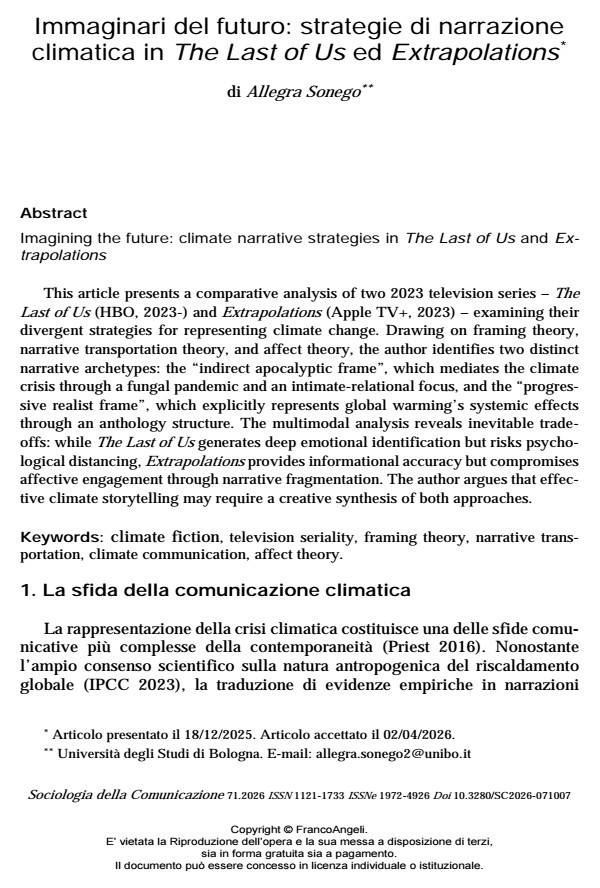
Qui sotto puoi vedere in anteprima la prima pagina di questo articolo.
Se questo articolo ti interessa, lo puoi acquistare (e scaricare in formato pdf) seguendo le facili indicazioni per acquistare il download credit. Acquista Download Credits per scaricare questo Articolo in formato PDF
FrancoAngeli è membro della Publishers International Linking Association, Inc (PILA), associazione indipendente e non profit per facilitare (attraverso i servizi tecnologici implementati da CrossRef.org) l’accesso degli studiosi ai contenuti digitali nelle pubblicazioni professionali e scientifiche.
This article presents a comparative analysis of two 2023 television series – The Last of Us (HBO, 2023-) and Extrapolations (Apple TV+, 2023) – examining their divergent strategies for representing climate change. Drawing on framing theory, narrative transportation theory, and affect theory, the author identifies two distinct narrative archetypes: the “indirect apocalyptic frame”, which mediates the climate crisis through a fungal pandemic and an intimate-relational focus, and the “progressive realist frame”, which explicitly represents global warming’s systemic effects through an anthology structure. The multimodal analysis reveals inevitable trade-offs: while The Last of Us generates deep emotional identification but risks psychological distancing, Extrapolations provides informational accuracy but compromises affective engagement through narrative fragmentation. The author argues that effective climate storytelling may require a creative synthesis of both approaches.
Parole chiave:climate fiction, television seriality, framing theory, narrative transportation, climate communication, affect theory.
- Altehenger H., Menges L. (2025), The Value of Climate Despair, in «Political Philosophy», 2(2).
- Baccolini R., Moylan T. (eds.) (2003), Dark Horizons: Science Fiction and the Dystopian Imagination, Routledge, New York-Londra.
- Bernardelli A., Pescatore G., Sonego A. (eds.) (2025), Green Narratives, Ecology and Sustainability in Contemporary Television, Media Mutations Publishing, Bologna.
- Murray R.L., Heumann J. K. (2011), Ecology and Popular Film: Cinema on the Edge, State University of New York Press, Albany.
- Bieniek-Tobasco A., Rimal R.N., McCormick S., Harrington C.B. (2020), The power of being transported: Efficacy beliefs, risk perceptions, and political affiliation in the context of climate change, in «Science Communication», 42(6), pp. 776-802. DOI: 10.1177/107554702095179
- Boykoff M.T. (2011), Who speaks for the climate?: Making sense of media reporting on climate change, Cambridge University Press, Cambridge.
- Chakrabarty D. (2009), The Climate of History: Four Theses, in «Critical Inquiry», 35, pp. 197-222. DOI: 10.1086/596640
- Corner A., Clarke J. (2016), Talking Climate: From Research to Practice in Public Engagement, Palgrave Macmillan, Londra.
- Doyle J. (2011), Acclimatizing nuclear? Climate change, nuclear power and the reframing of risk in the UK news media, in «International Communication Gazette», 73(1-2), pp. 107-125. DOI: 10.1177/174804851038674
- Dunleavy T. (2009), Television drama: form, agency, innovation, Palgrave Macmillan, Basingstoke.
- Entman R. (1993), Framing: Toward Clarification of a Fractured Paradigm, in McQuail D. (ed.), McQuail’s Reader in Mass Communication Theory, Sage Publications, Londra, pp. 390-397.
- Ghosh A. (2016), The Great Derangement: Climate Change and the Unthinkable, University of Chicago Press, Chicago.
- Green M.C., Brock T.C. (2000), The Role of Transportation in the Persuasiveness of Public Narratives, in «Journal of Personality and Social Psychology», 79(5), pp. 701-721.
- IPCC (2023), Climate Change 2023: Synthesis Report, IPCC, Ginevra.
- Kluwick U. (2014), Talking About Climate Change: The Ecological Crisis and Narrative Form, in Garrard G. (ed.), The Oxford Handbook of Ecocriticism, Oxford University Press, Oxford, pp. 502-516.
- Kress G. (2001), Multimodal Discourse: The Modes and Media of Contemporary Communication, Arnold, Londra.
- Leyda J., Negra D. (2021), Television in/of the Banal Anthropocene, in «Screen», 62(1), pp. 78-82.
- Lotz A.D. (2022), Netflix and Streaming Video: The Business of Subscriber-Funded Video on Demand, Polity Press, Cambridge.
- Mar R.A., Oatley K. (2008), The Function of Fiction is the Abstraction and Simulation of Social Experience, in «Perspectives on Psychological Science», 3, pp. 173-192.
- Massumi B. (2002), Parables for the Virtual: Movement, Affect, Sensation, Duke University Press, Durham.
- McCabe J., Akass K. (a cura di) (2007), Quality TV: Contemporary American Television and Beyond, I.B. Tauris, Londra.
- Mittell J. (2006), Narrative Complexity in Contemporary American Television, in «The Velvet Light Trap», 58, pp. 29-40.
- Mittell J. (2015), Complex TV: The Poetics of Contemporary Television Storytelling, NYU Press, New York.
- Morton T. (2013), Hyperobjects: Philosophy and Ecology after the End of the World, University of Minnesota Press, Minneapolis.
- Moser S.C., Dilling L. (eds) (2007), Creating a climate for change: Communicating climate change and facilitating social change, Cambridge University Press, Cambridge.
- Moser S. (2010), Communicating Climate Change: History, Challenges, Process and Future Directions, in «WIREs Climate Change», 1, pp. 31-53.
- Moyer-Gusé E. (2008), Toward a Theory of Entertainment Persuasion: Explaining the Persuasive Effects of Entertainment-Education Messages, in «Communication Theory», 18(3), pp. 407-425.
- Moylan T. (2000), Scraps of the Untainted Sky: Science Fiction, Utopia, Dystopia, Westview Press, Boulder.
- Nerlich B., Koteyko N., Brown B. (2010), Theory and language of climate change communication, in «WIREs Climate Change», 1(1), pp. 97-110.
- Nisbet M. (2009), Communicating Climate Change: Why Frames Matter for Public Engagement, in «Environment», 51(2), pp. 12-23. DOI: 10.3200/ENVT.51.2.12-2
- Norgaard K.M. (2011), Living in Denial: Climate Change, Emotions, and Everyday Life, MIT Press, Cambridge.
- O’Neill S., Nicholson-Cole S. (2009), “Fear won’t do it” promoting positive engagement with climate change through visual and iconic representations, in «Science communication», 30(3), pp. 355-379. DOI: 10.1177/107554700832920
- O’Neill S., Williams H.T., Kurz T., Wiersma B., Boykoff M. (2015), Dominant frames in legacy and social media coverage of the IPCC Fifth Assessment Report, in «Nature climate change», 5(4), pp. 380-385.
- Pescatore G. (2025), Narrative Ecosystems-Exploring Environmental Themes in Serial Television, in Bernardelli A., Pescatore G., Sonego A. (eds.), Green Narratives, Ecology and Sustainability in Contemporary Television-Exploring Narrative Ecosystems, Media Mutations Publishing, Bologna, pp. 15-31.
- Pihkala P. (2020), Anxiety and the Ecological Crisis: An Analysis of Eco-Anxiety and Climate Anxiety, in «Sustainability», 12(19).
- Priest S. (2016), Communicating Climate Change: The Path Forward, Palgrave Macmillan, Londra.
- Schäfer M.S., Schlichting I. (2018), Media representations of climate change: A meta-analysis of the research field, in Olausson U., Berglez P. (eds.), Media research on climate change, Routledge, Londra, pp. 14-32.
- Slater M.D., Rouner D. (2002), Entertainment-Education and Elaboration Likelihood: Understanding the Processing of Narrative Persuasion, in «Communication Theory», 12(2), pp. 173-191.
- Stoknes P.E. (2015), What We Think About When We Try Not to Think About Global Warming, White River Junction, Chelsea Green.
- Swyngedouw E. (2010), Apocalypse Forever? Post-Political Populism and the Spectre of Climate Change, in «Theory, Culture & Society», 27(2-3), pp. 213-232. DOI: 10.1177/026327640935872
- Trexler A. (2015), Anthropocene Fictions: The Novel in a Time of Climate Change, University of Virginia Press, Charlottesville.
- Trotta J., Filipovic A., Sadri H.A. (eds.) (2020), Broken Mirrors: Representations of Apocalypses and Dystopias in Popular Culture, Routledge, New York-Londra.
- Tyszczuk R.A. (2014), Architecture of the anthropocene: The crisis of agency, in «Scroope The Cambridge Architecture Journal», 23, pp. 44-51.
- Van Aken M. (2020), Campati per aria, Elèuthera, Milano.
- Whitmarsh L., O’Neill S., Lorenzoni I. (2013), Public engagement with climate change: what do we know and where do we go from here?, in «International Journal of Media & Cultural Politics», 9(1), pp. 7-25.
- Willoquet-Maricondi P. (ed.) (2010), Framing the World: Explorations in Ecocriticism and Film, University of Virginia Press, Charlottesville.
Allegra Sonego, Immaginari del futuro: strategie di narrazione climatica in The Last of Us ed Extrapolations in "SOCIOLOGIA DELLA COMUNICAZIONE " 71/2026, pp 127-144, DOI: 10.3280/SC2026-071007