An analysis of factors influencing the online presence in distant countries: the case of italian fashion brands in china
Titolo Rivista MERCATI & COMPETITIVITÀ
Autori/Curatori Francesca Checchinato, Giulia Zanichelli
Anno di pubblicazione 2016 Fascicolo 2016/3
Lingua Italiano Numero pagine 23 P. 45-67 Dimensione file 471 KB
DOI 10.3280/MC2016-003004
Il DOI è il codice a barre della proprietà intellettuale: per saperne di più
clicca qui
Qui sotto puoi vedere in anteprima la prima pagina di questo articolo.
Se questo articolo ti interessa, lo puoi acquistare (e scaricare in formato pdf) seguendo le facili indicazioni per acquistare il download credit. Acquista Download Credits per scaricare questo Articolo in formato PDF
FrancoAngeli è membro della Publishers International Linking Association, Inc (PILA), associazione indipendente e non profit per facilitare (attraverso i servizi tecnologici implementati da CrossRef.org) l’accesso degli studiosi ai contenuti digitali nelle pubblicazioni professionali e scientifiche.
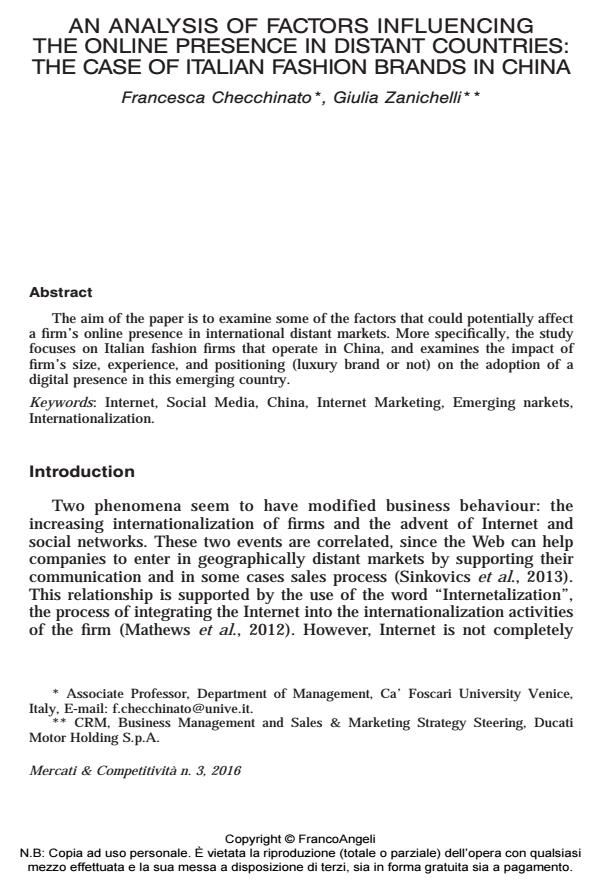
The aim of the paper is to examine some of the factors that could potentially affect a firm’s online presence in international distant markets. More specifically, the study focuses on Italian fashion firms that operate in China, and examines the impact of firm’s size, experience, and positioning (luxury brand or not) on the adoption of a digital presence in this emerging country.
Parole chiave:Internet, Social Media, China, Internet Marketing, Emerging narkets, Internationalization.
- Mathews S., Healy M., Wickramasekera R. (2012). The Internetalisation of information, knowledge, and interaction components of the firm’s internationalisation process. Journal of Marketing Management, 28(5-6), 733-754, DOI: 10.1080/0267257x.2011.560887
- Morgan-Thomas A., Bridgewater S. (2004). Internet and exporting: determinants of success in virtual export channels. International Marketing Review, 21(4/5): 393-408, DOI: 10.1108/02651330410547108
- O’Reilly T. (2005). What Is Web 2.0. O’Reilly.com, 1-5.
- Okonkwo U. (2009). Sustaining the luxury brand on the Internet. Journal of Brand Management, 16(5-6): 302-310, DOI: 10.1057/bm.2009.2
- Öztamur D., Sarper (2014). Exploring the role of social media for SMEs: as a new marketing strategy tool for the firm performance perspective. In 10th Interntional Strategic Management Conference, 150: 511-520, DOI: 10.1016/j.sbspro.2014.09.067
- Pariyar A., Murakami Y., Lin D., Ishida T. (2014). Content Sharing in Global Organization: A Cross-Country Perspective. In 2014 ASE BigData/SocialInformatics/PASSAT/BioMedCom Conference, Harvard University, December 14-16, 1-10.
- Perri A., Checchinato F., Colapinto C. (2013). The hidden costs of going global: insights from firms’ entry into foreign markets. Working Paper Series. Department of Management, Universita Ca’ Foscari Venezia.
- Petersen B., Welch L.S., Liesch P.W. (2002). The internet and foreign market expansion by firms. MIR: Management International Review, 207-221, DOI: 10.1109/emr.2003.24941
- Rao S.S., Metts G., Monge C.A.M. (2003). Electronic commerce development in small and medium sized enterprises: A stage model and its implications. Business Process Management Journal, 9(1): 11-32, DOI: 10.1108/14637150310461378
- Rogers E. (1983), Diffusion of Innovations. New York, NY: The Free Press.
- Samiee S. (1998), Exporting and the Internet: a conceptual perspective, International Marketing Review, 15: 413-26, DOI: 10.1108/02651339810236452
- Shneor R. (2012). Influences of culture, geography and infrastructure on website localization decisions. Cross Cultural Management: An International Journal, 19(3): 352-374, DOI: 10.1108/13527601211247099
- Sinkovics N., Sinkovics R.R., Jean R.-J. “Bryan” (2013). The internet as an alternative path to internationalization?. International Marketing Review, 30(2): 130-155, DOI: 10.1108/02651331311314556
- Strugatz R. (2012). Social Media’s Issue: Does It Drive Sales? Women’s Wear Daily,204(47): 1.
- Upadhyaya P., Mohanan P. (2009). Electronic marketplace adop- tion: A case study of manufacturing SMEs. The Icfaian Journal of Management Research, 8(6): 30-40.
- Valdani E., Bertoli G. (2014). Marketing internazionale. Milano: Egea.
- Vescovi T. (2011). Strategie di marca per i prodotti italiani in Cina. Micro&Macro Marketing, 1: 73-93.
- Vescovi T., Checchinato F., Disegna M., Gazzola, & P. Wang Z. (2013). Do country of origin and brand translation methods really matter in the Chinese market? Journal of Marketing Trends, 2, 25-34
- Walczuch, R., Van Braven, G., & Lundgren, H. (2000). Internet adoption barriers for small firms in The Netherlands. European Management Journal, 18(5), 561–572. DOI: 10.1016/S0263-2373(00)00045-1.WalczuchR.,VanBravenG.,LundgrenH.(2000).InternetadoptionbarriersforsmallfirmsinTheNetherlands.EuropeanManagementJournal,18(5):561-572,doi:10.1016/S0263-2373(00)00045-1
- Yeniyurt S., Townsend J.D., Talay M.B. (2007). Factors influencing brand launch in a global marketplace. Journal of Product Innovation Management, 24(5): 471-485. DOI: 10.1111/j.1540-5885.2007.00264.x
- El-Gohary H. (2010). Expanding TAM and IDT to Understand the Adoption of EMarketing by Small Business Enterprises: An Empirical Investigation. International Journal of Customer Relationship Marketing and Management (IJCRMM), 1(3): 56-75. Eriksson K., Johanson J., Majkgard A., Sharma D.D. (1997). Experiential Knowledge and Cost in the Internationalization Process. Journal of International Business Studies, 28(2): 337-360, DOI: 10.2307/155258
- Farrar L. (2012). Brands Rush To Tap China’s Web Boom. Women’s Wear Daily, 203(36): 1-1.
- Gandolfo A., Lupi L. (2014). Social network branding: la politica di marca nell’era delle reti sociali digitali. Mercati e Competitività, vol 2., 151-175, DOI: 10.3280/mc2014-002008
- Garvin D.A. (1993). Building a learning organization. Harvard Business Review, 71: 78-91.
- Godey B., Pederzoli D., Aiello G., Donvito R., Wiedmann K., Hennigs N. (2013). A cross cultural exploratory content analysis of the perception of luxury from six countries. Journal of Product & Brand Management, 22(3), 229–237, DOI: 10.1108/JPBM-02-2013-0254
- Harris L., Rae A., Grewal S. (2008). Out on the pull: how small firms are making themselves sexy with new online promotion techniques. International Journal of Technology Marketing, 3(2): 153-168, DOI: 10.1504/ijtmkt.2008.018862
- Hartley J., Montgomery L. (2009). Fashion as consumer entrepreneurship: emergent risk culture, social network markets, and the launch of “Vogue” in China. Chinese Journal of Communication, 2(1): 61-76.
- Jahn B., Kunz W. (2012). The Role of Social Media for Luxury Brands – Motives for Consumer Engagement and Opportunities for Business, Identitätsbasierte Luxusmarkenführung, Springer, 221-236, doi; 10.1007/978-3-8349-4060-5_14.
- Johanson J., Vahlne J.-E. (1977). The Internationalization Process of the Firm-A Model of Knowledge Development and Increasing Foreign Market Commitments. Journal of International Business Studies, 8(1): 23-32, DOI: 10.2307/25439
- Johanson J., Vahlne J.-E. (2009). The Uppsala internationalization process model revisited: From liability of foreignness to liability of outsidership. Journal of International Business Studies, 40(9): 1411-1431, DOI: 10.1057/jibs.2009.24
- Johanson J., Wiedersheim-Paul, F. (1975). The Internationalization Of The Firm – Four Swedish Cases. Journal of Management Studies, 12: 305-322, DOI: 10.1016/S0304-405X(00)00069-6
- Kim A.J., Ko E. (2010). Impacts of Luxury Fashion Brand’s Social Media Marketing on Customer Relationship and Purchase Intention. Journal of Global Fashion Marketing, 1(3): 164-171, DOI: 10.1080/20932685.2010.10593068
- Kraus S., Meier F., Eggers F., Bouncken R.B., Schuessler F. (2016). Standardisation vs. adaption: A conjoint experiment on the influence of psychic, cultural and geographical distance on international marketing mix decisions. European Journal of International Management, 10(2): 127-156, DOI: 10.1504/EJIM.2016.074468
- Li G., Li G., Kambele Z. (2012). Luxury fashion brand consumers in China: Perceived value, fashion lifestyle, and willingness to pay. Journal of Business Research, 65(10): 1516-1522, DOI: 10.1016/j.jbusres.2011.10.019
- Lowe N., Alistar N. (2012). A Precarious Business. Communication World, 29(6): 30-32.
- Ma L. (2013). Electronic Word-of-Mouth on Microblogs: A Cross-cultural Content Analysis of Twitter and Weibo. Intercultural Communication Studies, 3: 18-42.
- Mangold W.G., Faulds D.J. (2009). Social Media: The New Hybrid Element Of The Promotion Mix. Business Horizons, 52(4): 357-365, DOI: 10.1016/j.bushor.2009.03.002
- Anderson C. (2010). In The Next Industrial Revolution, Atoms Are The New Bits. Wired.com, 1-13: http://www.wired.com/magazine/18-02/ [access date 09/08/2014].
- Becker K., Nobre H., Kanabar V. (2013). Monitoring and protecting company and brand reputation on social networks: when sites are not enough. Global Business and Economics Review, 15(2/3), 293-308, DOI: 10.1504/gber.2013.053075.BelchM.,BelchG.(2014).AdvertisingandPromotion:AnIntegratedMarketingCommunicationsPerspective.McGraw-HillEducation
- Berthon P.R., Pitt L.F., Plangger K., Shapiro D. (2012). Marketing meets Web 2.0, social media, and creative consumers: Implications for international marketing strategy. Business Horizons, 55(3), 261-271. DOI: 10.1016/j.bushor.2012.01.007
- Bertoli G., Resciniti R. (2012). International Marketing and the Country of Origin Effect. The Global Impact of Made in Italy. Cheltenham: E. Elgar.
- Bingley S., Burgess S., Sellitto C., Cox C., Buultjens J. (2010). A classification scheme for analysing web 2.0 tourism websites. Journal of Electronic Commerce Research, 11(4): 281-298.
- Bulearca M., Bulearca S. (2010). Twitter: a Viable Marketing Tool for SMEs? Global Business and Management Research: An International Journal, 2(4), 296-309, DOI: 10.4018/ijom.2013100104
- Chang H.-J. (2011). Multinationals on theWeb: Cultural Similarities and Differences in English-Language and Chinese-LanguageWebsite Designs. Journal of the American Society for Information Science & Technology, 62(6): 1105-1117, DOI: 10.1002/asi.21515
- Chao M.C., Singh N., Hsu C.-C., Chen Y.N., Chao J. (2012). Web Site Localization in The Chinese Market. Journal of Electronic Commerce Research, 13(1): 33-49.
- Cho H., Tansuhaj P.S. (2013). Becoming a Global SME: Determinants of SMEs’ Decision to Use E-Intermediaries in Export Marketing. Thunderbird International Business Review, 55(5): 513-530, DOI: 10.1002/tie
- Chu S., Kamal S., Kim Y. (2013). Understanding consumers’ responses toward social media advertising and purchase intention toward luxury products, Journal of Global Fashion Marketing, 4(3), 158-174: DOI: 10.1080/20932685.2013.790709
- Constantinides E., Fountain S.J. (2008). Web 2.0: Conceptual foundations and marketing issues. Journal of Direct, Data and Digital Marketing Practice, 9(3): 231-244, DOI: 10.1057/palgrave.dddmp.4350098
- Cooke M., Buckley N. (2008). Web 2.0, social networks and the future of market research. International Journal of Market Research, 50(2): 267-292.
- Crampton T. (2011). Social Media In China: The Same, But Different. China Business Review, 38(1): 28-31.
- Cui A.P., Wajda T.A., Walsh M.F. (2015). Luxury brands in emerging markets: a case study on China. Enterpreneurship in International Marketing, 25, 287-305, DOI: 10.1017/CBO9781107415324.004
- Dahnil M.I., Marzuki K.M., Langgat J., Fabeil N.F. (2014). Factors Influencing SMEs Adoption of Social Media Marketing. Procedia – Social and Behavioral Sciences, 148: 119-126, DOI: 10.1016/j.sbspro.2014.07.025
- Daniel E.M., Grimshaw D.J. (2002). An exploratory comparison of e-commerce adoption in large and small enterprises, Journal of Information Technology, 17(3), 133-47. DOI: 10.1080/0268396022000018409
- Del Aguila-Obra A.R., Padilla-Meléndez A. (2006). Organizational factors affecting Internet technology adoption. Internet Research, 16(1): 94-110, DOI: 10.1108/10662240610642569
- Dholakia R., Kshetri N. (2004). Factors Impacting the Adoption of the Internet among SMEs. Small Business Economics, 23(4): 311-322, DOI: 10.1023/B:SBEJ.0000032036.90353.1f
- Yu L., & Asur S., Huberman B.A. (2011). What Trends in China Social Media. The 5th SNA-KDD Workshop’11 (SNA-KDD’11), August 21, 2011, San Diego CA USA, 1-10.
- Zhan L., He Y. (2012). Understanding luxury consumption in China: Consumer perceptions of best-known brands, Journal of Business Research, 65(10): 1452-1460.
- Exploring the online presence of food SMEs: a study on configurations and determinants in the north-east of Italy Francesca Checchinato, Vladi Finotto, Christine Mauracher, in Cogent Business & Management 2398190/2024
DOI: 10.1080/23311975.2024.2398190
Francesca Checchinato, Giulia Zanichelli, An analysis of factors influencing the online presence in distant countries: the case of italian fashion brands in china in "MERCATI & COMPETITIVITÀ" 3/2016, pp 45-67, DOI: 10.3280/MC2016-003004