"Cosa ha detto il dottore?" Idee e riflessioni per una comunicazione efficace tra medico e paziente migrante
Journal title SALUTE E SOCIETÀ
Author/s Maria Laura Russo, Fabrizia Petri, Maurizio Marceca
Publishing Year 2013 Issue 2013/1
Language Italian Pages 23 P. 141-163 File size 1154 KB
DOI 10.3280/SES2013-001011
DOI is like a bar code for intellectual property: to have more infomation
click here
Below, you can see the article first page
If you want to buy this article in PDF format, you can do it, following the instructions to buy download credits
FrancoAngeli is member of Publishers International Linking Association, Inc (PILA), a not-for-profit association which run the CrossRef service enabling links to and from online scholarly content.
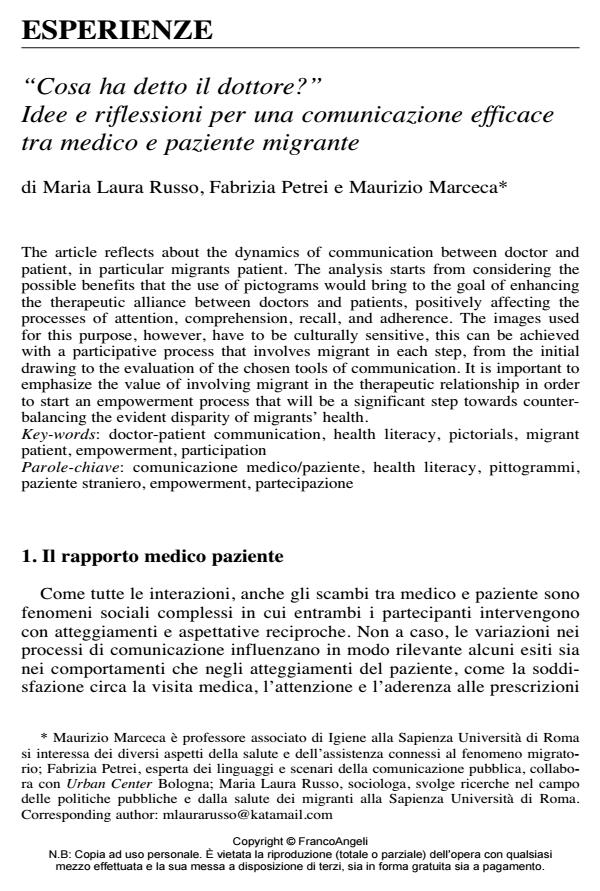
The article reflects about the dynamics of communication between doctor and patient, in particular migrants patient. The analysis starts from considering the possible benefits that the use of pictograms would bring to the goal of enhancing the therapeutic alliance between doctors and patients, positively affecting the processes of attention, comprehension, recall, and adherence. The images used for this purpose, however, have to be culturally sensitive, this can be achieved with a participative process that involves migrant in each step, from the initial drawing to the evaluation of the chosen tools of communication. It is important to emphasize the value of involving migrant in the therapeutic relationship in order to start an empowerment process that will be a significant step towards counterbalancing the evident disparity of migrants’ health.
Keywords: Doctor-patient communication, health literacy, pictorials, migrant patient, empowerment, participation
- Bischoff A. (2003). Caring for migrant and minority patients in European hospitals: a review of effective interventions. Neuchâtel: Swiss Forum for Migration and Population Studies
- Brown D.R. (2003). Health literacy: universal precautions needed. Journal of Allied Health, 33: 150-5
- Bruni A., Fasol R., Gherardi S. (2007). L’accesso ai servizi sanitari. Roma: Carocci
- Carducci A., Calamusa A., Tarsitani G., Muzzi A. (2007). Cittadini competenti ed alfabetizzazione sanitaria: importanza e ruolo del distretto. In: Atti 6° Congresso Nazionale di Cardiologia Distretto cittadino e comunità competenti: come governare i percorsi di salute in modo partecipato, Sorrento 15-17 novembre 2007 (pp. 41-52)
- Cattacin S. (2003). Ethnicity, Power and Health, relazione presentata alla Conferenza Internazionale HPH, Firenze, 18-20 maggio
- Cavicchi I. (2000). La medicina della scelta. Bollati & Boringhieri: Torino
- Cesaroni G., Forastiere F., Ferucci C.A. (2008). Are cesarean deliveries more likely for poorly educated parents? A brief report from Italy. Birth, 35: 3, 241-244
- Chiarenza A. (2006). Gli ospedali migrant-friendly: un’iniziativa europea di promozione della salute degli immigrati e delle minoranze etniche. Testo disponibile su: www.retehphitalia.it/Allegati/DOC_279786 (ultimo accesso 10/09/2012)
- Colasanti R., Geraci S. (2000). I livelli di incomprensione medico-paziente migrante. In Caritas di Roma (a cura di Geraci S.). Approcci transculturali per la promozione della salute. Argomenti di medicina delle migrazioni, Anterem, Roma: 213-220
- Cosmacini G. (1995). La qualità del tuo medico. Bari-Roma: Laterza
- Delp C., Jones J. (1996). Communicating information to patients: the use of cartoon illustrations to improve comprehension of instructions. Academic Emergency Medicine, 3: 264-70
- Dowse R., Ehlers M.S. (1998). Pictograms in pharmacy. The International Journal of Pharmacy Practice, 6:109-18
- Dowse R., Ehlers M.S. (2001). The evaluation of pharmaceutical pictograms in a low-literate South African population. Patient Education and Counseling, 45, 2: 87-99
- Fillippatou D., Pumfrey P.D. (1996). Pictures, titles, reading accuracy and reading comprehension: a research review (1973-95). Educational Research and Review, 38: 259-91
- Fortis D. (2003). Il plain language, quando le istituzioni si fanno capire. I quaderni del MdS
- Gardner M.P., Houston M.J. (1986). The effects of verbal and visual components of retail communications. Journal of Retailing, 62: 1-15
- Hodgdon L. (2011). Visual Strategies for Improving Communication. Quirk Roberts Publishing, Troy, MI
- Hosey G.M., Stracqualursi F. (1990). Designing and evaluating diabetes education materials for American Indians. The Diabetes Educator, 16: 400-8
- Houts P.S., Doak C.C., Doak L.G., Loscalzo M.J. (2006). The role of pictures in improving health communication: A review of research on attention, comprehension, recall, and adherence. Patient Education and Counseling, 6: 173-190
- Houts P.S., Witmer J.T., Egeth H.E., Loscalzo M.J., Zabora J.R. (2001). Using pictographs to enhance recall of spoken medical instructions. Patient Education and Counseling, 43: 231-42
- Keller D.L., Wright J., Pace H.A. (2008). Impact of health literacy on health outcomes in ambulatory care patients: a systematic review. Annals of Pharmacotherapy, 42, 9: 1272-81
- Kickbusch I., Wait S., Maag D. (2005). Navigating Health - The role of health literacy. Alliance for Health and the Future, International Longevity Centre-UK
- Kim H., Nakamura C., Zeng-Treitler Q. (2009). Assessment of Pictographs Developed Through a Participatory Design Process Using an Online Survey Tool. Journal of Medical Internet Research, 11, 1:e5 Testo disponibile al sito: www.jmir.org/2009/1 (ultimo accesso 25/07/2012)
- Kutner M., Greenberg E., Jin Y., Paulsen C., White S. (2003). The Health Literacy of America’s Adults - Results From the 2003 National Assessment of Adult Literacy. NAAL, Report of U.S. Department of Education. - NCES 2006-483
- Labranche E.R., Helweg-Larsen M., Byrd C.E., Choquette R.A. (1997). To picture or not to picture: levels of erotophobia and breast self-examination brochure techniques. Journal of Applied Social Psychology, 27: 2200-12
- Machenbach P. (2006). Health inequalities: Europe in profile. Report project Tackling Health Inequalities: Governing for Health. European Commission. Testo disponibile al sito www.who.int/social_determinants/resources/european_ inequalities.pdf (ultimo accesso 10/09/2012)
- Mangan J. (1978). Cultural conventions of pictorial representations: iconic literacy and education. Educational Communication and Technology Journal, 26, 3: 245-67
- Mansoor L.E., Dowse R. (2003). Effect of pictograms on readability of patient information materials. Annual Pharmacotherapy, 37: 1003-9
- Marceca M., Russo M.L. (2012). Il paziente straniero - Il rapporto di cura con persone di etnie diverse come occasione di arricchimento personale e professionale. Salute e Territorio, 191: 124-125
- Meade C.D., Byrd J.C. (1989). Patient literacy and the readability of smoking education literature. American Journal of Public Health, 79, 2: 204-206
- Michielutte R., Bahnson J., Digman M.B., Schroeder E. (1992). The use of illustrations and narrative text style to improve readability of a health education brochure. Journal of Cancer Education, 7: 251-60
- National Institute for Health and Clinical Excellence (2009). Medicines adherence, Involving patients in decisions about prescribed medicines and supporting adherence. Guideline 76
- Ngoh L.N., Shepherd M.D. (1997). Design, development, and evaluation of visual aids for communicating prescription drug instructions to non literate patients in rural Cameroon. Patient Education and Counseling, 31, 3: 245-61
- Nielsen-Bohlman L., Panzer A.M., Kindig D.A. (2004). Health Literacy: A Prescription to End Confusion. Committee on Health Literacy
- Osteberg L., Blaschke T. (2005). Adherence to Medication. The New England Journal of Medicine, 4, 353: 487-497
- Paasche-Orlow M.K., Wolf M.W. (2007). The Causal Pathways Linking Health Literacy to Health Outcomes. American Journal of Health Behavior, 3 (Supplement), S19-S26
- Pascuet E., Dawson J., Vaillancourt R. (2008). A picture worth a thousand words The use of pictograms for medication labeling. International Pharmacy Journal, 23, 32-36
- Ratzan S.C., Parker R.M. (2000). Introduction. In: Selden C.R., Zorn M., Ratzan S.C., Parker R.M., editors, National Library of Medicine Current Bibliographies in Medicine: Health Literacy, Vol. NLM Pub. No. CBM 2000-1. Bethesda, MD: National Institutes of Health, U.S. Department of Health and Human Services
- Satolli R. (2000). Abbasso Ippocrate il tiranno. La rivista dei libri 7/8
- Sclavi M. (2000). Arte di ascoltare e mondi possibili, Milano: Mondadori
- Scholman B.F. (2004). Health literacy: a key ingredient for managing personal health. Online Journal of Issues in Nursing: http://nursingworld.org
- Shonna Yin H., Mendelsohn A.L., Fierman A., van Schaick L., Bazan I.S., Dreyer B.P. (2011). Use of a Pictographic Diagram to Decrease Parent Dosing Errors With Infant Acetaminophen: A Health Literacy Perspective. Academic Pediatrics, 11: 50-57
- Sojourner R.J., Wogalter M.S. (1998). The influence of pictorials on the comprehension and recall of pharmaceutical safety and warning information. International Journal of Cognitive Ergonomics, 2: 93-106
- Taylor A.G., Skelton J.A., Czajkowski R.W. (1982). Do patients understand patient- education brochures? Nursing & health care, 3, 6: 305-310
- Watzlawick P. (1976). La realtà della realtà. Roma: Astrolabio
- Wilkinson R., Marmot M. (2003). Social determinants of health: The solid facts, II edition. Copenhagen: WHO
- Zaffani S., Cuzzolin L., Meneghelli G., Gangemi M., Murgia V., Chiamenti G,. Benoni G. (2005). An analysis of the factors influencing the paediatrician-parents relationship: the importance of the socio-demographic characteristics of the mothers. Child Care Health Development, 31, 5, 575-80
- Zani B., Selleri P., David D. (1994). La comunicazione. Modelli teorici e contesti sociali. Roma: Carocci
Maria Laura Russo, Fabrizia Petri, Maurizio Marceca, "Cosa ha detto il dottore?" Idee e riflessioni per una comunicazione efficace tra medico e paziente migrante in "SALUTE E SOCIETÀ" 1/2013, pp 141-163, DOI: 10.3280/SES2013-001011