Internal communication and intellectual and relational capital advantages. The General Business Community of IBM Italy
Journal title MERCATI E COMPETITIVITÀ
Author/s Alessandra Mazzei, Sonia C. Giaccone
Publishing Year 2014 Issue 2014/1
Language Italian Pages 22 P. 103-124 File size 577 KB
DOI 10.3280/MC2014-001006
DOI is like a bar code for intellectual property: to have more infomation
click here
Below, you can see the article first page
If you want to buy this article in PDF format, you can do it, following the instructions to buy download credits
FrancoAngeli is member of Publishers International Linking Association, Inc (PILA), a not-for-profit association which run the CrossRef service enabling links to and from online scholarly content.
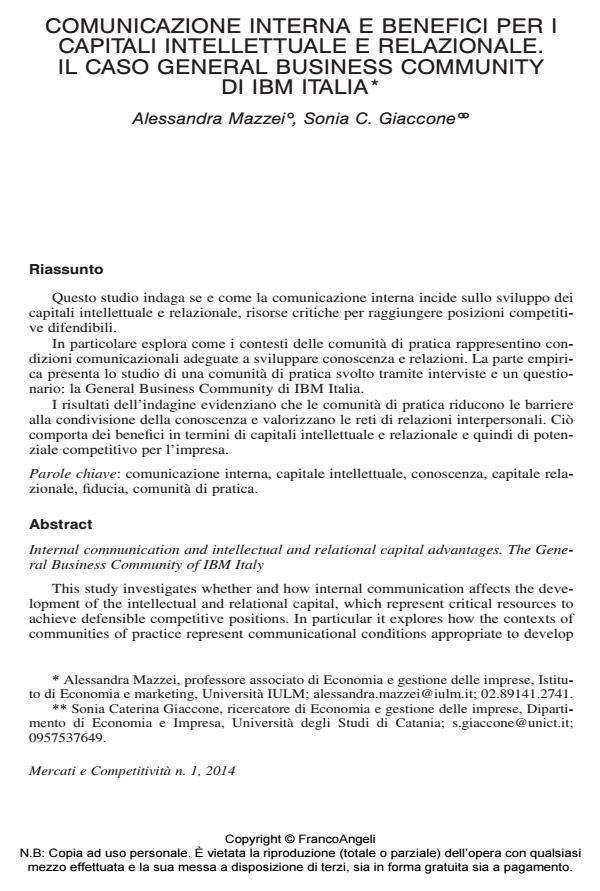
This study investigates whether and how internal communication affects the development of the intellectual and relational capital, which represent critical resources to achieve defensible competitive positions. In particular it explores how the contexts of communities of practice represent communicational conditions appropriate to develop knowledge and relationships. The empirical part provides a case study of one community of practice: the General Business Community of IBM Italy. The results of the interviews and of the questionnaire show that communities of practice help to generate both intellectual and relational capital, reducing barriers to knowledge sharing and developing networks of interpersonal relationships.
Keywords: Internal communication, intellectual capital, knowledge, relational capital, trust, community of practice
- Tsai W. (2001). Knowledge transfer in intraorganizational networks: effects of network position and absorptive capacity on business unit innovation and performance. Academy of Management Journal, 44 (5): 996-1004, DOI: 10.2307/3069443
- Tsai W., Ghoshal S. (1998). Social capital and value creation: the role of intrafirm networks. Academy of Management Journal, 41: 464-476, DOI: 10.2307/257085
- VanderStoep S.W., Johnston D. (2009). Research Methods for Real Life: Blending Qualitative and Quantitative Approaches. San Francisco: Jossey-Bass.
- Vangen S., Huxham C. (2003). Nurturing collaborative relations: building trust in interorganizational collaboration. The Journal of Applied Behavioral Science, 39 (1): 5-31, DOI: 10.1177/0021886303039001001
- Wang H., Chung J.E., Park N., McLaughlin M., Fulk J. (2012). Understanding on line community participation: a technology acceptance perspective. Communication Research, 39 (6): 781-801, DOI: 10.1177/0093650211408593
- Weick K.E. (1979). The Social Psychology of Organizing. Addison-Wesley Publishing.
- Wenger E. (1998). Communities of Practice: Learning, Meaning, and Identity. New York: Cambridge University Press.
- Wenger E., McDermott, Snyder W. (2002). Cultivating communities of practice: a guide to managing knowledge. Harvard Business School Press.
- Winter S.G. (2003). Understanding dynamic capabilities. Strategic Management Journal, 24 (10): 991-995, DOI: 10.1002/smj.318
- Wu J., Chen Y., Chung Y. (2010). Trust factors influencing virtual community members: a study of transaction communities. Journal of Business Research, 63 (9-10): 1025-1032, DOI: 10.1016/j.jbusres.2009.03.022
- Yin R.G. (1994). Case study research. Design and methods (2° ed.), Beverly Hills, CA: Sage publications.
- Zaragoza-sàez P., Claver-Cortéz E. (2011). Relational capital inside multinationals. Management Research & Practice, suppl. Special Issue: Managing knowledge assets, 9 (4): 293-304, DOI: 10.1057/kmrp.2011.34
- Zhou T. (2011). Understanding online community user participation: a social influence perspective. Internet Research, 21 (1): 67-81, DOI: 10.1108/10662241111104884
- Adiele C. (2011). Towards promoting interactivity in a B2B web community. Information Systems Frontiers, 13 (2): 237-249, DOI: 10.1007/s10796-009-9187-7
- Ahuja G., Katila R. (2004). Where do resources come from? The role of idiosyncratic situations. Strategic Management Journal, 25: 887-907, DOI: 10.1002/smj.401
- Alvai M., Leidner D.E. (2001). Review: knowledge management and knowledge management systems: conceptual foundations and research issues. MIS Quarterly, 25(1): 107-136, DOI: 10.2307/3250961
- Argote L., McEvily B., Reagans R. (2003). Managing knowledge in organizations: an integrative framework and review of emerging themes. Management Science, 49 (4): 571-582, DOI: 10.1287/mnsc.49.4.571.14424
- Armstrong A., Hagel J. (1996). The real value of on-line community. Harvard Business Review, 74 (3): 134-141.
- Ashcraft K.L., Khun T.R., Cooren F. (2009). Constitutional amendements: ‘Materializing’ organizational communication. The Accademy of Management Annuals, 3 (1): 1-64, DOI: 10.1080/19416520903047186
- Baccarani C. (2004). Riflessioni sulla creatività. Sinergie, 64-65: 347-360.
- Balmer J.M.T., Greyser S.S. (2003). Revealing the Corporation. London: Routledge.
- Barney J.K. (1991). Firm resources and sustained competitive advantage. Journal of Management, 17: 99-120, DOI: 10.1177/014920639101700108
- Barone M., Fontana A. (2005). Prospettive per la comunicazione interna e il benessere organizzativo. Milano: FrancoAngeli.
- Bernardes E.S. (2010). The effect of supply management on aspects of social capital and the impact on performance: a social network perspective. Journal of Supply Chain Management, 46 (1): 45-56, DOI: 10.1111/j.1745-493X.2009.03185.x
- Blackler F. (1999). Dal concetto statico di conoscenza al concetto dinamico di conoscere: il knowing come processo attivo e prodotto delle comunità. Studi Organizzativi, 3: 5-18.
- Brown J.S., Duguid P. (1991). Organizational learning and communities-of practice: toward a unified view of working, learning, and innovation. Organization Science, 2 (1): 40-57, DOI: 10.1287/orsc.2.1.40
- Bughin J., Byers A.H., Chui M. (2011). How social technologies are extending the organization. The McKinsey Quarterly, 11: 1-10.
- Butera F. (1999). L’organizzazione a rete attivata da cooperazione, conoscenza, comunicazione e comunità. Studi organizzativi, 2: 99-130.
- Chang H.H., Chuang S.S. (2011). Social capital and individual motivations on knowledge sharing: participant involvement as a moderator. Information & Management, 48 (1): 9-18, DOI: 10.1016/j.im.2010.11.001
- Chen J.S., Lovvron A.S. (2011). The speed of knowledge transfer within multinational enterprises: the role of social capital. International Journal of Commerce and Management, 21 (1): 46-62, DOI: 10.1108/10569211111111694
- Chesbrough H. (2006). A new paradigm for understanding industrial innovation. In: Chesbrough H., Vanhaverbeke W., West J., a cura di, Open innovation: researching a new paradigm: 1-12, Oxford: Oxford University Press.
- Choudhury J. (2010). Performance impact of intellectual capital: a study of Indian IT sector. International Journal of Business and Management, 5 (9): 72-80.
- Clopton A.W. (2011). Social capital and team performance. Team Performance Management, 17 (7/8): 369-381, DOI: 10.1108/13527591111182634
- Cohen W.M., Levinthal D.A. (1990). Absorptive capacity: a new perspective on learning and innovation. Administrative Science Quarterly, 5: 128-152, http://www.jstor.org/stable/2393553.
- Colbert B.A. (2004). The Complex Resource-Based View: Implications for Theory and Practice in Strategic Human Resource Management. Academy of Management Review, 29 (3): 341-358, DOI: 10.5465/AMR.2004.13670987
- Collins J.D., Hitt M.A. (2006). Leveraging tacit knowledge in alliances: the importance of using relational capabilities to build and leverage relational capital. Journal of Engineering and Technology Management, 23 (3): 147-167, DOI: 10.1016/j.jengtecman.2006.06.007
- Cooren F., Taylor J., Van Every E.J. (2006). Communication as Organizing. Erlbaum: Mahwah.
- Costabile M. (2001). Il capitale relazionale, Milano: McGraw-Hill.
- Dagnino G.B., Longo M.C. (2012). Knowledge creation and application in high-technology firms: the role of communities in the italian experience. International Journal of Strategic Change Management, 4 (1): 1-31, DOI: 10.1504/IJSCM.2012.045828
- Dahlander L., Magnusson M. (2008). How do firms make use of open communities. Long Range Planning, 41: 629-649, DOI: 10.1016/j.lrp.2008.09.003
- Daymon C., Holloway I. (2002). Qualitative Research Methods in Public Relations and Marketing Communications. Routledge: London.
- De Vries S., Kommers P. (1994). Online Knowledge community: future trends and research issues. Int. J. Web based Community, 1 (1): 115-123, DOI: 10.1504/IJWBC.2004.004804
- Dubè L., Parè G. (2003). Rigor in information systems positivist case research: current practices, trends, and recommendations. MIS Quarterly, 27 (4): 597-635, Article Stable URL: http://www.jstor.org/stable/30036550.
- Edvinsson L., Malone M.S. (1997). Intellectual capital. Realizing your company’s true value by finding its hidden brainpower. Harper Collins Publishers, Inc., 1° ed.
- Eisenhardt K.M. (1989). Building theories form case study research. Academy of Management Review, 4 (4): 532-550., DOI: 10.5465/AMR.1989.4308385
- Gongla P., Rizzuto C.R. (2001). Evolving communities of practice: IBM global services experience. IBM System Journal, 40 (4): 842-862, DOI: 10.1147/sj.404.0842
- Granovetter M.S. (1973), The Strenght of Weak Ties. American Journal of Sociology, 78: 1360-1380, http://www.jstor.org/stable/2776392.
- Grant R.M. (1996). Prospering in dynamically-competitive environments: organizational capability as knowledge integration. Organization Science, 7: 375-387, DOI: 10.1287/orsc.7.4.375
- Hamel H., Prahalad C.K. (1990). The core competence of the corporation. Harvard Business Review, 90 (3): 79-91.
- Hamzah N., Mat Isa R. (2010). Intellectual and social capitals development. A case in Malaysian’s ICT companies. International Journal of Business and management, 5 (1): 53-61.
- Heath R.L. (1994). Management of Corporate Communication, Hills Dale: Lawrence Erlbaum Associates.
- Heide M., Simonsson C. (2011). Putting coworkers in the limelight: new challenges for communication professionals. International Journal of Strategic Communication, 5, (4): 201-220, DOI: 10.1080/1553118X.2011.605777
- Hsu Y.H., Fang W. (2009). Intellectual capital and new product development performance: the mediating role of organizational learning capability. Technological Forecasting and Social Change, 76 (5): 664-677, DOI: 10.1016/j.techfore.2008.03.012
- Inkpen A., Tsang E.W.K. (2005). Social capital, networks and knowledge transfer. The Academy of Management Review, 30 (1): 146-165, DOI: 10.5465/AMR.2005.15281445
- Iverson J.O., McPhee R.D. (2002). Knowledge management in communities of practice. Management Communication Quarterly, 16 (2): 259-266, DOI: 10.1177/089331802237239
- Jablin F.M., Putnam L.L. (eds.). The New Handbook of Organizational Communication. Thousand Oaks: Sage Publications.
- Kalla H.K. (2005). Knowledge sharing through social capital: strategic role of communication. Conference on Corporate Communication 2005 Proceedings, CCI.
- Kogut B., Zander U. (1992). Knowledge of the firm, combinative capabilities and the replication of technology. Organization Science, 3 (3): 383-397, DOI: 10.1287/orsc.3.3.383
- Lee A.S. (1989). A scientific methodology for MIS case studies. MIS Quarterly, 13 (1): 33-52.
- Legrenzi P., Arielli E. (2003). La felicità manageriale. Sviluppo & Organizzazione, 199: 17-30.
- Lesser E.L., Storck J. (2001). Communities of practice and organizational performance. IBM System Journal, 40 (4): 831-8411, DOI: 10.1147/sj.404.0831
- Lewicki R.J., Bunker B.B. (1996). Developing and maintaining trust in work relationships. In: Kramer R.M., Tayler T.R., a cura di, Trust in organizations. Frontiers of Theory and Research. Thousand Oaks: Sage Publications.
- Lipparini A. (2002). La gestione strategica del capitale intellettuale e del capitale sociale, Bologna: il Mulino.
- MacMillan K., Money K., Downing S. (2000). Successful business relationships. Journal of General Management, 26 (1): 69-83.
- McAllister D.J. (1995). Affect and cognition-based trust ad foundations for interpersonal cooperation in organizations. Academy of Management Journal, 38 (1): 24-59, DOI: 10.2307/256727
- McPhee R.D., Scott Poole M. (2001). Organizational structures and configurations. In: Jablin F.M., Putnam L.L., a cura di, The New Handbook of Organizational Communication. Thousand Oaks: Sage Publications.
- McPhee R.D., Zaug P. (2000). The Communicative Constitution of Organizations: A Framework for Explanation. The Electronic Journal of Communication, 10 (1-2): 1-16.
- Miglietta A. (2010). Nuove visioni dell’impresa dopo la grande crisi: prime riflessioni. Sinergie, 81: 31-50.
- Miller K. (2006). Constructive. In: Shepherd G.J., St. John J., Striphas T., a cura di, Communication as... Perspectives on Theory. Thousand Oaks: Sage Publications.
- Mishira A.K. (1996). Organizational Responses to Crisis. The Centrality of Trust. In: Kramer R.M., Tyler T.M., a cura di, Trust in Organizations. Thousand Oaks: Sage Publications.
- Morgan D.L. (1988). Focus Group as Qualitative Research. Thousand Oaks: Sage Publications.
- Muhdi L., Boutellier R. (2011). Motivational factors affecting participation and contribution of members in two different swiss innovation communities. International Journal of Innovation Management, 15 (3): 54-562, DOI: 10.1142/S1363919611003477
- Nahapiet J.E., Ghoshal S. (1998). Social capital, intellectual capital and the organizational advantage. Academy of Management Review, 23: 242-266, DOI: 10.5465/AMR.1998.533225
- Nonaka I. (1994). A dynamic theory of organizational knowledge creation. Organization Science, 5 (1): 14-37, DOI: 10.1287/orsc.5.1.14
- Paniccia P. (2006). Il knowledge management: tra formale e informale. In: Paniccia P., editor. Creazione e valorizzazione della conoscenza in impresa. Roma: Aracne. Porter M. (1980). Competitive strategy. New York: Free Press.
- Putnam L.L., Phillips N., Chapman P. (1996). Metaphors of Communication and Organization. In: Clegg S.R., Hardy C., Nord W.R., a cura di, Handbook of Organization Studies. Thousand Oaks: Sage Publications.
- Ritter T. (1999). The Networking Company. Antecedents for Coping with Relationships and Networks Effectively. Industrial Marketing Management, 28 (5): 467-479., DOI: 10.1016/S0019-8501(99)00075-9
- Sheehan N.T., Stabell C.B. (2010). Reputation as a driver in activity level analysis: reputation and competitive advantage in knowledge intensive firms. Corporate Reputation Review, 13: 198-208, DOI: 10.1057/crr.2010.19
- Subramaniam M., Youndt M.A. (2005). The influence of intellectual capital on the types of innovative capabilities. The Academy of Management Journal, 48 (3):450-464.
- Teece D.J., Pisano G., Shuen A. (1997). Dynamic capabilities and strategic management. Strategic Management Journal, 18 (7): 509-533, DOI: 10.1142/9789812834478_0002
- Tompkins P.K., Wanca-Thibault M. (2001). Organizational Communication. Prelude and Prospects. In: Jablin F.M., Putnam L.L., a cura di, The New Handbook of Organizational Communication, Thousand Oaks: Sage Publications.
- Tovstiga G., Tulugurova E. (2009). Intellectual capital practices: a four-region comparative study. Journal of Intellectual Capital, 10 (1): 70-80, DOI: 10.1108/14691930910922905
Alessandra Mazzei, Sonia C. Giaccone, Comunicazione interna e benefici per i capitali intellettuale e relazionale. Il caso general business community di Ibm italia in "MERCATI E COMPETITIVITÀ" 1/2014, pp 103-124, DOI: 10.3280/MC2014-001006