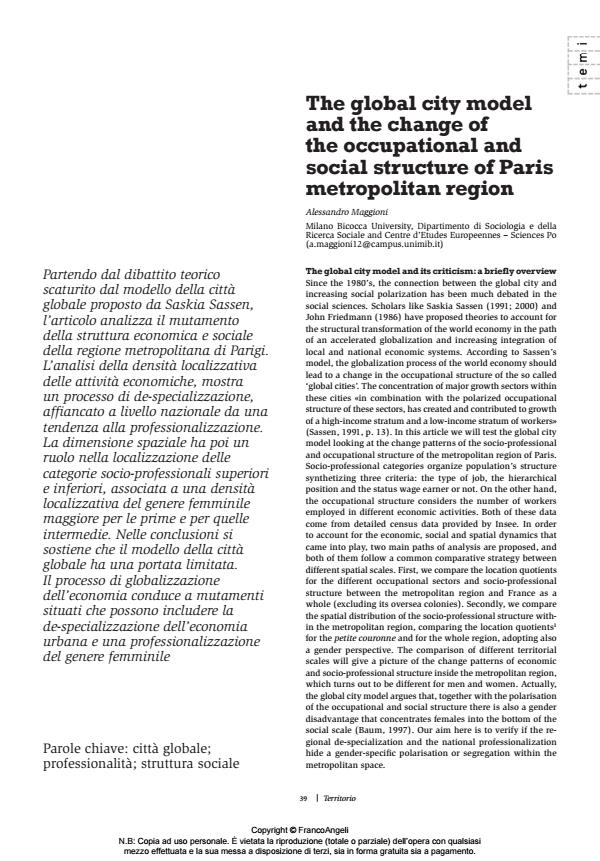
The global city model and the change of the occupational and social structure of Paris metropolitan region
Journal title TERRITORIO
Author/s Alessandro Maggioni
Publishing Year 2015 Issue 2015/73
Language English Pages 10 P. 39-48 File size 442 KB
DOI 10.3280/TR2015-073006
DOI is like a bar code for intellectual property: to have more infomation
click here
Below, you can see the article first page
If you want to buy this article in PDF format, you can do it, following the instructions to buy download credits
FrancoAngeli is member of Publishers International Linking Association, Inc (PILA), a not-for-profit association which run the CrossRef service enabling links to and from online scholarly content.
Partendo dal dibattito teorico scaturito dal modello della città globale proposto da Saskia Sassen, l’articolo analizza il mutamento della struttura economica e sociale della regione metropolitana di Parigi. L’analisi della densità localizzativa delle attività economiche, mostra un processo di de-specializzazione, affiancato a livello nazionale da una tendenza alla professionalizzazione. La dimensione spaziale ha poi un ruolo nella localizzazione delle categorie socio-professionali superiori e inferiori, associata a una densità localizzativa del genere femminile maggiore per le prime e per quelle intermedie. Nelle conclusioni si sostiene che il modello della città globale ha una portata limitata. Il processo di globalizzazione dell’economia conduce a mutamenti situati che possono includere la de-specializzazione dell’economia urbana e una professionalizzazione del genere femminile
Keywords: Città globale; professionalità; struttura sociale
- Baum S., 1997, «Sydney, Australia: A Global City? Testing the Social Polarization Thesis», Urban Studies, vol. 34, n. 11, pp. 1881-1902.
- Borel-Saladin J., Crankshaw O., 2009, «Social Polarisation or Professionalisation? Another Look at Theory and Evidence on Deindustrialisation and the Rise of the Service Sector», Urban Studies, vol. 46, n. 3, pp. 645-664. DOI: 10.1177/0042098008100999
- Bruegel I., 1996, «Gendering the Polarisation Debate: A Comment on Hamnett’s ‘Social Polarization Economic Restructuring and Welfare State Regime», Urban Studies, vol. 33, n. 8, pp. 1431-1439. DOI: 10.1080/0042098966736
- Friedmann J., 1986, «The World City Hypothesis.», Development and Change, vol. 17, n. 1, pp. 69-83. DOI: 10.1111/j.1467-7660.1986.tb00231.x
- Gilli F., 2005, «Le Bassin parisien. Une région métropolitaine», Cybergeo: European Journal of Geography, vol. 15, n. 305.
- Gilli F., 2009, «Sprawl or Reagglomeration? The Dynamics of Employment Deconcentration and Industrial Transformation in Greater Paris», Urban Studies, vol. 46, n. 7, pp. 1385-1420. DOI: 10.1177/0042098009104571
- Hamnett C., 1994, «Social Polarisation in Global Cities: Theory and Evidence», Urban Studies, vol. 31, n. 3, pp. 401-424. DOI: 10.1080/00420989420080401
- Hamnett C., 1996, «Social Polarisation, Economic Restructuring and Welfare State Regimes», Urban Studies, vol. 33, n. 8, pp. 1407-1430. DOI: 10.1080/0042098966727
- Hamnett C., 2003, «Gentrification and the Middle-class Remaking of Inner London, 1961-2001», Urban Studies, vol. 40, n. 12, pp. 2401-2426. DOI: 10.1080/0042098032000136138
- Insee, 2001, Île-de-France à la page, n. 196, April.
- Insee, 2011, «Zonage en aire urbaine 2010: le centre se densifie, le periurban s’etende.», Île-de-France à la page, n. 374, Octobre.
- Marcuse P., 1989, «Dual City: A Muddy Metaphor for a Quartered City», International Journal of Urban and Regional Studies, vol. 13 n. 4, pp.697-708. DOI: 10.1111/j.1468-2427.1989.tb00142.x
- Myles J., 1988, «The Expanding Middle: Canadian Evidence on the Deskilling Debate», Canadian Review of Sociology and Antropology, vol. 25, n. 3, pp. 335-364. DOI: 10.1111/j.1755-618X.1988.tb00109.x
- O’Connor K., 2010, «Global City Regions and the Location of Logistics Activity», Journal of Transport Geography, vol. 18, n. 3, pp. 354-362. DOI: 10.1016/j.jtrangeo.2009.06.015
- Preteceille E., 1995 «Division social de l’espace et globalization. Le cas de la metropole Parisienne», Societes Contemporaines, vol. 22, n. 1, pp. 33-67. DOI: 10.3406/socco.1995.1530
- Preteceille E., 2006, «La segregation sociale a-t-elle augmentè? La metropole parisienne entre polarisation et mixitè», Societes Contemporaines, n. 62, pp. 69-93. DOI: 10.3917/soco.062.0069
- Rodrigue J.-P., Hesse M., 2007, «Globalised Trade and Logistics: North American Perspectives», in Leinbach T.R., Capineri C. (eds.), Globalised Logistics Transport. Intermodality, E-Commerce, Logistics and Sustainability, Edward Elgar, Cheltenham, UK, pp. 103-134.
- Sassen S., 1991, The Global City: New York, London, Tokyo, Princeton U.P., Princeton, NJ.
- Sassen S., 1994 «La ville globale. Element pour une lecture de Paris», Le Debat, vol. 3, n. 80, pp. 137-153. DOI: 10.3917/deba.080.0137
- Sassen S., 1998, Globalization and its Discontents, New Press, New York.
- Sassen S., 2000, Cities in a World Economy, Pine Forge Press, Thousand Oaks, CA (2nd ed.)
- Stephen W.K. Chiu, Tai-lok Lui, 2004, «Testing the Global City-social Polarization Thesis: Hong Kong Since the 1990s», Urban Studies, vol. 41, n. 10, pp. 1863-1888. DOI: 10.1080/0042098042000256297
- Taylor P.J., 2004, World City Network. A Global Urban Analysis, Routledge, London.
- Vaattovaara M., Kortteinen M., 2003, «Beyond Polarisation versus Professionalisation? A Case Study of the Development of the Helsinki Region, Finland.», Urban Studies, vol. 40, n. 11, pp. 2127-2145. DOI: 10.1080/0042098032000123213
- Veltz P., 1997, «Une organisation géoéconomique à niveaux multiples », Politique étrangère, vol. 62, n. 2, pp. 265-276. DOI: 10.3406/polit.1997.4639
- Veltz P., 2000, «European Cities in the World Economy», in Bagnasco
- A., Le Galès P., Cities in Contemporary Europe, Cambridge U.P., Cambridge, pp. 33-47.
- White J.W., 1998, «Old Wine Cracked bottle?: Tokyo, Paris and the Global City Hypothesis», Urban Affairs Review, vol. 33, n. 4, pp 451-477. DOI: 10.1177/107808749803300401
- Wright E.O., Martin B., 1987 «The Transformation of the American Class Structure, 1960-1980», American Journal of Sociology, vol. 93, n. 1, pp. 1-29. DOI: 10.1086/228704
- Transformative Economies Alexandru Bănică, Gabriela-Carmen Pascariu, Ionel Muntele, pp.205 (ISBN:978-3-032-25297-5)
Alessandro Maggioni, The global city model and the change of the occupational and social structure of Paris metropolitan region in "TERRITORIO" 73/2015, pp 39-48, DOI: 10.3280/TR2015-073006