Empathy and systemic psychotherapy. Theoretical and clinical implications
Journal title PSICOBIETTIVO
Author/s Luigi Onnis
Publishing Year 2016 Issue 2016/3
Language Italian Pages 24 P. 23-46 File size 143 KB
DOI 10.3280/PSOB2016-003002
DOI is like a bar code for intellectual property: to have more infomation
click here
Below, you can see the article first page
If you want to buy this article in PDF format, you can do it, following the instructions to buy download credits
FrancoAngeli is member of Publishers International Linking Association, Inc (PILA), a not-for-profit association which run the CrossRef service enabling links to and from online scholarly content.
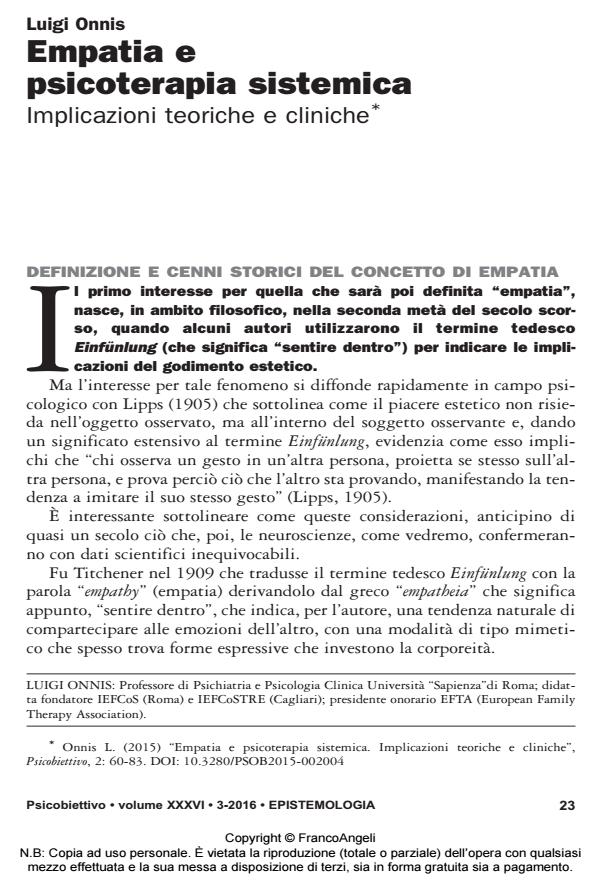
The Author, after proposing a definition and a brief historical reconstruction of the concept of empathy, takes into account the scientific contribution that nowadays draw great interest about empathy: those coming from developmental psychology, particularly through the importance of intersubjectivity, and those coming from neurosciences, through the mirror neurons function. It emerges that empathy is a relational construct which involves an intersubjective theming on emotional and affective basis (before than cognitive) mediated by implicit, specifically bodily languages. Those relational characteristics of empathy perfectly fit with the systemic-relational psychotherapy which inspires itself to the relevance of intersubjective relationship, moreover it gives a great importance to the therapeutic use of analogical languages in order to promote an emotional circulation between therapist and family. A clinical case is described in which the empathic activation among the family members and the therapist is promoted by the use of the analogical method of Family Time Sculptures. In the final part of the paper the risk of an overvaluation of empathy is also discussed, particularly when it is considered as a factor that, by itself, can produce change.
Keywords: Empathy; Intersubjectivity; Mirror Neurons; Systemic Therapy; Implicit Languages; Family Time Sculptures
- Baron-Cohen S. (1995) L’autismo e la lettura della mente (trad. it.: Astrolabio, Roma, 1997)
- Bateson G. (1976) Verso un’ecologia della mente, Adelphi, Milano
- Bonino S., Lo Coco A., Tani F. (1998) Empatia. I processi di condivisione delle emozioni, Giunti, Firenze
- Borke H. (1971) “Interpersonal perception of young children: egocentrism or empathy?”, Developmental Psychology, 5: 263-296
- Boszormeny-Nagy I., Spark J. (1988) Lealtà invisibili, Astrolabio, Roma Buder M. (1923-1970) I and you, english translation by W. Kauffman, Touchstone, New York
- Ceccarelli M., Pugliatti M., Avallone E., Brescia G., Cimmino M., Valente M., Farina B. (2013) “L’organizzazione gerarchica dei processi cognitivi: dalle social neurosciences alla pratica clinica”, Psicobiettivo, 2: 107-128
- Damasio A. (1995) L’errore di Cartesio, Adelphi, Milano
- Damasio A. (2000) Emozioni e coscienza, Adelphi, Milano
- Decety J., Jackson P.L. (2004) “The functional architecture of human empathy”, Behavioral Cognitive Neuro Sciences Review, 3: 71-100
- Eisenberg N., Strayer J. (1987) Empathy and its development, Cambridge Univ. Press, New York
- Elkaim M. (1989) Si tu m’aimes ne m’aimes pas, Le Seuil, Paris
- FreancoAngeli, Milano
- Rizzolatti G., Fadiga L., Gallese V., Fogassi L. (1996) “Premotor cortex and the recognition of motor actions”, Cognitive Brain Research, 9: 131-141
- Rizzolatti G., Sinigaglia C. (2006) So quel che fai: il cervello che agisce e i neuroni specchio, Raffaello Cortina, Milano
- Rogers C. (1975) “Empathic. An unappreciated way of being”, The counseling psychologist, 2: 2-10
- Sander L.W. (1975) “Infant and caretaking environment. Investigation and conceptualization of adaptive behavior in a system of increating complexity”, in Anthony E.J. (ed.), Exploration in child Psychiatry, Plenum, New York
- Siegel D.J. (2009) La mente relazionale, Raffaello Cortina, Milano
- Stern D.N. (1985) Il mondo interpersonale del bambino, Bollati Boringhieri, Torino
- Stern D.N. (2005) Il momento presente, Raffaello Cortina, Milano
- Stern D.N. (2006) “L’implicito e l’esplicito in psicoterapia”, in Spagnuolo-Lobb M. (a cura di), Atti del Convegno della Federazione Italiana Associazioni di Psicoterapia (FIAP), FrancoAngeli, Milano
- Stern D.N., Hefer L., Haff W., Dore J. (1984) La “sintonizzazione affettiva” (trad. it. in: Le interazioni madre-bambino nello sviluppo e nella clinica, Raffaello Cortina, Milano, 1998)
- Stern D.N., Sander L.W., Nehum J.P., Harrison A.M., Lyons-Ruth K.,
- Morgan A.C., Brushweler Stern N., Tronick E. (1998) “Non interpretive mechanism in psychoanalytic therapy: the ‘something more’, than interpretation”, International Journal of Psychoanlysis, 79: 903-918 (trad. it. in: Onnis L. (a cura di), Una nuova alleanza tra psicoterapia e neuroscienze. Dialogo tra D. Stern e V. Gallese, FrancoAngeli, Milano)
- Strayer J. (1987) “Affective and cognitive perspective on empathy”, in Eisemberg, F. Strayer (eds.), Empathy and its development, Cambridge Univ. Press, New York
- Titchener E. (1909) Experimental psychology of the thought processes, Mc Millan, New York
- Trevarthen C. (1980) “The foundation of intersubjectivity. Development of interpersonal and cooperative understanding in infants”, in Olson D. (ed.), The social foundation of Language and thought, Norton, New York
- Trevarthen C. (1993) “Il sé generale dell’intersoggettività, la psicologia della comunicazione infantile”, in Neisser U. (a cura di), La percezione di Sé: le fonti ecologiche interpersonali della conoscenza di sé, Bollati Boringhieri, Torino, 1999
- Tronick E.Z., Als H., Brazelton T.B. (1977) “The infant capacity to regulate mutually in face to face interaction”, Journal of Communication, 27: 74, 80
- Fodor J. (1992) “A theory of the child’s theory of mind”, Cognition, 44: 283-296
- Freud S. (1899) L’interpretazione dei sogni (trad. it.: Boringhieri, Torino, 1989)
- Gallese V. (2005) “Emboded simulation: from neurons to phenomenal experience”, Phenomenology and the Cognitive Science, 4: 23-48
- Gallese V. (2015) “Sé corporei in relazione: simulazione incarnate come prospettiva in seconda persona sull’intersoggettività”, in Onnis L. (a cura di), Una nuova alleanza tra psicoterapia e neuroscienze: dall’intersoggettività ai neuroni specchio. Dialogo tra D. Stern e V. Gallese, FrancoAngeli, Milano
- Gallese V., Fadiga L., Fogassi L., Rizzolatti G. (1996) “Action recognition in premotor cortex”, Brain, 119: 593-601
- Gallese V., Migone P., Eagle M. (2006) “La simulazione incarnata e i neuroni specchio. Le basi neurofisiologiche dell’intersoggettività ed alcune implicazioni per la psicoanalisi”, Psicoterapia e Scienze Umane, 40, 3: 543-580
- Hobson R.P. (2002) The cradle of thought, Pan Mc Millan, London
- Hoffman M.L. (1982) “Development of prosocial motivation: empathy and quilt”, in Eisemberg N. (ed.), The development of prosocial behavior, Academic Press, New York
- Kandel E.R. (1999) “Biology and the future of Psychoanalysis: a new intellectual frame work for psychiatry”, American J. of Psychiatry, 156: 505-524
- Kohut H. (1971) The analysis of the self, International Univ. Press, New York (trad. it.: Narcisismo e analisi del Sé, Boringhieri, Torino, 1976)
- Le Doux J. (1998) Il cervello emotivo, Baldini, Castoldi, Milano
- Lipps T. (1905) “Das wissen von fremden ichen”, Psychologische Untersuchungen, 4: 694-722
- Meltloff A.N., Moore M.K. (1977) “Imitation of facial and manual gestures by human neonates”, Sciences, 198: 75-78
- Meltloff A.N., Moore M.K. (1999) “Persons and representations: why infant imitation is important for theories of human development”, in Nadel J., Butterworth G. (eds.), Imitation in infancy, Cambridge Univ. Press, Cambridge
- Onnis L., Di Gennaro A., Cespa G., Agostini B., Chouhy A., Dentale R.C., Quinzi P. (1980a) “Le sculture del presente e del futuro: un modello di lavoro terapeutico nelle situazioni psicosomatiche”, Ecologia della Mente, 1: 21-48
- Onnis L., Laurent M., Bendetti P., Cespa G., Onnis L., Di Gennaro A., Cespa G., Dentale R.C., Quinzi P. (1980b) “Il mito familiare. Concetti teorici e implicazioni terapeutiche”, Ecologia della Mente, 2: 95-112
- Onnis L., Di Gennaro A., Cespa G., Agostini B., Chouhy A., Dentale R.C., Quinzi P. (1980c) “Sculpting present and future: a systemic intervention model applied to psychosomatic families”, Family Process, 33, 3: 341-355
- Onnis L. (2004) Il tempo sospeso, FrancoAngeli, Milano
- Onnis L. (2009) “Se la psiche è il riflesso del corpo: una nuova alleanza tra neuroscienze e psicoterapia”, Psicobiettivo, 2: 51-73. DOI: 10.3280/PSOB2009-00200
- Onnis L. (2012) “Le voci interne della famiglia: Miti e fantasmi familiari”, in Onnis L. (a cura di), La terapia familiare in Europa, FrancoAngeli, Milano
- Onnis L. (2013) “Le Sculture del Tempo Familiare: un metodo di “narrazione analogica” in psicoterapia sistemica”, Ecologia della Mente, 1: 5-27
- Onnis L. (2014a) “La dimensione dell’intersoggettività nella psicoterapia sistemica relazionale”, Ecologia della Mente, 1: 5-15
- Onnis L. (2014b) (a cura di) Una nuova alleanza tra psicoterapia e neuroscienze: dall’intersoggettività ai neuroni specchio. Dialogo tra D. Stern e V. Gallese,
Luigi Onnis, Empatia e psicoterapia sistemica Implicazioni teoriche e cliniche in "PSICOBIETTIVO" 3/2016, pp 23-46, DOI: 10.3280/PSOB2016-003002