Connections that create, connections that heal. attachment: a bridge theory for psychotherapy
Journal title PSICOBIETTIVO
Author/s Luigi Onnis
Publishing Year 2016 Issue 2016/3
Language Italian Pages 30 P. 61-90 File size 154 KB
DOI 10.3280/PSOB2016-003004
DOI is like a bar code for intellectual property: to have more infomation
click here
Below, you can see the article first page
If you want to buy this article in PDF format, you can do it, following the instructions to buy download credits
FrancoAngeli is member of Publishers International Linking Association, Inc (PILA), a not-for-profit association which run the CrossRef service enabling links to and from online scholarly content.
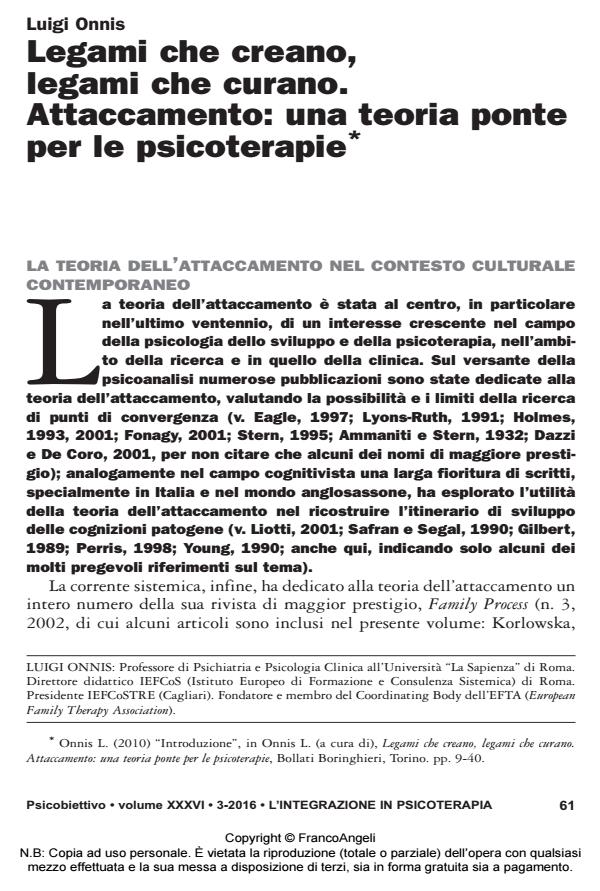
The paper aims at exploring the current dimension of the Attachment Theory in the contemporary cultural context. The author highlights the deeper aspects shared by the attachment theory with psychoanalysis, cognitivism and systemic orientation. With regard to the latter, it highlights the common enhancement of experiences and "real" relationships as a matrix of psychological development of the child. It emerges, with respect to the attachment theory, a vision of this as a "bridge" between the different addresses. In this sense it is activated as a bridge towards multiple directions, primarly towards the inside of each model, stimulating an original research of connections between "external reality" and "inner world"; then it becomes a bridge built between different psychotherapist models soliciting research and intersections.
Keywords: Theory of Attachment; Intersubjectivity; Bridge; Self-Healing of the Psyche.
- A.A.V.V. (2002) “Attachment and Family Systems”, Family Process, 41, 3 (numero monografico)
- A.A.V.V. (2006) “Realtà e rappresentazione in psicoterapia”, Psicobiettivo, 26, 3 (numero monografico)
- Ainsworth M.D. et al. (1978) Pattern of attachment, Erlbaum, Hillsdale, NJ
- Ainsworth M.D., Eichberg C.G. (1991) “Effects on infant-mother attachment of mother’s unresolved loss of an attachment figure or other traumatic experience”, in Parkers C.M., Stevenson-Hindle J., Marris P. (eds.), Attachment across the life cycle, Routledge, London
- Ammanniti M., Stern D. (a cura di) (1992) Attaccamento e psicoanalisi, Laterza, Bari
- Ammanniti M., Zavattini G.C. (2002) Introduzione a Fonagy P. “Psicoanalisi e teoria dell’attaccamento”, Raffaello Cortina, Milano
- Aron L. (2004) Menti che si incontrano, Raffaello Cortina, Milano
- Bateman A., Holmes J.V. (1995) La psicoanalisi contemporanea: ¨teoria, pratica, ricerca (trad. it.: Raffaello Cortina, Milano, 1998)
- Bateson G. (1972) Verso un’ecologia della mente (trad. it.: Adelphi Milano, 1976)
- Bateson G., Haley J., Jackson D.D., Weakland J. (1956) “Toward a theory of schizophrenia”, Behavioral Sciences, 1: 251-264 (trad. it. in: Bateson G., Verso un’ecologia della mente, Adelphi, Milano, 1976)
- Bying-Hall J. (1995a) “Crating a secure family base: some implication of attachment theory for family therapy”, Family Process, 34, 1: 25-38 (trad. it. in questo volume)
- Bying-Hall J. (1995b) Le trame della famiglia: attaccamento sicuro e cambiamento sistemico (trad. it.: Raffaello Cortina, Milano, 1998)
- Bocchi G., Ceruti M. (1985) La sfida della complessità, Feltrinelli, Milano
- Boszormenyi-Nagi I., Spark G.M. (1973) Lealtà invisibili (trad. it.: Astrolabio Roma, 1988)
- Bowen M. (1978) Family Therapy in Clinical Practice, J. Aronson, New York
- Bowlby J. (1944) “Forty-Four Juvenile Thieves. Their Characters and Home-Life. Intern”, Journal of Psychoanalysis, 25: 1-57
- Bowlby J. (1949) “The study and reduction of group tension in the family”, Human Relations, 2, 2: 123-128
- Bowlby J. (1958) “The nature of the child tie to his mother”, Inter. Journal of Psychoanalysis, 39: 350-373
- Bowlby J. (1969) Attaccamento e perdita,vol. I: l’attaccamento alla madre (trad. it.: Boringhieri, Torino, 1972)
- Bowlby J. (1979) “On knowing what you are not supposed to know and on feeling what you are not supposed to feel”, Canadian Journal of Psychiatry, 24: 403-408
- Bowlby J. (1988) Una base sicura (trad. it.: Raffaello Cortina, Milano, 1989)
- Bretherton J. (1994) “Infant subjective world of relatedness: moments, feeling, shape, protonarrative envelops and internal working models”, Infant Mental Health Journal, 15: 36-41
- Bretherton J. (1995) “The origin of attachment theory: John Bowlby and Mary Ainsworth”, in Goldberg S., Meir R., Kerr J. (eds.), Attachment theory: Social Developments and Clinical Perspectives, Analytic Press, Hillsdale, NJ
- Caillè P. (1991) Uno più uno fanno tre (trad. it.: Armando Roma, 2007)
- Caillè P., Rey Y. (1994) Gli oggetti fluttuanti (trad. it.: Armando Roma, 2006)
- Capra F. (1982) Il punto di svolta (trad. it.: Feltrinelli, Milano, 1987)
- Cigoli V. (2006) “La realtà familiare: legami in azione e legami rappresentati”, Psicobiettivo, 26, 3: 13-35
- Crittenden R.M. (1999) Attaccamento in età adulta: l’approccio dinamico-maturativo all’Adult Attachment Interview (trad. it.: Raffaello Cortina, Milano, 1999)
- Damasio A. (1999) Emozioni e coscienza (trad. it.: Adelphi, Milano, 2000)
- Dazzi N., De Coro A. (2001) Psicologia dinamica: le teorie cliniche, Laterza, Bari
- De Coro A., Andreassi S. (2006) “Il mondo tra fantasia e realtà: note per una teoria psicodinamica della mente e del processo terapeutico”, Psicobiettivo, 26, 3: 37-55
- Doane J.A., Diamond D. (1994) Affetto e attaccamento nella famiglia (trad. it.: Raffaello Cortina, Milano, 1996)
- Donley G.D. (1999) “Attachment and the emotional unit”, Family Process, 32, 1: 3-20
- Eagle M. (1987) “The psychoanalitic and the cognitive unconscious”, in Stern R. (ed.), Theories of the unconscious and theories of the Self, Analytic Press, Hillsdale, NJ
- Eagle M. (1997) “Attachment and psychoanalysis”, British Journal of Medical Psychology, 70: 217-229 Edelman G.M. (1989) Il presente ricordato: una teoria biologica dell’inconscio (trad. it.: Rizzoli, Milano, 1991)
- Fivaz-Depeursinge E., Corboz-Warney A. (1999) Il triangolo primario (trad. it.: Raffaello Cortina, Milano, 2000)
- Fonagy P. (2001) Psicoanalisi e terapia dell’attacamento (trad. it.: Raffaello Cortina, Milano, 2002)
- Fonagy P., Target M. (2001) Attaccamento e funzione riflessiva (trad. it.: Raffaello Cortina, Milano, 2002)
- Gallese V. (2001) “The shared manifold hypothesis: from mirror neurons to empathy”, Journal of Consciousness Studies, 8: 35-40
- Gilbert J. (1989) Human nature and suffering, L. Erlbaum Ass., New York
- Gill M.M. (1994) Psicoanalisi in transizione (trad. it.: Raffaello Cortina, Milano, 1996)
- Greenber G J., Mitchell S.A. (1983) Le relazioni oggettuali nella teoria psicoanalitica (trad. it.: Il Mulino, Bologna, 1986)
- Greenberg M.T., Cicchetti D., Cummings E.M. (eds.) (1988) Attachment in the Pre-School years: theory, research and intervention, Univ. Chicago Press, Chicago
- Grossmann K.E., Grossmann K. (1993) “Legame d’attaccamento infantile e sviluppo delle dinamiche psichiche individuali nel corso della vita”, Terapia Familiare, 41: 5-18
- Guidano V., Liotti G. (1983) Cognitive Processes and the emotional disorders, Guilford Press, New York
- Harrè R. (1986) La costruzione sociale delle emozioni (trad. it.: Giuffrè, Milano, 1992)
- Hobson P. (1993) The cradle of thought: exploring the origins of thinking, Mc Millan, London
- Holmes J. (1993) La teoria dell’attaccamento: J. Bowlby e la sua scuola (trad. it.: Raffaello Cortina, Milano, 1994)
- Holmes J. (2001) The search for the secure base: attachment theory and psychotherapy, Brunnel Routledge, London
- Kerr M.E., Bowen M. (1988) Family evaluation. An approach based on Bowen Theory, Norton, New York
- Kozlowsk A.K., Hanney L. (2002) “The network perspective: an interaction of attachment and family systems theories”, Family Process, 41, 3: 285-312 (tradotto in questo volume)
- Linehan M.M. (1993) Cognitive behavioral treatment for borderline personality disorders, Guilford Press, New York
- Liotti G. (1994) La dimensione interpersonale della coscienza, NIS, Roma
- Liotti G. (2001) Le opere della coscienza: psicopatologia e psicoterapia nella prospettiva cognitivo-evoluzionista, Raffaello Cortina, Milano
- Liotti G. (2006) “Realtà e rappresentazione delle emozioni nella psicoterapia cognitivo-evoluzionista”, Psicobiettivo, 26, 3: 56-73. DOI: 10.1400/70877
- Lyons-Ruth K. (1991) “Rapprochment or approchment: Mahler’s theory reconsidered from the vantage point of recent research in early attachment relationships”, Psychoanalytic Psychology, 8: 1-23
- Main M. (1991) “Metacognitive Knowledge, metacognitive monitoring and singular (coherent) versus multiple (incoherent) models of attachment”, in Parkes C.M., Stevenson-Hinde J., Morris P. (eds.), Attachment across the life cycle, Routledge, London
- Main M., Goldwing R. (1989) Adult attachment rating and classification system, manoscritto non pubblicato, Univ. California, Berkley
- Main M., Hesse E. (1992) “Attaccamento disorganizzato/disorientato nell’infanzia e stati mentali dissociati dei genitori”, in Ammaniti M., Stern D. (a cura di), Attaccamento e psicoanalisi, Laterza, Roma-Bari
- Main M., Solomon J. (1986) “Discovery of a new insecure disorganized attachment pattern”, in Brazelton T.B., Yogman M.W. (eds.), Affective development in Infancy, Ablex, Norwood
- Main M., Solomon J. (1990) “Procedures for identifying infants as disorganized/disoriented during the Ainsworth Strange Situation”, in Greenberg M.,
- Cicchetti D., Cummings E.M. (eds.), Attachment in the pre- school years: theory, research and intervention, Univ. Chicago Press, Chicago
- Marvin R.S., Steward T. (1990) “A family systems framework for the study of attachment”, in Greenberg M.T., Cicchetti D., Cummings E.M. (eds.), Attachment in the preschool years: theory, research and intervention, Univ. Chicago Press, Chicago
- Meltzoff A.N., Moore M.N. (1977) “Imitation of facial and manual gestures by human neonates”, Sciences, 198: 75-78
- Minuchin P. (1985) “Families and individual development: provocation from the field of family therapy”, Child Development, 56: 289-302
- Minuchin P. (2002) “Cross-cultural perspectives: implication for Attachment Theory and Family Therapy”, Family Process, 41, 3: 546-550 (numero monografico)
- Minuchin S. (1974) Famiglie e terapia della famiglia, (trad. it.: Astrolabio, Roma, 1976)
- Mitchell S.A. (2000) Il modello relazionale: dall’attaccamento all’intersoggettività (trad. it.: Raffaello Cortina, Milano, 2002)
- Morin E. (1977) Il metodo (trad. it.: Feltrinelli, Milano, 1983)
- Morin E. (1990) Introduction à la pensèe complexe, ESF, Paris
- Neuburger R. (1995) Le mythe familial, ESF, Paris
- Onnis L. (1989a) “Psicoterapia sistemica, epistemologia e complessità: riflessioni in un processo evolutivo in corso”, Psicoterapia e Scienze Umane, 23, 3: 29-41
- Onnis L. (1989b) “Therapie saystemique et optique de la complexite”, Cahiers Critiques de therapie familiale et de pratiques de reseaux, 11: 107-110
- Onnis L. (1993) “Psychosomatic Medicine: toward a new epistemology”, Family Systems Medicine, 11, 2: 137-148
- Onnis L. (1994a) “Sviluppi attuali della psicoterapia sistemica nella teoria e nella pratica”, in Onnis L., Galluzzo W. (a cura di), La terapia relazionale e i suoi contesti, NIS, Roma
- Onnis L. (1994b) “Verso un’etica della complessità”, Psicobiettivo, 14: 59-64
- Onnis L. (2002) “Psicoterapia e complessità”, Relazione introduttiva al Convegno: “Teoria dell’attaccamento e psicoterapie” (Roma, 1 febbraio, 2002), manoscritto non pubblicato
- Onnis L. (2004) Il tempo sospeso, FrancoAngeli, Milano
- Onnis L., Laurent M., Benedetti P., Cespa G., Di Gennaro A., Dentale R.C., De Tiiberis F., Forato F., Maurelli F. (1994c) “Il mito familiare: concetti teorici e implicazioni terapeutiche”, Ecologia della Mente, 17, 2: 95-112
- Perris C., Perris H. (1998) Personalighestornigar, Natur ch Cultur, Stokholm
- Piaget J. (1967) “La construction du reel cher l’enfant”, Delachauxe Niestle, Paris (trad. it.: La costruzione del reale nel bambino, La Nuova Italia, Firenze, 1973)
- Pierrehumbert B. (2003) Le premierlien: theorie de l’attachement, Odile Jacob, Paris Reiss D. (1989) “La famiglia rappresentata e la famiglia reale” (trad. it. in: Sameroff A.J., Emde R.N. (a cura di), I disturbi relazionali nella prima infanzia, Bollati Boringhieri, Torino, 1991)
- Rizzolatti G., Arbib M.A. (1998) “Language within our group”, Trends in Neurosciences, 21: 188-194
- Rizzolatti G., Buccino G. (2005) “The mirror neuron system and its role in imitation and language”, in Dehaene S., Duhamel J.R., Hauser M.D., Rizzolatti G. (eds.), From monkey brain to human brain, A Fyssen Foundation Symposium, Mit Press, Cambridge, MA
- Rizzolatti G., Fadiga L., Gallese V., Fogassi L. (1996) “Premotor cortex and the recognition of motor actions”, Cognitive Brain Research, 3: 131-141
- Rizzolatti G., Gallese V. (1997) “From action to meaning: a neurophysiological perspective”, in Petit J. (ed.), Les neurosciences et la philosophie de l’action, Vrin, Paris
- Rizzolatti G., Sinigaglia C. (2006) So quel che fai: il cervello che agisce e i neuroni a specchio, Raffaello Cortina, Milano
- Sandler J. (1985) “Toward a reconsideration of the psychoanalytic theory of motivation”, Bullettin of A. Freud Center, 18: 223-243
- Safran J., Segal Z. (1990) Il processo interpersonale nella terapia cognitiva (trad. it.: Feltrinelli, Milano, 1993)
- Selvini Palazzoli M., Cirillo S., Selvini M., Sorrentino A.M. (1988) I giochi psicotici nella famiglia, Raffaello Cortina, Milano
- Selvini Palazzoli M., Cirillo S., Selvini M., Sorrentino A.M. (1998) Ragazze anoressiche bulimiche, Raffaello Cortina, Milano
- Sorrentino A.M. (2000) “Teoria dell’attaccamento e psicoterapia familiare”, Psicobiettivo, 20, 3: 37-47
- Speranza A.M., Dazzi N. (2000) “Eventi di perdita e attaccamento disorganizzato nell’infanzia”, Psicobiettivo, 20, 3: 49-60
- Sroufe L.A. (1996) Lo sviluppo delle emozioni: i primi anni di vita (trad. it.: Raffaello Cortina, 2000)
- Sroufe L.A., Waters E. (1977) “Attachment as an organized construct”, Child
- Development, 48: 1184-1199
- Stern D. (1987) Il mondo interpersonale del bambino, Bollati Boringhieri, Torino
- Stern D. (1989) “La rappresentazione dei modelli di relazione: considerazioni evolutive”, in Sameroff A., Emde R. (a cura di), I disturbi delle relazioni nella prima infanzia (trad. it.: Bollati Boringhieri, Torino, 1991)
- Stern D. (1994) “One way to build a clinically relavant baby”, Infant Mental Health Journal, 15: 9-25
- Stern D. (1995) La costellazione materna (trad. it.: Bollati Boringhieri, Torino, 1995)
- Stern D. (2005) Il momento presente (trad. it.: Raffaello Cortina, Milano, 2005)
- Stern D., Sander L.W., Nahum J.P., Harrison A.M., Lyons-Ruth K., Morgan A.C., Bruschweiler-Tern N., Tronick E. (1998) “Non interpretive mechanism in psychoanalytic therapy: the ‘something more’ than interpretation”, International Journal of Psychoanalysis, 79: 903-915 (trad. it. in Psicobiettivo, 20, 3: 139-164, 2000)
- Stevenson-Hinde J. (1990) “Attachment within family systems: an overview”, Infant Mental Health Journal, 3: 218-227
- Storolow R.D., Atwood G.E. (1992) I contesti dell’essere: i fondamenti intersoggettivi della vita psicologica (trad. it.: Bollati Boringhieri, Torino, 1995)
- Tomasello O. (1999) The cultural origins of human cognition, Harvard Univ. Press, Cambridge, MA
- Trevarthen C. (1980) “The foundation of intersubjectivity: development of interpersonal and cognitive understanding in infants”, in Olson D. (ed.), The social foundation of language and thought, Norton, New York
- Trevarthen C., Hubley P. (1978) “Secondary Intersubjectivity: confidence, confiders, and acts of meaning in the first year”, in Lock A. (ed.), Action, gesture and symbol, Academic Press, New York
- Young J.E. (1990) Cognitive Therapy for personality disorders. A schema focused approach, Professional Resource Exchange, Saratoga (FL)
- Zoja L. (2000) Il gesto di Ettore. Preistoria, Storia, Attualità e scomparsa del padre, Bollati Boringhieri, Torino
Luigi Onnis, Legami che creano, legami che curano. Attaccamento: una teoria ponte per le psicoterapie in "PSICOBIETTIVO" 3/2016, pp 61-90, DOI: 10.3280/PSOB2016-003004