Il benessere organizzativo in sanità. Riflessioni da una ricerca sui medici marchigiani
Journal title PRISMA Economia - Società - Lavoro
Author/s Micol Bronzini
Publishing Year 2017 Issue 2016/1
Language Italian Pages 25 P. 90-114 File size 298 KB
DOI 10.3280/PRI2016-001008
DOI is like a bar code for intellectual property: to have more infomation
click here
Below, you can see the article first page
If you want to buy this article in PDF format, you can do it, following the instructions to buy download credits
FrancoAngeli is member of Publishers International Linking Association, Inc (PILA), a not-for-profit association which run the CrossRef service enabling links to and from online scholarly content.
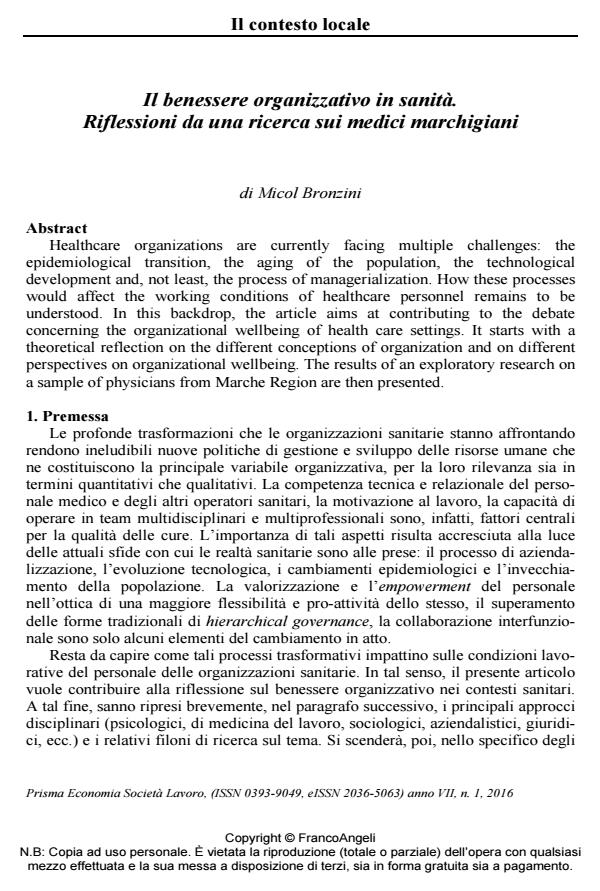
Healthcare organizations are currently facing multiple challenges: the epidemiological transition, the aging of the population, the technological development and, not least, the process of managerialization. How these processes would affect the working conditions of healthcare personnel remains to be understood. In this backdrop, the article aims at contributing to the debate concerning the organizational wellbeing of health care settings. It starts with a theoretical reflection on the different conceptions of organization and on different perspectives on organizational wellbeing. The results of an exploratory research on a sample of physicians from Marche Region are then presented
- Lazarus, R. (1966) Psychological stress and the coping process, McGraw-Hill, New York
- Maggi B., (1990) Razionalità e benessere. Studio interdisciplinare dell’organizzazione, Etas Libri, Milano
- Maggi B., (2003) De l’agir organisationnel. Un point de vue sur le travail, le bien-être, l’apprentissage, Octarès Editions, Toulouse
- Maggi B., (a cura di) (2011) Interpretare l’agire: una sfida teorica, Carocci, Roma
- Maggi B., Rulli G. (2012) L’analisi del lavoro per la prevenzione secondo il Programma “Organization and Well-being”, TAO Digital Library, Bologna
- Marchiori M., Albano, V. Barbini, F.M., (2012) Organizational choices and occupational health and safety risks prevention. An interpretation of Italian regulations, TAO Digital Library, Bologna
- Mayo E., (1933) The Human Problems of an Industrial Civilization, Harvard University Press, Cambridge
- Pascucci P., (2011) “La prevenzione primaria nel decreto legislativo 81/2008, tra ombre e luci”, in B. Maggi, G. Rulli (Eds.), Decreto Legislativo 81/2008. Quale prevenzione nei luoghi di lavoro? TAO Digital Library, Bologna. -- http://amsacta.cib.unibo.it
- Pollitt C., (2000) “Is the Emperor In His Underwear?”, Public Management: An International Journal of Research and Theory, 2(2), pp. 181-200. doi. 10.1080/14719030000000009
- Quadrio A., Pajardi D., (2016) La società ri-pensata, Elsevier Masson Italia
- Rulli G. (ed.), (2014) Teorie sullo stress Rulli Giovanni, TAO Digital Library, Bologna
- Rulli G., (2010) Lo stress nel lavoro: valutazione del rischio e prevenzione, TAO Digital Library, Bologna
- Schein E.H., (1985) Organizational Culture and Leadership, Jossey-Bass, San Francisco
- Simon H.A., (1947) Administrative Behavior, McMillan, New York, (trad. it. Il comportamento amministrativo, il Mulino, Bologna, 1958)
- Smircich L., (1983a) “Organizations as shared meanings”, in L.R. Pondy, P. Frost, G. Morgan, T. Dandridge (eds.) Organizational Symbolism, Jai Press, Greenwich
- Smircich L., (1983b) “Studying organizations as cultures”, in G. Morgan (ed.) Beyond Method: Social Research Strategies, Sage, Beverly Hills
- Smircich L., Morgan G., (1982) “Leadership: The Management of Meaning”. Journal of Applied Behavioral Science, 18(3), pp. 257-73
- Thompson J.D., (1990) L’azione organizzativa, Isedi, Torino
- Van Maanen J., Barley S.R., (1984) “Occupational communities: culture and control in organizations”. Research in Organizational Behavior, 6, pp. 287-365
- Vicarelli G., (2011) “Le politiche sanitarie” in U. Ascoli (a cura di), Il welfare in Italia, il Mulino, Bologna.
- Vicarelli G., (2012) [Medici e Manager] Verso un nuovo professionalismo? Cambio, 3, pp. 125-136
- Vicarelli G., (2013) “Verso nuove configurazioni di benessere” in G. Vicarelli (a cura di), Cura e salute. Prospettive sociologiche, Carocci, Roma
- Weber M., (1922) Wirtschaft und Gesellschaft, Mohr, Tubinga (trad. it. Economia e società, Comunità, Milano, 1961)
- Weick K.E., (1979) The Social Psychology of Organizing, McGraw-Hill, New York
- Bronzini M., (2016) “Relazioni di cura e modelli di attivazione”, in G. Vicarelli (a cura di), Oltre il coinvolgimento. L’attivazione del cittadino nelle nuove configurazioni di benessere, il Mulino, Bologna, pp.141-166
- Brunson N., (1982) “The Irrationality of Action and Action Rationality: Decisions, Ideologies and Organizational Actions”. Journal of Management Studies, 19(1), pp. 29-44
- Consiglio Nazionale delle Ricerche (CNR), (2012) Il benessere, il clima e la cultura delle organizzazioni: significati ed evoluzione in letteratura, Roma
- Crozier M., Friedberg E., (1978) Attore sociale e sistema: sociologia dell’azione organizzata, Etas, Milano
- Deccache A., Ballekom K. Van, (2010) “From patient compliance to empowerment and consumer’s choice: Evolution or regression? An overview of patient education in French speaking European countries”. Patient Education and Counselling, 78(3), pp. 282-287
- Diefenbach T., (2009) “New public management in public sector organisations – the dark sides of managerialistic ‘enlightenment’”, Public Administration, 87(4), pp. 892-909.
- Faïta D., Maggi B., (2007) Un débat en analyse du travail. Deux méthodes en synergie dans l’étude d’une situation d’enseignement, Octarès Editions, Toulouse
- FIASO, (2015) Promozione della salute organizzativa nelle Aziende sanitarie in tempo di crisi. Dati oggettivi, azioni di contrasto e sperimentazioni di conciliazione vita lavorativa-vita privata, Roma
- Freidson E., (2011) Professionalism, the Third Logic, Polity Press, Cambridge
- Friedmann G., (1946) Problèmes humains du machinisme industriel, Gallimard, Parigi (trad. it. Problemi umani del macchinismo industriale, Einaudi, Torino, 1949)
- Gruman J., Rovner M.H., French M.E., Jeffress D., Sofaer S., Shaller D., Prager D.J., (2010) “From patient education to patient engagement: Implications for the field of patient education”. Patient Education and Counselling, 78(3), pp. 350-356
- Haque M.S., (1999) “Ethical Tension in Public Governance: Critical Impacts on Theory-Building”, Administrative Theory & Praxis, 21(4), 468-73
- Hoggett P., (1996) “New Modes of control in the Public Service”, Public Administration, 74, pp. 9-32.
- INAIL, (2011) Valutazione e gestione del rischio da stress lavoro-correlato, Milano
- Jaffe D.T., (1995) “The healthy company. Research paradigms for personal and organizational health”, in S.L. Sauter, L.R. Murphy, Organizational risk factors for job stress, APA, Washington, pp. 13-39
- Jorgensen T., (1999) “The Public Sector in a In-Between Time: Searching for New Public Values”, Public Administration, 77(3), pp. 565-84
- Karasek R.A., (1979) “Job demands, job decision latitude, and mental strain: implications for job redesign”, Administrative Science Quarterly, 24, pp. 285-307
- Karasek R.A., (1998) “Demand/control model: a social, emotional and physiological approach to stress risk and active behavior development”, in J.M. Stellman (Ed.), Encyclopaedia of occupational health and safety, 24.6-34.14, International Labour Office, Geneve
- Kets de Vries M.F.R., Miller, D., (1984) The neurotic organization, Jossey-Bass, San Francisco
- Kirkpatrick I., (1999) “The worst of both world? Public services without Markets or Bureaucracy”, Public Money & Management, 19(4), pp. 7-14
- Kirkpatrick I., Ackroyd S., Walker R., (2005) The New Managerialism and Public Service Professions. Change in Health, Social Services and Housing, Palgrave, London
- AA.VV, (2012) Laboratorio FIASO. Sviluppo e tutela del benessere e della salute organizzativa nelle Aziende Sanitarie, Edizioni Iniziative Sanitarie, Roma
- Avallone F., Bonaretti M., (2003) Benessere Organizzativo. Per migliorare la qualità del lavoro nelle amministrazioni pubbliche, Rubbettino, Roma
- Bauman Z., (2002) Modernità liquida, Laterza, Roma-Bari
Micol Bronzini, Il benessere organizzativo in sanità. Riflessioni da una ricerca sui medici marchigiani in "PRISMA Economia - Società - Lavoro" 1/2016, pp 90-114, DOI: 10.3280/PRI2016-001008