The three-dimensionality of integration policies: the process of policymaking in the era of Europeanization
Journal title MONDI MIGRANTI
Author/s Gaia Testore
Publishing Year 2018 Issue 2018/1
Language Italian Pages 20 P. 67-86 File size 191 KB
DOI 10.3280/MM2018-001004
DOI is like a bar code for intellectual property: to have more infomation
click here
Below, you can see the article first page
If you want to buy this article in PDF format, you can do it, following the instructions to buy download credits
FrancoAngeli is member of Publishers International Linking Association, Inc (PILA), a not-for-profit association which run the CrossRef service enabling links to and from online scholarly content.
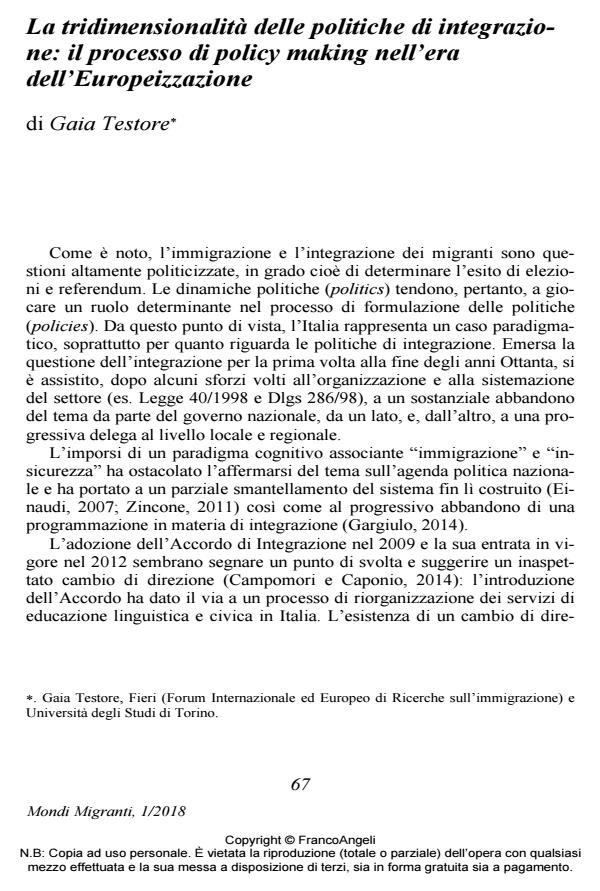
Migrant integration is a politicized issue: hence, the political dynamics and the politics play an important role in the policymaking process. Italy represents a valuable example: for a long time national government has been reluctant to deal with the migrant integration issue, mainly because of a dominant security paradigm. In 2009, the Integration Agreement was adopted: this national policy marked a change in the migrant integration policy approach, interrupting the regionalization of these policies. The analysis of the policymaking process highlights the gap between the policy announcement and the implementation, the impact of the Europeanization in the process and notably of the Eif. In other words, the research shows one of the parallel dynamics of Europeanization: it is able to impact on the balance of power but also between the different stages of the policymaking process.
Keywords: Integration; migrant, Europeanization; policies; Eif; Italy.
- Caponio T., Hunter A. and Verbeek S. (2015). (De) constructing Expertise: Comparing Knowledge Utilization in the Migrant Integration “Crisis”. Journal of Comparative Policy Analysis: Research and Practice, 17, 1: 26-40; DOI: 10.1080/13876988.2014.889902
- Caponio T., Testore G. and Wisthaler V. (2018). IGR in Italy. A case study of Piedmont and South Tyrol (in corso di referaggio).
- Carmagnani M. e Pastore F., a cura di (2018). Migrazioni in Europa: Instabilità e Innovazione. Firenze: Olschki (in corso di pubblicazione).
- Carmel E. (2011). European Union migration governance: utility, security and integration. In: Carmel E., Cerami A. and Papadopoulos T., eds., cit.
- Carmel E., Cerami A. and Papadopoulos T., eds. (2011). Migration and welfare in the new Europe: Social protection and the challenges of integration. Bristol: The Policy Press.
- Crozier M., Thoenig J. (1976). The Regulation of Complex Organized Systems. Administrative Science Quarterly, 21, 4: 547-570; DOI: 10.2307/2391716
- Einaudi L. (2007). Le politiche dell'immigrazione in Italia dall'Unità a oggi. Bari: Laterza.
- Favell A. (1998). The Europeanisation of immigration politics. European Integration online Papers (EIoP), 2, 10.
- Finotelli C., Sciortino G. (2009). Importance of Being Southern: The Making of Policies of Immigration Control in Italy. European Journal of Migration and Law, 11, 2: 119-138; DOI: 10.1163/157181609X439998
- Gargiulo E. (2014). Dall'inclusione programmata alla selezione degli immigrati: le visioni dell'integrazione nei documenti di programmazione del governo italiano. Polis, 28, 2: 221-250.
- Geddes A. (2008). Il rombo dei cannoni? Immigration and the centre-right in Italy. Journal of European Public Policy, 15, 3: 349-366; DOI: 10.1080/13501760701847416
- Geddes A., Guiraudon V. (2004). Britain, France, and EU Anti-discrimination Policy: the Emergence of an EU Policy Paradigm. West European Politics, 27, 2: 334-353; DOI: 10.1080/0140238042000214937
- Geddes A., Scholten P. (2013). Policy Analysis and Europeanization: An Analysis of EU Migrant Integration Policymaking. Journal of Comparative Policy Analysis: Research and practices, 17, 1: 41-59; DOI: 10.1080/13876988.2013.849849
- Graziano P., Vink M. (2007). Europeanization: new research agendas. Houndmills: Palgrave Macmillan.
- Guiraudon V. (2003 [2010]). The constitution of a European immigration policy domain: a political sociology approach. In: Martiniello M. and Jan R., eds., cit.
- Hall P.A. (1993). Policy paradigms, social learning, and the state: the case of economic policymaking in Britain. Comparative politics, 275-296; DOI: 10.2307/422246
- Hepburn E. and Zapata-Barrero R., eds. (2014). The politics of immigration in multi-level states. London: Palgrave Macmillan.
- Joppke C. (2007). Beyond national models: Civic integration policies for immigrants in Western Europe. West European Politics, 30, 1: 1-22; DOI: 10.1080/01402380601019613
- Kaunert C., Léonard S. (2012). The development of the EU asylum policy: venue-shopping in perspective. Journal of European Public Policy, 19, 9: 1396-1413; DOI: 10.1080/13501763.2012.677191
- Kingdon J.W. [(1984)2011]. Agendas, alternatives, and public policies. New York: Longman Classics in Political Science.
- Lavenex S. (2001). The Europeanization of refugee policies: Normative challenges and institutional legacies. Jcms: Journal of Common Market Studies, 39, 5: 851-874; DOI: 10.1111/1468-5965.00334
- Martiniello M. and Jan R., eds. (2010), Selected studies in international migration and immigrant incorporation. vol. 1. Amsterdam, Amsterdam University Press.
- Permoser J.M. (2012). Civic Integration as Symbolic Politics: Insights from Austria. European Journal of Migration and Law, 14, 2: 173-198; DOI: 10.1163/157181612X642367
- Regonini G. (2001). Capire le politiche pubbliche. Bologna: il Mulino.
- Rossi E., Biondi Dal Monte F. e Vrenna M., a cura di (2013). La governance dell’immigrazione. Diritti, politiche e competenze. Bologna: il Mulino.
- Sabatier P.A. (1998). The advocacy coalition framework: revisions and relevance for Europe, Journal of European Public Policy, 5, 1: 98-130; DOI: 10.1080/13501768880000051
- Scharpf F.W. (1997). Games Real Actors Play: Actor-Centered Institutionalism in Policy Research. Boulder, CO: Westview Press.
- Scholten P.W. (2013). Agenda dynamics and the multi-level governance of intractable policy controversies: the case of migrant integration policies in the Netherlands. Policy Sciences,46, 3: 217-236;
- Schon D.A., Rein M. (1995). Frame reflection: Toward the resolution of intractrable policy controversies. New York: Basic Books.
- Sciortino G., Colombo A. (2004). The flows and the flood: the public discourse on immigration in Italy, 1969-2001. Journal of Modern Italian Studies, 9, 1: 94-113; DOI: 10.1080/1354571042000179209
- Stone D. (1989). Causal Stories and the Formation of Policy Agendas. Political Science Quarterly, 104, 2: 281-300; DOI: 10.2307/2151585
- Teisman G.R. (2000). Modes for research into decision-making process: on phases, streams and decision-making rounds, Public Administration, 78, 4: 937-956; DOI: 10.1111/1467-9299.00238
- Testore (2015). ‘In vogue’ and ‘versatile’ The spread of the civic integration policies to Italy, PhD. Tesi. Dipartimento di Cultura Politica Società, Università di Torino and Faculté des Sciences Sociales et Politiques, Université Libre de Bruxelles.
- Testore (2018). Il Fondo Fei e la gestione dell'integrazione Analisi dell'implementazione di una politica europea. In: Carmagnani M. e Pastore F., a cura di, cit.
- Vrenna M. (2013). Le regioni di fronte all’immigrazione: line di tendenza degli ultimi anni. In: Rossi E., Biondi Dal Monte F. e Vrenna M., a cura di, cit.
- Zetter R. (2009). La securitizzazione e le politiche europee in materia di asilo e rifugiati. Mondi Migranti, 3: 7-25; DOI: 10.3280/MM2009-003001
- Zincone G. (2011). The Case of Italy. In: Zincone G., Penninx R. and M. Borkert, editor, cit.
- Zincone G. (2006). The making of policies: Immigration and immigrants in Italy. Journal of Ethnic and Migration Studies, 32, 3: 347-375; DOI: 10.1080/13691830600554775
- Zincone G., Di Gregorio L. (2002). Il processo delle politiche di immigrazione in Italia: uno schema interpretativo integrato. Stato e mercato, 22, 3: 433-466; DOI: 10.1425/8091
- Zincone G., Penninx R. and M. Borkert, eds. (2011). Migration Policymaking in Europe: the Dynamics of Actors and Contexts in Past and Present. Amsterdam, Amsterdam University Press.
- Anderson J.E. (1984). Public policy and politics in America. Harcourt Brace.
- Block L., Bonjour S. (2013). Fortress Europe or Europe of rights? The Europeanisation of family migration policies in France, Germany and the Netherlands. European Journal of Migration and Law, 15, 2: 203-224; DOI: 10.1163/15718166-12342031
- Bonjour S., Vink M. (2013). When Europenization backfires: the normalization of European migration politics. Acta Politica, 48, 4: 389-407;
- Boswell C. (2009). The political uses of expert knowledge: Immigration policy and social research. Cambridge: Cambridge University Press
- Boswell C., Geddes A. (2010). Migration and mobility in the European Union. London: Palgrave Macmillan.
- Brunsson N. (1993). Ideas and actions: Justification and hypocrisy as alternatives to control. Accounting, Organizations and Society, 18, 6: 489-506; DOI: 10.1016/0361-3682(93)90001-M
- Campomori F. (2007). Il ruolo di policy-making svolto dagli operatori dei servizi per gli immigrati. MondiMigranti, 3: 83-106.
- Campomori F., Caponio T. (2014). Migrant Reception Policies in a Multilevel System: Framing and Implementation Structures in the Italian Regions. In: Hepburn E. and Zapata-Barrero R., editor, cit.
- Campomori F., Caponio T. (2013). Competing frames of immigrant integration in the EU: geographies of social inclusion in Italian regions. Policy Studies, 34, 2: 162-179; DOI: 10.1080/01442872.2013.767586
- Caponio T. (2007). La gestione locale delle politiche di soggiorno. Poste in gioco, attori e logiche di azione in alcune province del Piemonte. Mondi Migranti, 3, 107-129.
Gaia Testore, La tridimensionalità delle politiche di integrazione: il processo di policy making nell’era dell’Europeizzazione in "MONDI MIGRANTI" 1/2018, pp 67-86, DOI: 10.3280/MM2018-001004