Università, terza missione e sviluppo economico: le spin-off accademiche italiane
Journal title PRISMA Economia - Società - Lavoro
Author/s Francesca Zanier
Publishing Year 2019 Issue 2018/1-2
Language Italian Pages 23 P. 46-68 File size 300 KB
DOI 10.3280/PRI2018-001004
DOI is like a bar code for intellectual property: to have more infomation
click here
Below, you can see the article first page
If you want to buy this article in PDF format, you can do it, following the instructions to buy download credits
FrancoAngeli is member of Publishers International Linking Association, Inc (PILA), a not-for-profit association which run the CrossRef service enabling links to and from online scholarly content.
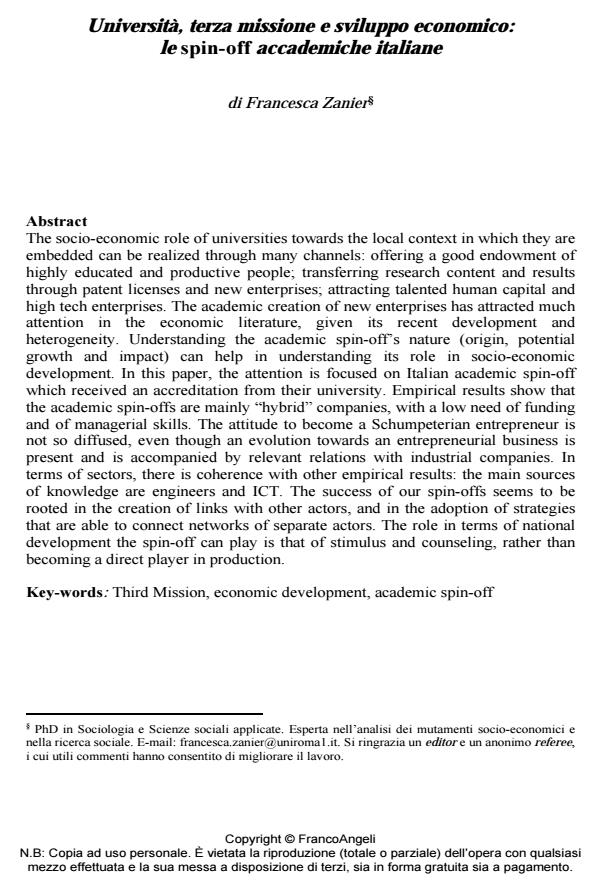
The socio-economic role of universities towards the local context in which they are embedded can be realized through many channels: offering a good endowment of highly educated and productive people; transferring research content and results through patent licenses and new enterprises; attracting talented human capital and high tech enterprises. The academic creation of new enterprises has attracted much attention in the economic literature, given its recent development and heterogeneity. Understanding the academic spin-off’s nature (origin, potential growth and impact) can help in understanding its role in socio-economic development. In this paper, the attention is focused on Italian academic spin-off which received an accreditation from their university. Empirical results show that the academic spin-offs are mainly "hybrid" companies, with a low need of funding and of managerial skills. The attitude to become a Schumpeterian entrepreneur is not so diffused, even though an evolution towards an entrepreneurial business is present and is accompanied by relevant relations with industrial companies. In terms of sectors, there is coherence with other empirical results: the main sources of knowledge are engineers and ICT. The success of our spin-offs seems to be rooted in the creation of links with other actors, and in the adoption of strategies that are able to connect networks of separate actors. The role in terms of national development the spin-off can play is that of stimulus and counseling, rather than becoming a direct player in production.
Keywords: Third Mission, economic development, academic spin-off
- Ramaciotti L., (2006) Creare valore all’università. Alte tecnologie, creazione d’impresa e nuovo sviluppo locale in Emilia Romagna, FrancoAngeli, Milano
- Ramaciotti L., Rizzo U., (2015) “The Determinants of Academic Spin-off Creation by Italian Universities”, R and D Management, 45, pp.501-514
- Regini M., (2015) “Conseguenze non previste delle riforme: i mutamenti della governance universitaria in Europa”, Stato e Mercato, 2, Agosto, pp. 159-188
- Rostan M., (Ed.) (2011) La professione accademica in Italia: Aspetti, problemi e confronti nel contesto europeo, LED Edizioni Universitarie
- Rostan M., Vaira M., (2010) “Gli spin-off universitari in Italia: un possibile contributo allo sviluppo”, Sociologia del lavoro, n°118, p. 55-66
- Rothaermel F.T., Agung S.D., Jiang L., (2007). “University entrepreneurship: a taxonomy of the literature”. Industrial and corporate change,16(4), pp. 691-791
- Schartinger D., Rammera C., Fischer M.M., Fröhlich J., (2002) “Knowledge interactions between universities and industry in Austria: Sectoral patterns and determinants”, Research Policy, V, 31, 303-328
- Shane S.A., (2004) Academic Entrepreneurship: University Spinoffs and Wealth Creation, Edward Elgar Publishing
- Steiner P., (2012) Introduzione alla sociologia economica, Bologna, il Mulino
- Trigilia C., (1999) “Capitale sociale e sviluppo locale”, Stato e Mercato, Vol. 19, pp. 419-440
- Trigilia C, Burroni L., (2010) Le città dell’innovazione in Italia e in Europa, Rapporto di Artimino sullo Sviluppo Locale
- Trigilia C., Ramella F., (a cura di) (2010) Imprese e territori dell’alta tecnologia in Italia, Incontri di Artimino, il Mulino, Bologna
- Varaldo R., Di Minin A., (2009). “A new form of entrepreneurial capitalism based on innovation and Research in Italy”, Finmeccanica Occasional Paper
- Wright M., Clarysse B., Lockett A., Knockert M., (2008) “Mid-range universities’ in Europe linkages with industry: Knowledge types and the role of intermediaries”. Research Policy, V, 37(8), 1205-1223
- Zanier F., (2016). “Ricerca Scientifica e fare impresa: Spin-off, Terza Missione e Sviluppo Territoriale. Tesi di Dottorato in Sociologia e Scienze Sociali Applicate, Università degli studi di Roma ‘Sapienza’
- Zanier F., Violante A., (2017) “Le spin-off di ricerca e la loro sopravvivenza, Argomenti, (6), pp. 125-150
- Lester R. K., (2005) Universities, innovation, and the competitiveness of local economies. Industrial Performance Center Working Paper 05-010, Massachusetts Institute of Technology (December).
- Lester R.K., Piore M.J., (2004) Innovation – The Missing Dimension, Harvard University Press
- Marra C., Turcio S., (2016) “Insider e outsider nel mercato del lavoro italiano”, Argomenti, 4, pp. 89-134
- Moscati R., (2010) (a cura di) Come e perchè cambiano le università in Italia e in Europa. Nuove politiche dell’istruzione superiore e resistenza al cambiamento, Liquori, Napoli
- Muscio A., (2008) “Il trasferimento tecnologico in Italia: risultati di un’indagine sui dipartimenti universitari”, L’industria / n.s., a. XXIX
- Muscio A., Quaglione D., Vallanti G., (2015) “University regulation and university-industry interaction: a performance analysis of Italian academic departments”, Industrial and Corporate Change, 24, pp.1047-1079
- Mustar P., Renault M., Colombo M.G., Piva E., Fontes M., Lockett A., Moray N., (2006) “Conceptualising the heterogeneity of research-based spin-offs: A multi-dimensional taxonomy”, Research Policy, 35(2), pp.289-308
- Mustar P., Wright M., Clarysse B., (2008) “University spin-off firms: lessons from ten years of experience in Europe”, Science and Public Policy, 35(2), pp. 67-80
- Mutti A., (1998) Capitale sociale e sviluppo: la fiducia come risorsa, Bologna, il Mulino
- Netval, (2013) Seminiamo ricerca per raccogliere innovazione
- Netval, (2014) Unire i puntini per completare il disegno dell’innovazione
- Netval, (2015) Protagonisti dell’ecosistema dell’innovazione?
- Netval, (2016) Ricerca, valorizzazione dei risultati ed impatti
- Netval, (2017) La rete del trasferimento tecnologico si rafforza con la clinica innovation
- Nicolaou N., Birley S., (2003) “Academic networks in a trichotomous categorisation of università spinout”, Journal of Business venturing, Vol. 18, pp. 333-359
- Nosella, A., Grimaldi R., (2009). “University-level mechanisms supporting the creation of new companies: an analysis of Italian academic spin-offs”, Technology Analysis & Strategic Management, 21(6), pp. 679-698
- Oakey R., (2003) “Technical entrepreneurship in high technology small firms: some observations on the implications for management”, Technovation, Vol. 23, pp. 679-688
- Oakey R., (2007) “Clustering and the R&D management of high‐technology small firms: in theory and practice”. R&D Management, 37(3), pp. 237-248
- O’Shea R.P., Allen T.J., Chevalier A., Roche F., (2005) “Entrepreneurial orientation, technology transfer, and spin-off performance of US Universities”, Research Policy, 34(7), pp. 994-1009.
- Orazi F., (2012) “Innovazione tecnologica e governance: il ruolo dell’università nel rilancio delle economie locali”, Sociologia del lavoro, n° 125, pp. 155-173
- Piccaluga A., (2001) La valorizzazione della ricerca scientifica: come cambia la ricerca pubblica e quella industriale, FrancoAngeli, Milano
- Piccaluga A., Balderi C., (2006) “Consistenza ed Evoluzione delle Imprese Spin-off della Ricerca pubblica in Italia, Laboratorio InSat – Finlombarda
- Pirnay F., Surlemont B., Nlemvo F., (2003) “Toward a Typology of University Spin-offs”, Small Business Economics, Vol. 21, pp. 355-369
- Ramella F., (2013) Sociologia dell’innovazione economica, il Mulino, Bologna
- Balderi C., Patrono A., Piccaluga A., (2011) “La ricerca pubblica e le sue perle: le imprese spin-off in Italia, Quaderni dell’Istituto di Management
- Bishop K., D’Este P., Neely A., (2011) “Gaining from interactions with universities: Multiple methods for nurturing absorptive capacity”, Research Policy, V, 40(1), 30-40
- Boffo S., Moscati R., (2015) “La Terza Missione dell’università. Origini, problemi e indicatori”, Scuola Democratica, 2, maggio-agosto
- Bonaccorsi A., (2003) (a cura di) Il sistema della ricerca pubblica in Italia, Milano, FrancoAngeli
- Bullock M., (1983) Academic Enterprice, Industrial Innovation and the development of High Technology Financing in the United States, London, Brand Brothers
- Burroni L., Trigilia C., (2011) (a cura di) Le città dell’innovazione. Dove e perché cresce l’alta tecnologia in Italia, Bologna, il Mulino.
- Calza Bini P., (2001) “Diversità socio territoriali e sistemi di welfare”, Argomenti, vol. 1, pp. 29-42.
- Calza Bini P., (2010a) “Quale sviluppo? Quale Locale? Ripensando i sistemi territoriali nel terzo millennio”. Argomenti, vol. 30, pp. 119-147
- Calza Bini P., (2010b) “Introduzione”. In: Fulvio Pellegrini. Sociologia Economica. Contesti, attori, processi, pp. 5-8, Roma, Kappa
- Calza Bini P., (2011) “Quale modello di sviluppo? Un analisi delle dinamiche tra globale e locale”. Economia & diritto agroalimentare, vol. 3, pp. 317-331
- Cesaroni F., Conti G., Piccaluga A., (2005) “Technology transfer offices (TTO) in Italian universities: What they do and how they do it.” Paper presentato alla 5th Triple Helix Conference: “The capitalization of knowledge: Cognitive, economic, social and cultural aspects”, Torino, Maggio 18-21
- Chesbrough H., Vanhaverbeke W., West J., (2006) Open innovation: Researching a new paradigm, Oxford University Press on Demand
- Clark B.R., (2004) “Delineating the Character of the Entrepreneurial University”, Higher Education Policy, Vol. 17, 4, pp. 355-370
- CNVSU, (2012) XI Rapporto del sullo stato del Sistema Universitario. -- Online: http://www.cnvsu.it
- Colombo S., (2010) “Università e contesto socio-economico nel Regno Unito. Il contributo della ricerca universitaria allo sviluppo”, Sociologia del lavoro, Vol. 118, pp. 67-79
- Conti G., Granieri M., Piccaluga A., (2012) La gestione del trasferimento tecnologico: strategie, modelli e strumenti, Springer Science & Business Media
- DjoKovic D., Souitaris V., (2008) “Spinouts from academic institutions: a literature review with suggestions for further research”, Journal of Technology Transfer, 33, pp. 225-247
- Druihle C., Garnsey E., (2004) “Do Academic spin-outs Differ and Does it Matter?”, Journal of Technology Transfer, 29, pp. 269-285
- Etzkowitz H., (2003) “Research groups as ‘quasi-firms’: the invention of the entrepreneurial university”, Research policy, 32(1), pp. 109-121
- Etzkowitz H., (2008) The triple helix: university-industry-government innovation in action, Routledge
- Etzkowitz H., (2014) “The entrepreneurial university wave: From ivory tower to global economic engine”, Industry and Higher Education, 28(4), pp. 223-232
- Etzkowitz H., Leydesdorff L., (2000) “The dynamics of innovation: from National Systems and “Mode 2” to a Triple Helix of university-industry-government relations”, Research Policy
- Fadda S., (2016) “Labour coefficients reduction and working time reduction” Argomenti, (4), pp. 67-87
- ANVUR, (2014) Rapporto sullo stato del sistema universitario e della ricerca 2013, Roma.
- ANVUR, (2016) Rapporto biennale sullo stato del Sistema universitario e della ricerca.
- Bagnasco A., (2004) “Città in cerca di università. Le università regionali e il paradigma dello sviluppo locale”, Stato e Mercato, n. 3, pp. 455-474
- Bagnasco A., (2006) “Imprenditorialità e capitale sociale: il tema dello sviluppo locale”, Stato e mercato, Vol. 78
- Feldman M., Feller I., Bercovitz J., Burton R., (2002) “Equity and the Technology Transfer Strategies of American Research Universities”, Management Science, 48(1), pp. 105-121.
- Fini R., Grimaldi R., Santoni S., Sobrero M., (2011) “Complements or substitutes? The role of universities and local context in supporting the creation of academic spin-offs”, Research Policy, 40(8), pp. 1113-1127
- Fini R., Grimaldi R., Sobrero M., (2009) “Factors fostering academics to start up new ventures: an assessment of Italian founders’ incentives”, Journal Technology Trasfer, 34, pp. 380-402
- Florida R., Cohen, W.M., (1999) “Engine or infrastructure? The university role in economic development”, in Branscomb L.M., Kodama F., Florid R., (Eds.), Industrializing Knowledge: University-Industry Linkages in Japan and the United States, MIT Press, 589-610
- Gherardini A., (2012). “Andante ma non troppo. L’apertura delle università italiane alle imprese”, Stato e mercato, pp. 465-501
- Gherardini A., (2015) Squarci nell’avorio. Le università italiane e l’innovazione economica, Firenze University Press
- Grandi A., Grimaldi R., (2003) “Exploring the networking characteristics of new ventures founding teams: a study of italian academic spin-off”, Small Business Economics, 21, pp. 329-341
- Grandi A., Grimaldi R., (2005) “Academic organizational characteristics and the generation of successful business idea”, Journal of Business Venturing, 20(6), pp 821-845
- Grimaldi R., Kenney M., Siegel D.S., Wrigt M., (2011) “30 years after Bayh-Dole: Reassessing academic entrepreneurship”, Research Policy, 40, pp. 1045-1057
- Guarascio D., Fana M., Cirillo V., (2016) “La crisi e le riforme del mercato del lavoro in Italia: un’analisi regionale del Jobs Act”, Argomenti, (5), pp. 29-56
- Guena A., Muscio A., (2009) “The Governance of University Knowledge Transfer: a critical Review of the literature”, Minerva, 47, pp. 93-114
- Heirman A., Clarysse B., (2004) Do Intangible Assets and Pre-founding R&D Efforts Matter for Innovation Speed in Start-Ups? Working Paper
- Higher Education Funding College of England (HEFCE), (2011) Ref 2014. Assessment Framework, guidance on submissions, -- estratto da http://www.hefce.ac.uk/research/ref/pubs/2011/03_11/
- Iacobucci D., Iacopini A., Micozzi A., Orsini S., (2011) “Fostering Entrepreneurship in Academic SpinOffs”, International Journal of Entrepreneurship and Small Business, 12, pp. 513-533
- Iacobucci D., Micozzi A., (2015) ‘How to Evaluate the Impact of Academic Spin-Offs on Local Development: An Empirical Analysis of the Italian Case’, Journal of Technology Transfer, 40, pp. 434-452
- Iacobucci D., Micozzi, A.. Micucci G., (2013) ‘Gli Spin-off Universitari in Italia: Un quadro del fenomeno e un’analisi della governance e della performance’, L’industria, 34, pp.761-784.
- Krabel S., Mueller P., (2009) “What drives scientists to start their own company?: An empirical investigation of Max Planck Society scientists”, Research Policy, 38(6), pp. 947-956
- Lawton Smith H., (2007) “Universities, innovation and territorial development: a review of the evidence”, Environment and Planning C: Government and Policy, 25, pp. 98-114
- Lawton Smith H., (2011) “High technology entreprenuership, universities and the development of the Oxford city-region”, Stato e Mercato, 3, pp. 451-478
- Lazzeri F., Piccaluga A., (2012) “Le imprese spin-off della ricerca pubblica: convinzioni, realtà e prospettive future”, Economia e società regionale, 1, pp. 43-65
Francesca Zanier, Università, terza missione e sviluppo economico: le spin-off accademiche italiane in "PRISMA Economia - Società - Lavoro" 1-2/2018, pp 46-68, DOI: 10.3280/PRI2018-001004