La crisi ed il declino italiani. Dibattito ed evidenze recenti
Journal title PRISMA Economia - Società - Lavoro
Author/s Nicola Matteucci
Publishing Year 2019 Issue 2018/1-2
Language Italian Pages 20 P. 77-96 File size 274 KB
DOI 10.3280/PRI2018-001006
DOI is like a bar code for intellectual property: to have more infomation
click here
Below, you can see the article first page
If you want to buy this article in PDF format, you can do it, following the instructions to buy download credits
FrancoAngeli is member of Publishers International Linking Association, Inc (PILA), a not-for-profit association which run the CrossRef service enabling links to and from online scholarly content.
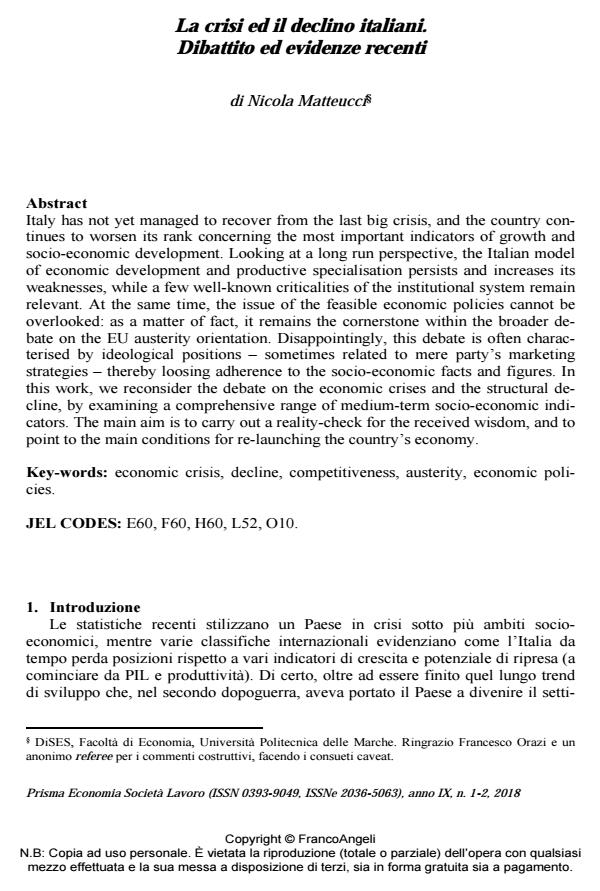
Italy has not yet managed to recover from the last big crisis, and the country con-tinues to worsen its rank concerning the most important indicators of growth and socio-economic development. Looking at a long run perspective, the Italian model of economic development and productive specialisation persists and increases its weaknesses, while a few well-known criticalities of the institutional system remain relevant. At the same time, the issue of the feasible economic policies cannot be overlooked: as a matter of fact, it remains the cornerstone within the broader de-bate on the EU austerity orientation. Disappointingly, this debate is often charac-terised by ideological positions - sometimes related to mere party’s marketing strategies - thereby loosing adherence to the socio-economic facts and figures. In this work, we reconsider the debate on the economic crises and the structural de-cline, by examining a comprehensive range of medium-term socio-economic indi-cators. The main aim is to carry out a reality-check for the received wisdom, and to point to the main conditions for re-launching the country’s economy
Keywords: Economic crisis, decline, competitiveness, austerity, economic policies.
Jel codes: E60, F60, H60, L52, O10
- Dosi G., Pereira M.C., Roventini A., Virgillito M.E., (2017) “When More Flexibility Yields More Fragility: The Microfoundations of Keynesian Aggregate Unemployment”, Journal of Economic Dynamics and Control, Vol. 81, pp. 162-186
- Felice E., (2015) Ascesa e declino. Storia economica d’Italia, il Mulino, Bologna
- Franzini M., (2013) Disuguaglianze inaccettabili. L’immobilità economica in Italia, Laterza, Bari
- Franzini M., Pianta M., (2015) “La disuguaglianza: fatti e interpretazioni”, Rivista delle Politiche Sociali, n. 4, pp. 11-31
- Freeman C., Perez C., (1988) “Structural Crises of Adjustment, Business Cycles and Investment Behaviour”, in Dosi G., Freeman C., Nelson R, Silverberg G., Soete L. (eds.), Technical Change And Economic Theory, Pinter Publishers, London and New York
- Fuà G., Zacchia C., (a cura di) (1983) L’industrializzazione senza fratture, il Mulino, Bologna
- Gallino L., (2003) La scomparsa dell’Italia industriale, Einaudi, Torino
- Gallo R., (2016) Torniamo a industriarci. A novant'anni dalla «grande crisi», Guida editori
- Giannetti R., (1998) Tecnologia e sviluppo economico italiano: 1870-1990, il Mulino, Bologna
- Groenewegen J., van der Steen M., (2006) “The Evolution of National Innovation Systems”, Journal of Economic Issues, Vol. 40(2), pp. 277-285
- Guarascio D., Sacchi S., (2018) “Le piattaforme digitali in Italia. Un’analisi della dinamica economica e occupazionale”, INAPP Policy Brief, n. 8, giugno, -- disponibile a: https://inapp.org/it/inapp-comunica/notizie/gig-economy-accompagnare-il-lavoro-che-cambia
- InCiSE, (2018) International Civil Service Effectiveness (InCiSE) Index, 2017, Main Report, -- disponibile a: https://www.bsg.ox.ac.uk/about/partnerships/international-civil-service-effectiveness-index
- ISTAT, (2017a) Conti economici nazionali per settore istituzionale, 11 aprile, Roma
- ISTAT, (2017b) Rapporto Annuale 2017. La situazione del Paese, maggio, Roma
- ISTAT, (2017c) Spese per consumi delle famiglie, Anno 2016, 6 luglio, Roma
- Kumhof M., Rancière R., Winant P., (2015) “Inequality, Leverage, and Crises”, American Economic Review, Vol. 105(3), pp. 1217-45
- Lucchese M., Nascia L., Pianta M., (2016) “Industrial Policy and Technology in Italy”, Economia e Politica Industriale, Vol. 43(3), pp. 233-260
- Matteucci N., Seri P., (2012) “Crisi e declino nella manifattura italiana: note per l'agenda di ricerca e la politica industriale”, Prisma, Vol. 2012(3), pp. 148-60
- Matteucci N., Seri P., (2015) “Editoriale”, Prisma, Vol. 2015(1), pp.5-18
- Mazzucato M., (2014) Lo Stato Innovatore, Laterza, Bari
- Menghini F., (2017) Le FANGs. Facebook, Amazon, Netflix, Google, Firenze, goWare
- Ministry of Economy and Finance, (MEF) (2015) 2014: A Turning Point for Italy, Rome, February
- Nussbaum M.C., (2012) Creare capacità. Liberarsi dalla dittatura del Pil, il Mulino, Bologna
- Papi L., Sarno E., Zazzaro A., (2017) “The Geographical Network of Bank Organizations: Issues and Evidence for Italy”, in Martin R., Pollard J. (eds.), Handbook on the Geographies of Money and Finance, Edward Elgar, Cheltenham, pp. 156-196
- Perugini C., Hölscher J., Collie S., (2016) “Inequality, Credit and Financial Crises”, Cambridge Journal of Economics, Vol. 40, pp. 227-257
- Reinhart C.M., Rogoff K.S., (2014) “Recovery from Financial Crises: Evidence from 100 Episodes”, American Economic Review, Vol. 104(5), pp. 50-55
- Russo A., (2017) “Introduction to the Special Issue on Large Economic Crises”, Journal of Economic Dynamics and Control, Vol. 81, pp. 1-4
- Russo A., Riccetti L., Gallegati M., (2016) “Increasing Inequality, Consumer Credit and Financial Fragility in an Agent Based Macroeconomic Model”, Journal of Evolutionary Economics, Vol. 26(1), pp. 25-47
- Schmidt V.A., Thatcher M., (eds.) (2013) Resilient Liberalism in Europe’s Political Economy, Cambridge University Press, Cambridge
- Stiglitz J., (2018) “Beyond Secular Stagnation”, 5 Semptember, -- disponibile a: https://www.project-syndicate.org/commentary/stiglitz-beyond-secular-stagnation-larry-summers-debate-by-joseph-e-stiglitz-2018-09?barrier=accesspay
- Summers L.H., (2015) “Demand Side Secular Stagnation”, American Economic Review, Vol. 105 (5), pp. 60-65
- Vivarelli M., Pianta M., (eds.) (2000) The Employment Impact of Innovation: Evidence and Policy, Routledge, London
- Alessandrini P., Zazzaro A., (2009) “Bank Localism and Industrial Districts”, in: Becattini G., Bellandi M., De Propris L. (eds.), A Handbook of Industrial Districts, Edward Elgar, Cheltenham, pp. 471-482
- Ascoli U. Pavolini E., (eds.) (2015) The Italian Welfare State in a Comparative Perspective. A comparative Analysis, Bristol, Policy Press
- Bagnasco A., (1977) Tre Italie. La problematica territoriale dello sviluppo italiano, il Mulino, Bologna
- Balloni V., Crivellini M., Pettenati P., (2013) Un agenda non conformista per la crescita economica, il Mulino, Bologna
- Becattini G., (2007) Il calabrone Italia, il Mulino, Bologna
- Borsa M., De Biase L., (1996), Capitani di sventura, Ed. Oscar, Mondadori, Milano
- Cappelli R., Matteucci N., (2009) “Innovazione tecnologica, organizzazione e produttività nella manifattura italiana: evidenze recenti per l’area NEC”, Economia Marche, n. 2, pp. 115-137
- Centro studi Confindustria, (2012) “Vuoti di domanda e nuovi divari tra le imprese. Manifattura cuore dell’innovazione: torna strategica la politica industriale”, Scenari industriali, n. 3, Giugno, Roma
- Conti G., Modiano P., (2012) “Problemi dei paesi a sviluppo tardivo in Europa: riflessioni sul caso italiano”, L’industria, (n.s.), Vol. XXXIII(2), pp. 221-236
Nicola Matteucci, La crisi ed il declino italiani. Dibattito ed evidenze recenti in "PRISMA Economia - Società - Lavoro" 1-2/2018, pp 77-96, DOI: 10.3280/PRI2018-001006