Naples: Stories, Places and Characters of a Complex City of Cinema
Journal title STORIA URBANA
Author/s Vito Saracino
Online First 6/17/2025 Issue 2024/179
Language Italian Pages 23 P. 1-23 File size 166 KB
DOI 10.3280/SU-18245
DOI is like a bar code for intellectual property: to have more infomation
click here
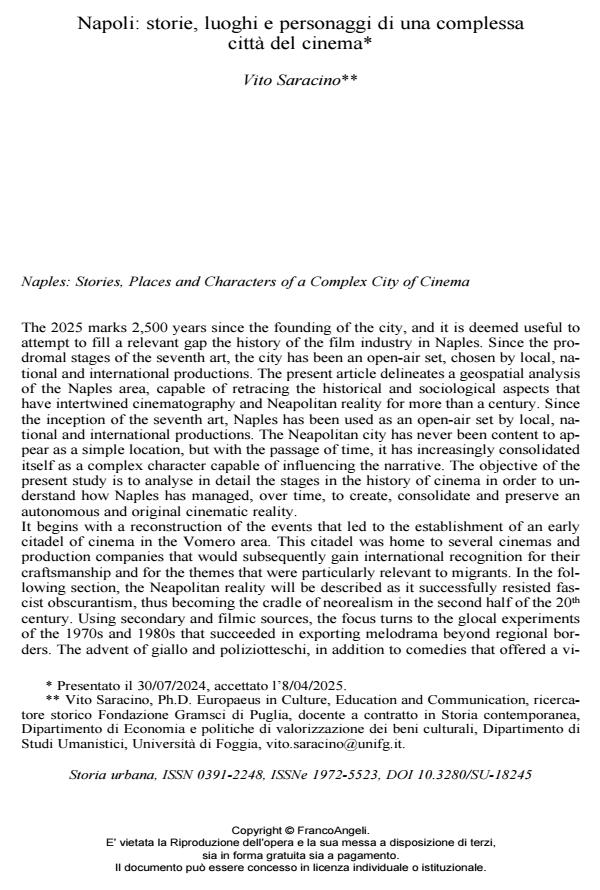
Below, you can see the article first page
If you want to buy this article in PDF format, you can do it, following the instructions to buy download credits
FrancoAngeli is member of Publishers International Linking Association, Inc (PILA), a not-for-profit association which run the CrossRef service enabling links to and from online scholarly content.
The 2025 marks 2,500 years since the founding of the city, and it is deemed useful to attempt to fill a relevant gap the history of the film industry in Naples. Since the pro--dromal stages of the seventh art, the city has been an open--air set, chosen by local, na--tional and international productions. The present article delineates a geospatial analysis of the Naples area, capable of retracing the historical and sociological aspects that have intertwined cinematography and Neapolitan reality for more than a century. Since the inception of the seventh art, Naples has been used as an open--air set by local, na--tional and international productions. The Neapolitan city has never been content to ap--pear as a simple location, but with the passage of time, it has increasingly consolidated itself as a complex character capable of influencing the narrative. The objective of the present study is to analyse in detail the stages in the history of cinema in order to un--derstand how Naples has managed, over time, to create, consolidate and preserve an autonomous and original cinematic reality. It begins with a reconstruction of the events that led to the establishment of an early citadel of cinema in the Vomero area. This citadel was home to several cinemas and production companies that would subsequently gain international recognition for their craftsmanship and for the themes that were particularly relevant to migrants. In the fol--lowing section, the Neapolitan reality will be described as it successfully resisted fas--cist obscurantism, thus becoming the cradle of neorealism in the second half of the 20th century. Using secondary and filmic sources, the focus turns to the glocal experiments of the 1970s and 1980s that succeeded in exporting melodrama beyond regional bor--ders. The advent of giallo and poliziotteschi, in addition to comedies that offered a vision of the city that transcended stereotypes, will also be discussed. The article con-cludes with a discussion of contemporary portrayals of a reality that is increasingly complex and multifaceted, departing from the traditional narrative of a folkloric centre and gloomy suburbs.
Keywords: Media Studies, Southern Italy, History of Cinema, Geospatial Analysis of Cinema, Social History, Cultural Studies.
Vito Saracino, Napoli: storie, luoghi e personaggi di una complessa città del cinema in "STORIA URBANA " 179/2024, pp 1-23, DOI: 10.3280/SU-18245