Learn to desire
Journal title PSICOANALISI
Author/s Simona Argentieri
Publishing Year 2025 Issue 2025/1
Language Italian Pages 13 P. 23-35 File size 81 KB
DOI 10.3280/PSI2025-001002
DOI is like a bar code for intellectual property: to have more infomation
click here
Below, you can see the article first page
If you want to buy this article in PDF format, you can do it, following the instructions to buy download credits
FrancoAngeli is member of Publishers International Linking Association, Inc (PILA), a not-for-profit association which run the CrossRef service enabling links to and from online scholarly content.
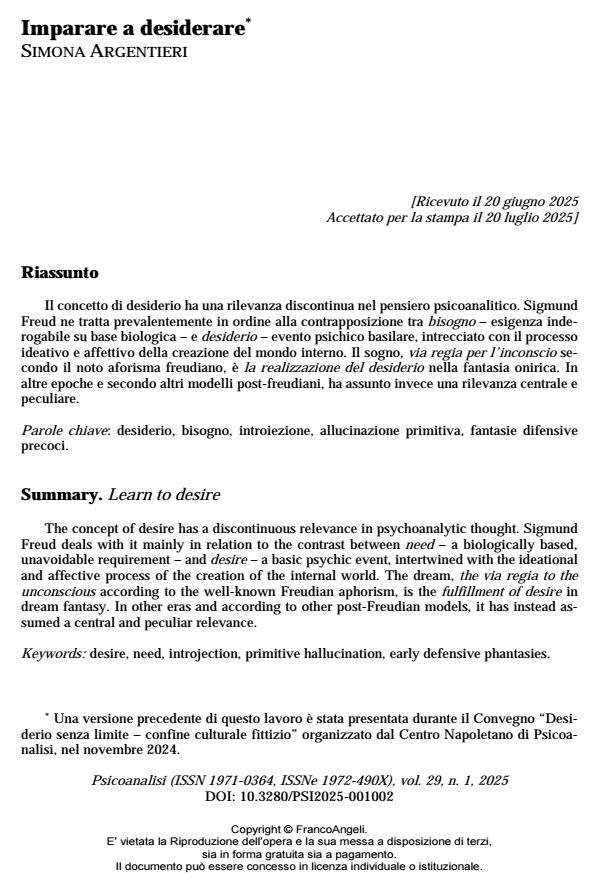
The concept of desire has a discontinuous relevance in psychoanalytic thought. Sigmund Freud deals with it mainly in relation to the contrast between need – a biologically based, unavoidable requirement – and desire – a basic psychic event, intertwined with the ideational and affective process of the creation of the internal world. The dream, the via regia to the unconscious according to the well-known Freudian aphorism, is the fulfillment of desire in dream fantasy. In other eras and according to other post-Freudian models, it has instead assumed a central and peculiar relevance.
Keywords: desire, need, introjection, primitive hallucination, early defensive phantasies.
- Argentieri S. (2006). Meccanismi di difesa e livelli precoci. Psicoanalisi, 10, 1.
- Argentieri S. (2008). L’ambiguità. Torino: Einaudi.
- Argentieri S. (2013). Etica e Bioetica in psicoanalisi. Gli Argonauti, 26, 12: 15-27.
- Argentieri S. (2016). Defence Mechanism and very early levels. In: AA. VV., Reading Italian Psychoanalysis. pp. 601-613. London: Routledge.
- Argentieri S. (2022). Piet Mondrian, Una semplicità molto complicata. In: Andreoli V., Genio e follia, vol. 11, Roma: GEDI editore.
- Argentieri S. (2025). La parola che cura – Uso e maluso della psicoanalisi oggi. La Nave di Teseo, in corso di pubblicazione
- Bleger J. (1967). Simbiosi e ambiguità. Loreto AN: Libera Editrice Lauretana, 1992.
- Canestri J. (2005). Some reflections on the use and meaning of conflict in contemporary psychoanalysis. Psychoanalytic Quarterly, 74.
- Deleuze G. (1989). Bartleby ou la formule. Paris: Flammarion.
- Fairbairn W.D.R. (1952). Studi psicoanalitici sulla personalità. Torino: Boringhieri, 1977.
- Ferraro F. (2020). Analisi in-finita e orizzonte edipico. Milano: FrancoAngeli.
- Freud S. (1907). Il poeta e la fantasia. In: OSF, vol. 5, Torino: Bollati Boringhieri.
- Freud S. (1911). Sui due principi dell'accadere psichico. In: OSF, vol. 6, Torino: Bollati Boringhieri.
- Freud S. (1925). Inibizione, sintomo, angoscia. In: OSF, vol. 10, Torino: Bollati Boringhieri.
- Freud S. (1915). Metapsicologia – L’inconscio. In: OSF, vol. 8, Torino: Bollati Boringhieri.
- Gaddini E. (1981). Fantasie difensive precoci e processo psicoanalitico. In: Scritti 1953-1985, Milano: Raffaello Cortina, 1989.
- Gentile A. (2016). Irriconoscibilità del desiderio / Reminiscenze del corpo. In: Atti del Convegno “Il desiderio preso per la coda: beatitudine, solitudine, intensità - Monastero di Fonte Avellana 23-25 aprile 2016, Nicomp L.E. ed.
- Gosio N. (2020). Nemici miei. La pervasiva rabbia quotidiana. Torino: Einaudi.
- Green A. (2005). Il lavoro del negativo. Roma: Borla.
- Green A. (2010). Illusions et désillusion du travail psychanalytique. Paris: Odile Jacob.
- Greenacre P. (1973). Primal scene and the sense of reality. Psychoanalytic Quarterly, 42, 1: 10-41. (trad. it. Psicoanalisi, 2, 2: 1998). DOI: 10.1080/21674086.1973.1192661
- Laplanche J., Pontalis J.B. (1967). Vocabulaire de la psychanalyse. Paris: Presses Universitaires de France.
- Maccioni L. (2016). La psicoanalisi e il desiderio: breve excursus. In: Nicomp L.E., ed., Atti del Convegno Il desiderio preso per la coda: beatitudine, solitudine, intensità - Monastero di Fonte Avellana 23-25 aprile 2016, pp. 81-89.
- Manfredi Turillazzi S. (1974). Dalle interpretazioni mutative di Strachey alle interpretazioni tra gli oggetti interni. Rivista di Psicoanalisi, 20, 1: 127-143.
- Melville H. (1853). Bartleby lo scrivano. Torino: Einaudi, 1954.
- Sandler J., Sandler A. (2002). Gli oggetti interni – Una rivisitazione. Milano: FrancoAngeli.
- Sandler J. (1983). Reflection on same relation between psychoanalitic concepts and psychoanalitic practice. International Journal of Psycho-Anal., 64: 33-45.
- Sermonti V. (1993). Il Paradiso di Dante. Milano: RCS Rizzoli Libri, p. 47.
- Steiner J. (1993). Psychic Retreats. Pathological Organisation in Psychotic, Neurotic and Borderline Patients. London: Routledge.
- Szpilka J. (1985). Edipo precoce, effetto retroattivo (‘Nachträglichkeit’) e conflitto psichico. Rivista di Psicoanalisi, 31, 1: 34-55.
- Toraldo di Francia M. (2002). I dilemmi etici della medicina contemporanea. Cure di fine vita. Salute e territorio. 134: 300.
Simona Argentieri, Imparare a desiderare in "PSICOANALISI" 1/2025, pp 23-35, DOI: 10.3280/PSI2025-001002