The Social Worker between Complexity and Autonomy
Journal title SOCIOLOGIA DEL LAVORO
Author/s Marco Carradore, Giorgio Gosetti, Cristina Lonardi
Publishing Year 2025 Issue 2025/172
Language Italian Pages 26 P. 94-119 File size 220 KB
DOI 10.3280/SL2025-172005
DOI is like a bar code for intellectual property: to have more infomation
click here
Below, you can see the article first page
If you want to buy this article in PDF format, you can do it, following the instructions to buy download credits
FrancoAngeli is member of Publishers International Linking Association, Inc (PILA), a not-for-profit association which run the CrossRef service enabling links to and from online scholarly content.
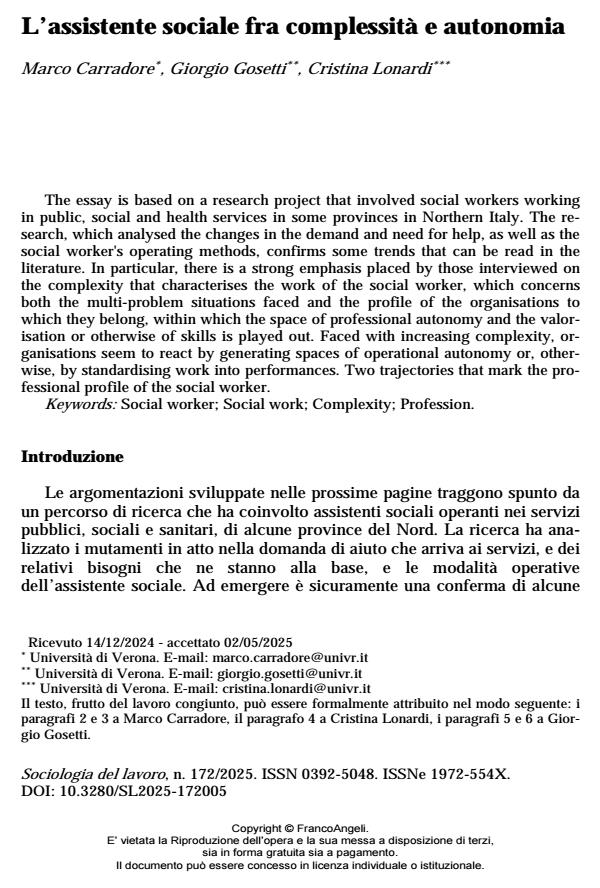
The essay is based on a research project that involved social workers working in public, social and health services in some provinces in Northern Italy. The research, which analysed the changes in the demand and need for help, as well as the social worker's operating methods, confirms some trends that can be read in the literature. In particular, there is a strong emphasis placed by those interviewed on the complexity that characterises the work of the social worker, which concerns both the multi-problem situations faced and the profile of the organisations to which they belong, within which the space of professional autonomy and the valorisation or otherwise of skills is played out. Faced with increasing complexity, organisations seem to react by generating spaces of operational autonomy or, otherwise, by standardising work into performances. Two trajectories that mark the professional profile of the social worker.
Keywords: Social worker; Social work; Complexity; Profession.
- Batini F. (2023). Un panorama lunare: la dispersione scolastica. RicercAzione, 15(1): 19-31. DOI: 10.32076/RA15101
- Bauman Z. (2011). Modernità liquida. Bari: Laterza.
- Beccaria F., Scavarda A., Roggero A., Rabaglietti E. (2022). Protective and risk factors for social withdrawal in adolescence. A mixed-method study of Italian students’ wellbeing. Modern Italy. 27(3): 259-276.
- Biasin C., Boscaini F. (2023). Il contrasto alla dispersione scolastica per il successo educativo e formativo: il progetto “Ricomincio da tre”. Annali online della Didattica e della Formazione Docente, 15(26): 61-75. DOI: 10.15160/2038-1034/2759
- Bifulco L. (2002). Che cos’è una organizzazione. Roma: Carocci.
- Bjørknes R., Skogen J.C., Nærde A., Sandal G.M., Haug E., Mæland S. (2022). Parental stress during the COVID-19 pandemic: A one-year follow-up. PLoS ONE, 17(12): e0276190.
- Butera F., Alberti F. (2012). Il governo delle reti inter-organizzative per la competitività. Studi Organizzativi, 1: 77-111. DOI: 10.3280/SO2012-001004
- Campanini A. (2020). Gli ambiti di intervento del servizio sociale. Roma: Carocci.
- Carradore M., Gosetti G., Lonardi C. (2025). Dealing with the post-pandemic challenges faced by youths and families: The perspectives of social workers. Children and Youth Services Review, 169: 108-117.
- Castells M. (2002). La nascita della società in rete. Milano: Università Bocconi Editore.
- Ceruti M. (2018). Il tempo della complessità. Milano: Raffaelo Cortina.
- Chung G., Tilley J.L., Netto N., Chan A., Lanier P. (2024). Parenting stress and its impact on parental and child functioning during the COVID-19 pandemic: A meta-analytical review. International Journal of Stress Management, 31(3): 238–251.
- Dal Pra Ponticelli M. (1983). Obiettivi e funzioni del servizio sociale nella nuova organizzazione dei servizi territoriali. Servizi Sociali, 4.
- Dellavalle M. (2022), Il processo di aiuto e i suoi elementi costitutivi. In: Cellini G. e Dellavalle M., a cura di, Il processo di aiuto del servizio sociale Prospettive metodologiche. Torino: Giappichelli Editore.
- Eriksson E.M. (2019). Representative co-production: broadening the scope of the public service logic. Public Management Review, 21(2): 291. DOI: 10.1080/14719037.2018.1487575
- Exworthy M., Halford S., a cura di (1999). Professionals and the New Managerialism in the Public Sector. Buckingham: Open University Press.
- Fargion S. (2009). Il servizio sociale. Storia, temi e dibattiti. Bari: Laterza.
- Franzoni F., Anconelli M. (2021). La rete dei servizi alla persona. Dalla normativa all’organizzazione. Roma: Carocci.
- Gori C., a cura di (2022). Le politiche del welfare sociale. Milano: Mondadori.
- Gosetti G., La Rosa M. (2006). Sociologia dei servizi. Elementi di organizzazione e programmazione. Milano: FrancoAngeli.
- Gui L. (2022). “Trifocalità”. In: Campanini A., a cura di, Nuovo dizionario di servizio sociale. Edizione rivista e aggiornata. Roma: Carocci.
- Gui L., Sanfelici M. (2022). The Conditions of Resilience: Families, Social Services and Social Workers Facing the COVID-19 Pandemic. Italian Sociological Review, 12(6S): 249-268.
- Harlow E., Berg E., Barry J., Chandler J. (2013). Neoliberalism, managerialism and the reconfiguring of social work in Sweden and United Kingdom. Organization, 20(4): 534-549. DOI: 10.1177/1350508412448222
- Hatch M.J. (2022). Teoria dell’organizzazione. Bologna: il Mulino.
- Honneth A. (2025). Il lavoratore sovrano. Lavoro e cittadinanza democratica. Bologna: il Mulino.
- King N., Horrocks C. (2010). Interviews in Qualitative Research. SAGE Publications Ltd.
- Marzilli E., Cerniglia L., Tambelli R., Trombini E., De Pascalis L., Babore A., Trumello C., Cimino S. (2021). The COVID-19 Pandemic and Its Impact on Families’Mental Health: The Role Played by Parenting Stress, Parents’Past Trauma, and Resilience. International Journal of Environmental Research and Public Health, 18(21): 11450.
- Mintzberg H. (1996). La progettazione organizzativa. Bologna: il Mulino.
- Morin E. (1985). Le vie della complessità. In: Bocchi G.L. e Ceruti M., a cura di, La sfida della complessità. Milano: Feltrinelli.
- Morin E. (2000). La testa ben fatta. Riforma dell’insegnamento e riforma del pensiero. Milano: Raffaello Cortina.
- Morris A. (2015). A practical introduction to in-depth interviewing. SAGE Publications Ltd.
- Neve E. (2013). Il servizio sociale nel contesto attuale. In: Campanini A., Diomede Canevini M., a cura di, Servizio sociale e Lavoro sociale: questioni disciplinari e professionali. Bologna: il Mulino.
- Rossi P., Colombo M. (2019). Non sarà un’avventura? L’innovazione delle partnership pubblico-privato e la co-progettazione dei servizi di welfare sociale. Stato e Mercato, 117(3): 411. DOI: 10.1425/95909
- Rossi P. (2024). L’organizzazione dei servizi socioassistenziali. Istituzioni, professionisti e assetti di regolazione. Roma: Carocci.
- Samsonsen V., Heggdalsvik I.K. (2023). Critical realism as a fruitful approach to social work research as illustrated by two studies from the field of child and family welfare. Journal of Critical Realism, 23(1): 18-32. DOI: 10.1080/14767430.2023.2251238
- Sassen S. (2008). Una sociologia della globalizzazione. Torino: Einaudi.
- Sorrentino M., Sicilia M., Howlett M. (2018). Understanding co-production as a new public governance tool. Policy and Society, 37(3): 277-293. DOI: 10.1080/14494035.2018.1521676
- Teater B., Chonody J.M., Davis N. (2020). Risk and Protective Factors of Loneliness among Older Adults: The Significance of Social Isolation and Quality and Type of Contact. Social Work in Public Health, 36(2): 128-141. DOI: 10.1080/19371918.2020.1866140
- Torfing J., Lotte B.A., Greve C., Klausen K.K., a cura di (2020). Public Governance Paradigms. Cheltenham: Edward Elgar.
- Tsui M., Cheung F.C.H. (2004). Gone with the Wind: The Impacts of Managerialism on Human Services. British Journal of Social Work, 34: 437-442.
- Weinstein M. (2006). TAMS Analyzer: Anthropology as Cultural Critique in a Digital Age. Social Science Computer Review, 24(1): 68-77. DOI: 10.1177/0894439305281496
- Zan S. (2011). Le organizzazioni complesse. Logiche d’azione dei sistemi a legame debole. Roma: Carocci.
Marco Carradore, Giorgio Gosetti, Cristina Lonardi, L’assistente sociale fra complessità e autonomia in "SOCIOLOGIA DEL LAVORO " 172/2025, pp 94-119, DOI: 10.3280/SL2025-172005