Can institutional trust research benefit from the addition of public service motivation?
Journal title SOCIOLOGIA DEL LAVORO
Author/s Francesco Paolo Cerase
Publishing Year 2025 Issue 2025/172
Language Italian Pages 20 P. 167-186 File size 233 KB
DOI 10.3280/SL2025-172008
DOI is like a bar code for intellectual property: to have more infomation
click here
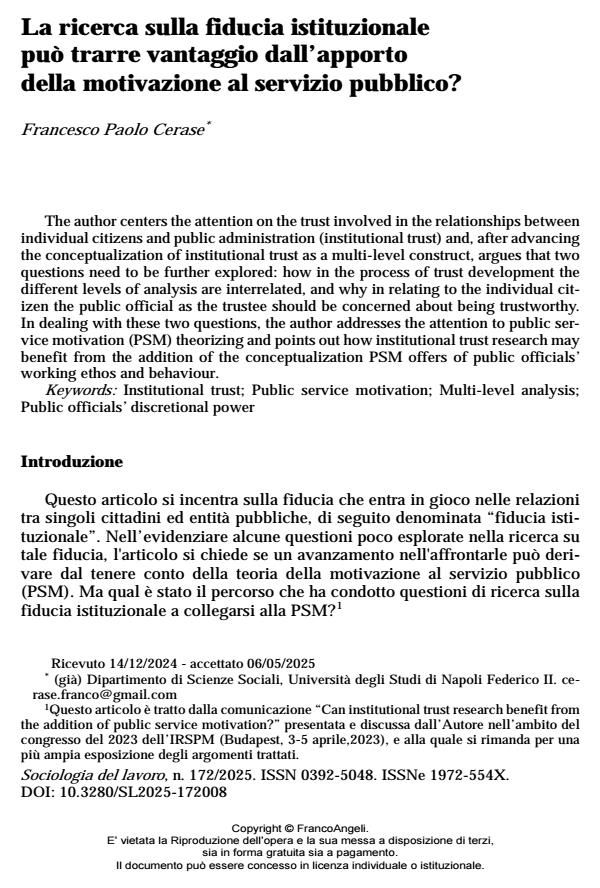
Below, you can see the article first page
If you want to buy this article in PDF format, you can do it, following the instructions to buy download credits
FrancoAngeli is member of Publishers International Linking Association, Inc (PILA), a not-for-profit association which run the CrossRef service enabling links to and from online scholarly content.
The author centers the attention on the trust involved in the relationships between individual citizens and public administration (institutional trust) and, after advancing the conceptualization of institutional trust as a multi-level construct, argues that two questions need to be further explored: how in the process of trust development the different levels of analysis are interrelated, and why in relating to the individual citizen the public official as the trustee should be concerned about being trustworthy. In dealing with these two questions, the author addresses the attention to public service motivation (PSM) theorizing and points out how institutional trust research may benefit from the addition of the conceptualization PSM offers of public officials’ working ethos and behaviour.
Keywords: Institutional trust; Public service motivation; Multi-level analysis; Public officials’ discretional power
- Bachmann R. and Inkpen A.C. (2011). Understanding Institutional-based Trust Building Processes in Inter-organizational Relationships. Organization Studies, 32(2): 281-301. DOI: 10.1177/017084061039747
- Bachmann R. and Zaheer A. (2013). Handbook of advances in trust research. Cheltenham, UK: Edward Elgar.
- Bentzen T.Ø. (2022). The tripod of trust: A multilevel approach to trust-based leadership in public organizations. Public Management Review. DOI: 10.1080/14719037.2022.213227
- Beshi T.D. and Kaur R. (2020). Public trust in local government: Explaining the role of good governance practices. Public Organization Review, 20 (2): 337–350.
- Bianchi L. e Liani S. (2017). Fidarsi della fiducia? Quaderni di Sociologia, 74: 127-140.
- Bozeman B. and Su X. (2015). Public service motivation concepts and theory: A critique. Public Administration Review, 75(5): 700-710.
- Braithwaite V. and Levi M., a cura di (1998). Trust and Governance. New York: Russell Sage Foundation.
- Braithwaite V., a cura di (2002). Taxing Democracy. Understanding Tax Avoidance and Tax Evasion. Aldershot, UK: Ashgate.
- Brewer G. A. and Selden S. C. (1998). Whistle blowers in the federal civil service: new evidence of the public service ethic. Journal of public administration research and theory, 8(3): 413-439.
- Brewer G.A., Selden S.C., Facer., R.L. (2000). Individual Conceptions of Public Service Motivation. Public Administration Review, 60(3): 254-264. DOI: 10.1111/0033-3352.0008
- Bornstein B. H., Tomkins, A. J. a cura di (2015a). Motivating Cooperation and Compliance with Authority. The Role of Institutional Trust. New York: Springer.
- Cerase F.P. (1998). Pubblica amministrazione. Un’analisi sociologica. Roma: Carocci.
- Cerase F.P. (2017). Institutional Trust and the Effectiveness of Public Institutions.(Annual Bulletin of the Institute of Social Sciences, Chuo University) 22: 177-198.
- Cerase F.P. (2018). La fiducia nelle relazioni tra cittadini e istituzioni pubbliche. Amministrare, XLVIII(1): 91-115. DOI: 10.1442/9111
- Cerase F. P. and Farinella D. (2006). Explorations in Public Service Motivation. The Case of the Italian Revenue Agency. Paper presented at the EGPA annual meeting. Milan, September 6-9.
- Chen C.-A., Hsieh C.-W. and Chen D.-Y. (2014). Fostering public service motivation through workplace trust: Evidence from public managers in Taiwan. Public Administration, 92(4): 954-973.
- Cho Y. J. and Poister T. H. (2013). Human resource management practices and trust in public organizations. Public Management Review, 15(6): 816-838. DOI: 10.1080/14719037.2012.69885
- Crucke S., Kluijtmans T., Meyfroodt K. and Desmidt S. (2022). How does organizational sustainability foster public service motivation and job satisfaction? The mediating role of organizational support and societal impact potential. Public Management Review, 24(8): 1155-1181. DOI: 10.1080/14719037.2021.189380
- Currall S. C. and Inkpen A. C. (2002). A multilevel approach to trust in joint ventures. Journal of International Business Studies,33(3): 479-495.
- European Social Survey, (2011). Round 5 Module on Trust in the Police & Courts – Final Question Design Template. City University London, London: Centre for Comparative Social Surveys.
- Fulmer A., and Dirks K. (2018). Multilevel trust: A theoretical and practical imperative. Editorial. Journal of Trust Research, 8(2): 137-141. DOI: 10.1080/21515581.2018.153165
- Giddens A. (1990). The consequences of modernity. Stanford: Stanford University Press.
- González S. and Smith C. (2017). The Accuracy of Measures of Institutional Trust in Household Surveys: Evidence from the OECD Trust Database. OECD, Working Paper 87. DOI: 10.1787/1815203
- Gro¨nlund K. and Seta¨la¨ M. (2012). In Honest Officials We Trust. Institutional Confidence in Europe. American Review of Public Administration, 42(5): 523–542. DOI: 10.1177/027507401141294
- Hardin R. (2002). Trust and Trustworthiness. New York: Russell Sage Foundation.
- Hardin R. (2013). Government without trust. Journal of Trust Research, 3(1): 32-52. DOI: 10.1080/21515581.2013.77150
- Hasche N., Höglund L. and Mårtensson M. (2021). Intra-organizational trust in public organizations – the study of interpersonal trust in both vertical and horizontal relationships from a bidirectional perspective. Public Management Review, 23 (12):1768-1788. DOI: 10.1080/14719037.2020.1764081
- Herian M.N. and Neal T.M.S. (2016). Trust as a multilevel phenomenon: Implications for improved integrative science in trust research. In: Shockley E., Neal T.M.S., PytlikZillig L.M. and Bornstein B.H., editors, Interdisciplinary perspectives on trust. New York: Springer.
- Hetherington M. J. (2004). Why Trust Matters: Declining Political Trust and the Demise of American Liberalism. Princeton: Princeton University Press.
- Horton S. (2010). Il modello di competenze per la gestione delle risorse umane nell’amministrazione statale britannica: continuità e cambiamento. Amministrare, XL(1), pp.91-119. DOI: 10.1442/3139
- Jackson J. (2015). On the Dual Motivational Force of Legitimate Authority. In: Bornstein B.H. and Tomkins A. J., editors, Motivating Cooperation and Compliance with Authority. The Role of Institutional Trust. New York, Springer.
- Jakobsen M., Moynihan J. O. and Nabatchi T. D. (2017). Virtual Issue on Citizen-State Interactions in Public Administration Research. Journal of Public Administration Research and Theory.
- Jensen U. T., Andersen L. B., Jacobson Ch. B. (2019). Only When We Agree! How Value Congruence Moderates the Impact of Goal-Oriented Leadership on Public Service Motivation. Public Administration Review, 79 (1): 12–24.
- Kim S., Vandenabeele W., Wright B.E. and others (2013). Investigating the Structure and Meaning of Public Service Motivation across Populations: Developing an International Instrument and Addressing Issues of Measurement Invariance. Journal of Public Administration Research and Theory, 23(1): 79-102. DOI: 10.2307/2332108
- Kroeger F. (2015). The development, escalation and collapse of system trust: From the financial crisis to society at large. European Management Journal, 33(6): 431-437. Quotations from post-print web version.
- Lee H. J., Oh H. G. and Park S. M. (2020). Do Trust and Culture Matter for Public Service Motivation Development? Evidence From Public Sector Employees in Korea. Public Personnel Management, 49(2): 290–323. DOI: 10.1177/009102601986973
- Leisink P. (2004). Do public personnel policies nourish public service motivation? Paper presented at the EGPA annual meeting. Llubljana, September 1-4.
- Levi M. (1998). A State of Trust. In: Braithwaite V. and Levi M., editors, Trust and Governance. New York: Russell Sage Foundation.
- Luhmann N. (1979). Trust and Power. Chichester: Wiley.
- Lumineau F. and Schilke O. (2018). Trust Development Across Levels of Analysis: An Embedded-Agency Perspective. Journal of Trust Research, 8(2): 238-248. DOI: 10.1080/21515581.2018.153176
- Mayer R. C., Davis J. H. and Schoorman F. D. (1995). An integrative model of organizational trust. Academy of Management Review, 20(3): 709-734. DOI: 10.5465/AMR.2007.2434841
- Maesschalck J., van der Wal Z. and Huberts L. (2008). Public Service Motivation and Ethical Conduct. In: Perry J. L. and Hondeghem A., editors, Motivation in public management: The call of public service. New York: Oxford University Press.
- Meyer R. E., Egger-Peitler I., Ho¨llerer M. A. and Hammerschmid G. (2014). Of Bureaucrats and Passionate Public Managers: Institutional Logics, Executive Identities, and Public Service Motivation. Public Administration, 92 (4): 861-885.
- Moynihan D. P. and Pandey S. K. (2007). The role of organizations in fostering public service motivation. Public Administration Review 67(1): 40-53.
- Mutti A. (1998). Capitale sociale e sviluppo. La fiducia come risorsa. Bologna: il Mulino.
- Newton K. and Smerli S. (2011). Three forms of trust and their association. European Political Science Review, 3(2): 169-200. DOI: 10.1017/S175577391000033
- Newton K., Stolle D. and Zmerli S. (2018). Social and Political Trust. In: Uslaner E. M., editor, The Oxford Handbook of Social and Political Trust. Oxford: Oxford University Press.
- Nooteboom B. (2002). Trust. Forms, Foundations, Functions, Failures and Figures. Northampton, Mass.: Edward Elgar.
- North D. C. (1990). Institutions, Institutional Change and Economic Performance. Cambridge: Cambridge University Press.
- Offe K. (1999). How can we trust our fellow citizens? In: Warren M. E., editor, Democracy & Trust. Cambridge: Cambridge University Press.
- O’Leary Ch. (2018). Public Service Motivation: A Rationalist Critique. Public Personnel Management, 48(1): 82-96. DOI: 10.1177/009102601879196
- Perry J. L. and Wise L. R. (1990). The Motivational Bases of Public Service. Public Administration Review, 50(May/June): 367-373. DOI: 10.2307/97661
- Perry J. L. (1996). Measuring Public Service Motivation: An Assessment of Construct Reliability and Validity. Journal of Public Administration Research and Theory, 6(1): 5-22.
- Perry J. L. and Hondeghem A., a cura di, (2008). Motivation in public management: The call of public service. New York: Oxford University Press.
- PytlikZillig L.M. and Kimbrough Ch.D. (2016). Consensus on Conceptualizations?and Definitions of Trust: Are We There Yet? In: Shockley E., Neal T.M.S., PytlikZillig L.M. and Bornstein B.H., editors, Interdisciplinary perspectives on trust. New York: Springer.
- Ripoll G. and Schott C. (2020) (2023). Does public service motivation foster justification of unethical behaviour? Evidence from survey research among citizen. International Public Management Journal, 26(1): 1-22. DOI: 10.1080/10967494.2020.182557
- Ritz A., Brewer G. A. and Neumann O. (2016). Public Service Motivation: A Systematic Literature Review and Outlook. Public Administration Review, 76(3): 414–26.
- Rottman D.B. (2015). Who Trusts the Trial Courts, To What Extent, and Why? In: Bornstein B.H. and Tomkins A. J., editors, Motivating Cooperation and Compliance with Authority. The Role of Institutional Trust. New York: Springer.
- Rousseau D. M., Sitkin S. B., Burt R. S. and Camerer C. (1998). Not So-Different After All: A Cross-Discipline View of Trust. Academy of Management Review, 23(3): 393-404. DOI: 10.5465/AMR.1998.92661
- Schaap D. and Scheepers P. (2014). Comparing Citizens’ Trust in the Police Across European Countries: An Assessment of Cross-Country Measurement Equivalence. International Criminal Justice Review, 24(1): 82–98. DOI: 10.1177/105756771452405
- Schaap D. (2021). Police trust-building strategies. A socio-institutional, comparative approach. Policing and Society, 31(3): 304-320. DOI: 10.1080/10439463.2020.172634
- Schilke O. and Cook K.S. (2013). A cross-level process theory of trust development in interorganizational relationships. Strategic Organization, 11(3): 281–303. DOI: 10.1177/147612701247209
- Shockley E., Neal T.M.S., PytlikZillig L.M. and Bornstein B.H., a cura di (2016). Interdisciplinary Perspectives on Trust. New York: Springer. DOI: 10.1007/978-3-319-22261-
- Scholz J. T. (1998). Trust, Taxes, and Compliance. In: Braithwaite V. and Levi M., editors, Trust and Governance. New York: Russell Sage Foundation.
- Schoorman F.D., Mayer R.C. and Davis J.H. (2007). An integrative model of organizational trust: Past, present and future. Academy of Management Review, 32(2): 344-354. DOI: 10.5465/AMR.2007.2434841
- Schott C., van Kleef D. D., and Steen T. (2015). What Does It Mean and Imply to be public-service motivated? The American Review of Public Administration, 45(6): 689–707. DOI: 10.1177/027507401453358
- Schott C. and Ritz A. (2018). The dark sides of public service motivation: A theoretical framework. Perspectives on Public Management and Governance, 1(1): 29–42.
- Schott C., Neumann O., Baertschi M. and Ritz A. (2019). Public service motivation, prosocial motivation and altruism: Towards disentanglement and conceptual clarity. International Journal of Public Administration, 42 (14): 1200–1211. DOI: 10.1080/01900692.2019.158830
- Staubli S. (2017). Trusting the Police: Comparisons across Eastern and Western Europe. New York: Columbia University Press.
- Sztompka P. (2017). Trust in the moral space. Keynote paper read at the International Conference on Trust. Tokyo, November 18-20.
- Tepe M. (2016). In Public Servants We Trust?: A behavioural experiment on public service motivation and trust among students of public administration, business sciences and law. Public Management Review, 18(4): 508-538. DOI: 10.1080/14719037.2015.101439
- Tyler T. and Huo Y., a cura di (2002). Trust in the Law: Encouraging Public Cooperation with the Police and Courts. New York: Russell Sage Foundation.
- Tyler T. and Jackson J. (2014). Popular legitimacy and the exercise of legal authority: Motivating compliance, cooperation, and engagement. Psychology, Public Policy, and Law, 20(1): 78–95.
- Van Loon N. M., Bækgaard M., Moynihan D. P. (2020). Stability Not Change: Improving Frontline Employee Motivation Through Organizational Reform is Harder than it Looks. Public Administration, 98(39): 591-608.
- Vandenabeele W. (2007). Toward a public administration theory of public service motivation: an institutional approach. Public Management Review, 9(4): 545–556.
- DOI: 10.1080/1471903070172669
- Vandenabeele W., Steijn B. and others (2009). Comparing public service motivation within various Europe countries: do institutional environments make a difference? https://www.researchgate.net/publication/46711568
- Warren M.E., a cura di (1999a). Democracy & Trust. Cambridge: Cambridge University Press.
- Warren M.E. (1999b). Conclusion. In: Warren M. E., editor, Democracy & Trust. Cambridge: Cambridge University Press.
- Yang K. (2005). Public Administrators' Trust in Citizens: A Missing Link in Citizen Involvement Efforts. Public Administration Review, 65(3): 273-285.
Francesco Paolo Cerase, La ricerca sulla fiducia istituzionale può trarre vantaggio dall’apporto della motivazione al servizio pubblico? in "SOCIOLOGIA DEL LAVORO " 172/2025, pp 167-186, DOI: 10.3280/SL2025-172008