The Right to University Education in the Grip of Incarceration: Notes from a Field Study

Journal title PRISMA Economia - Società - Lavoro
Author/s Giovanni Torrente
Publishing Year 2025 Issue 2025/1
Language Italian Pages 12 P. 45-56 File size 103 KB
DOI 10.3280/PRI2025-001004
DOI is like a bar code for intellectual property: to have more infomation click here

Below, you can see the article first page

If you want to buy this article in PDF format, you can do it, following the instructions to buy download credits
Article preview

FrancoAngeli is member of Publishers International Linking Association, Inc (PILA), a not-for-profit association which run the CrossRef service enabling links to and from online scholarly content.

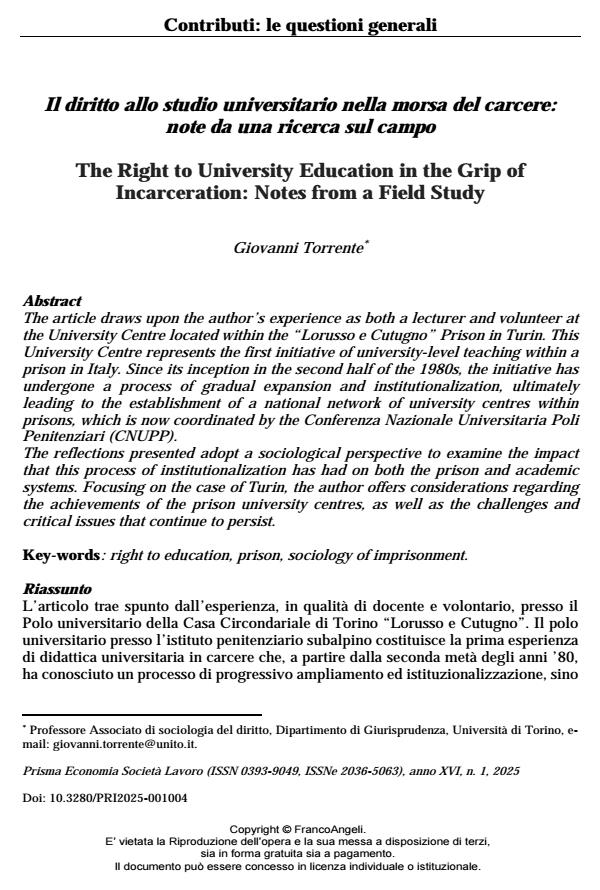
The article draws upon the author’s experience as both a lecturer and volunteer at the University Centre located within the “Lorusso e Cutugno” Prison in Turin. This University Centre represents the first initiative of university-level teaching within a prison in Italy. Since its inception in the second half of the 1980s, the initiative has undergone a process of gradual expansion and institutionalization, ultimately leading to the establishment of a national network of university centres within prisons, which is now coordinated by the Conferenza Nazionale Universitaria Poli Penitenziari (CNUPP). The reflections presented adopt a sociological perspective to examine the impact that this process of institutionalization has had on both the prison and academic systems. Focusing on the case of Turin, the author offers considerations regarding the achievements of the prison university centres, as well as the challenges and critical issues that continue to persist.

Keywords: right to education, prison, sociology of imprisonment.

  1. Auletta K. (2023) The Underclass, Open Road Media.
  2. Berzano L. (1994) La pena del non lavoro, Franco Angeli.
  3. Bourdieu P. (2021) Sistema, habitus, campo, Mimesis Edizioni.
  4. Clemmer D. (1997) La comunità carceraria, in Santorio E., a cura di, Carcere e società liberale, Giappichelli, pp. 210-225.
  5. Crozier M., Friedberg E. (1995) Attore sociale e sistema. Sociologia dell’azione organizzata, Etas Libri.
  6. De Giorgi, A. (2002) Il governo dell’eccedenza. Post-fordismo e controllo della moltitudine, Ombre Corte.
  7. De Vito C. (2009) Camosci e girachiavi. Storia del carcere in Italia, Edizioni Laterza.
  8. Ferrajoli L. (2016) Il paradigma garantista. Filosofia e critica del diritto penale, Editoriale Scientifica.
  9. Goffman E. (1961) Asylum. Le istituzioni totali: i meccanismi dell’esclusione e della violenza, Einaudi editore.
  10. Kalica E., Santorso S. (2018) Farsi la galera. Spazi e culture del penitenziario, Ombre Corte.
  11. Pichetto M. T. (2018) Se la cultura entra in carcere. Dalle riforme carloalbertine al polo universitario per studenti detenuti, Effatà editrice.
  12. Prina F. (2018) I poli universitari penitenziari in Italia. L’impegno delle università per il diritto allo studio dei detenuti, in Friso V., Decembrotto L., a cura di, Università e carcere. Il diritto allo studio tra vincoli e progettualità, Guerini Scientifica, pp. 87-117.
  13. Ronco D. (2016) “La competizione tra i reclusi. L’impatto della scarsità di risorse e della logica del beneficio sulla comunità carceraria”, Etnografia e ricerca qualitativa, 2, pp. 211-226.
  14. Ronco D., Torrente G. (2017) Pena e ritorno. Una ricerca su interventi di sostegno e recidiva, Ledizioni.
  15. Sykes G. M. (1997) La società dei detenuti. Studio su un carcere di massima sicurezza, in Santoro E., a cura di, Carcere e società liberale, Giappichelli, pp. 223-237.
  16. Torrente G. (2016) “Saper farsi la galera. Pratiche di resistenza (e di sopravvivenza) degli immigrati detenuti”, Sociologia del diritto, 1, pp. 109-133.
  17. Torrente G. (2018) Le regole della galera. Pratiche penitenziarie, educatori e processi di criminalizzazione, L’Harmattan Italia.
  18. Verdolini V. (2022) L’istituzione reietta. Spazi e dinamiche del carcere in Italia, Carocci editore.
  19. Vianello F. (2019) Sociologia del carcere. Nuova edizione, Carocci editore.
  20. Wacquant L. (2008) The Place of the Prison in the New Government of Poverty, in After the War on Crime, New York University Press.
  21. Zimbardo P. (2007) L’effetto Lucifero. Cattivi si diventa?, Raffaello Cortina editore.

Giovanni Torrente, Il diritto allo studio universitario nella morsa del carcere: note da una ricerca sul campo in "PRISMA Economia - Società - Lavoro" 1/2025, pp 45-56, DOI: 10.3280/PRI2025-001004