Microcosm Exploration of Bangladeshi and Afghan Migrant Workers in Ancona, Italy

Journal title PRISMA Economia - Società - Lavoro
Author/s Balkrishna Bhosale
Publishing Year 2025 Issue 2025/1
Language English Pages 15 P. 103-117 File size 146 KB
DOI 10.3280/PRI2025-001009
DOI is like a bar code for intellectual property: to have more infomation click here

Below, you can see the article first page

If you want to buy this article in PDF format, you can do it, following the instructions to buy download credits
Article preview

FrancoAngeli is member of Publishers International Linking Association, Inc (PILA), a not-for-profit association which run the CrossRef service enabling links to and from online scholarly content.

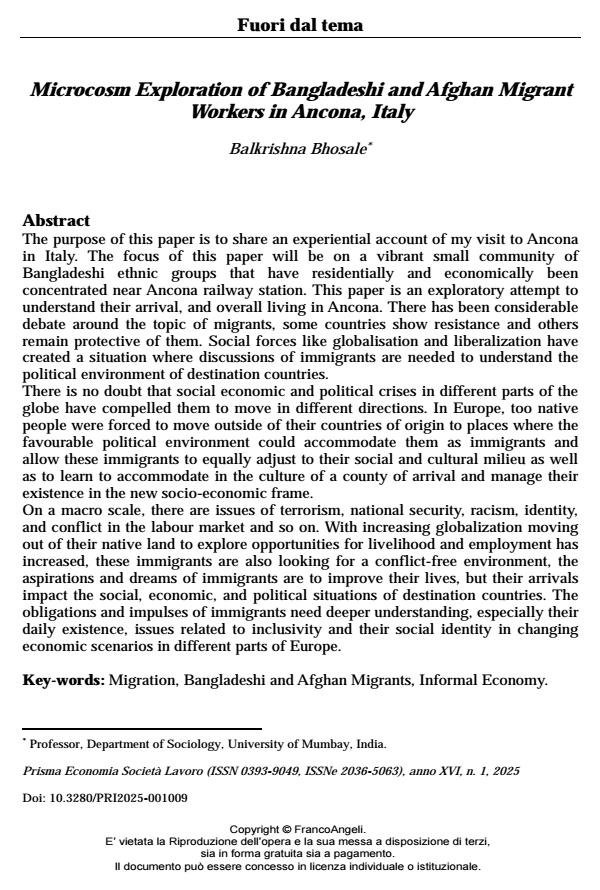
The purpose of this paper is to share an experiential account of my visit to Ancona in Italy. The focus of this paper will be on a vibrant small community of Bangladeshi ethnic groups that have residentially and economically been concentrated near Ancona railway station. This paper is an exploratory attempt to understand their arrival, and overall living in Ancona. There has been considerable debate around the topic of migrants, some countries show resistance and others remain protective of them. Social forces like globalisation and liberalization have created a situation where discussions of immigrants are needed to understand the political environment of destination countries. There is no doubt that social economic and political crises in different parts of the globe have compelled them to move in different directions. In Europe, too native people were forced to move outside of their countries of origin to places where the favourable political environment could accommodate them as immigrants and allow these immigrants to equally adjust to their social and cultural milieu as well as to learn to accommodate in the culture of a county of arrival and manage their existence in the new socio-economic frame. On a macro scale, there are issues of terrorism, national security, racism, identity, and conflict in the labour market and so on. With increasing globalization moving out of their native land to explore opportunities for livelihood and employment has increased, these immigrants are also looking for a conflict-free environment, the aspirations and dreams of immigrants are to improve their lives, but their arrivals impact the social, economic, and political situations of destination countries. The obligations and impulses of immigrants need deeper understanding, especially their daily existence, issues related to inclusivity and their social identity in changing economic scenarios in different parts of Europe.

Keywords: Migration, Bangladeshi and Afghan Migrants, Informal Economy.

  1. Castles, S., & Miller, M. J. (1998). The age of migration: International population movements in the modern world. Macmillan Education UK. (p.73-74).
  2. Dahrendorf, R. (1995). The modern social conflict: An essay on the politics of liberty. Weidenfeld & Nicolson.
  3. European Commission – Migrant Integration Statistics. (2016). Migration statistical yearbook – Italy. Retrieved January 31, 2025, -- from https://migrant-integration.ec.europa.eu/library-document/migration-statistical-yearbook-2016-italy_en.
  4. Eurostat. (2024). Acquisition of citizenship statistics. -- Retrieved January 31, 2025, from https://ec.europa.eu/eurostat/statistics-explained/index.php/ Acquisition_of_citizenship_statistics.
  5. Geddes, A., & Scholten, P. (2016). The politics of migration and immigration in Europe (2nd ed.). SAGE Publications.
  6. International Monetary Fund. (2016). The refugee surge in Europe: Economic challenges (IMF Staff Discussion Note No. SDN/16/02). International Monetary Fund. -- Retrieved from https://www.imf.org/external/pubs/ ft/sdn/2016/sdn1602.pdf on February 1, 2025.
  7. International Organization for Migration. (2020). Bangladeshi migrants in Europe 2020 – A multiple source snapshot. Retrieved from https://dtm.iom.int/dtm_ download_track/15102?file=1.
  8. Islamic State claims attacks at Brussels airport and metro station. The Guardian. -- Retrieved from https://www.theguardian.com/world/2016/mar/22/brussels-airport-explosions-live-updates.
  9. ISMU Foundation. (2018). The Twenty-third Italian Report on Migrations 2017. -- Retrieved January 31, 2025, from https://www.ismu.org/wp-content/uploads/2018/03/XXIII-Report-on-migrations-2017.pdf.
  10. ISMU Foundation. (2018). XXIII Report on migrations – 2017. -- Retrieved January 31, 2025, from https://www.ismu.org/wp-content/uploads/2018/05/XXIII-Report-on-migrations-2017-1.pdf.
  11. Italian National Institute of Statistics (ISTAT). (2020). Migration report: Trends and statistics. -- Retrieved January 31, 2025, from https://www.istat.it/it/files/2020/05/Migrazioni_EN.pdf.
  12. Lachmann, R. (2016). Crisis of Neoliberalism, Crisis of the World? Contemporary Sociology, 45(1), pp. 40-43.
  13. Macionis, J. J., & Plummer, K. (2014). Sociology: A global introduction (5th ed., pp. 366-367). Pearson Education Limited.
  14. Morettini, G. (2011). Entrepreneurship and immigration: Italian case and regional models (1990s-2000). In F. Chiapparino (Ed.), The alien entrepreneur: Migrant entrepreneurship in Italian emigration (late 19th-20th century) and in the immigration in Italy at the turn of the 21st century (pp. 85-96). FrancoAngeli.
  15. Norwegian Refugee Council (NRC). (2024). 10 things you should know about the Central Mediterranean migration route. Retrieved January 31, 2025, -- from https://www.nrc.no/feature/2024/10-things-you-should-know-about-the-Central-Mediterranean-migration-route.
  16. Orazi, F. (2016). The crisis of the Italian industrial districts and its new successful entrepreneurs: Data and suggestions of a search. Journal of Sociology and Social Work, 4(2), 11-19.
  17. Orazi, F. (2017). False myths and labour reforms in Italy: Migration, precarity, and economic change. International Journal of Social Science and Technology, 2(5), 6.
  18. Orazi, F. (2019). The crisis of migration and European transition: A sociological perspective.
  19. Pompeo, F. (2017). Invisible youth mobility: The Bangladesh population in Rome. Belgeo: Belgian Journal of Geography. -- Retrieved from https://journals.openedition.org/belgeo/23322.
  20. Rodríguez-Pose, A. (2018). The revenge of the places that don't matter (and what to do about it). Cambridge Journal of Regions, Economy and Society, 11(1), 189-209.
  21. Triandafyllidou, A. (2017). Migration and globalisation: What is new in the European experience?. Routledge.
  22. Vertovec, S. (2006). The emergence of super-diversity in Britain (Working Paper No. 25). Centre on Migration, Policy and Society, University of Oxford. -- Retrieved from https://www.compas.ox.ac.uk/wp-content/uploads/WP-2006-025-Vertovec_Super-Diversity_Britain.pdf on February 1, 2025.
  23. Waldinger, R. (1995). The ‘other side’ of embeddedness: A case study of the interplay of economy and ethnicity. Ethnic and Racial Studies, 18(3), 555-580. -- Retrieved from https://www.tandfonline.com/doi/abs/10.1080/01419870. 1995.9993879 on February 1, 2025.
  24. Wallerstein, I. (2004). World-systems analysis: An introduction. Duke University Press.

Balkrishna Bhosale, Microcosm Exploration of Bangladeshi and Afghan Migrant Workers in Ancona, Italy in "PRISMA Economia - Società - Lavoro" 1/2025, pp 103-117, DOI: 10.3280/PRI2025-001009