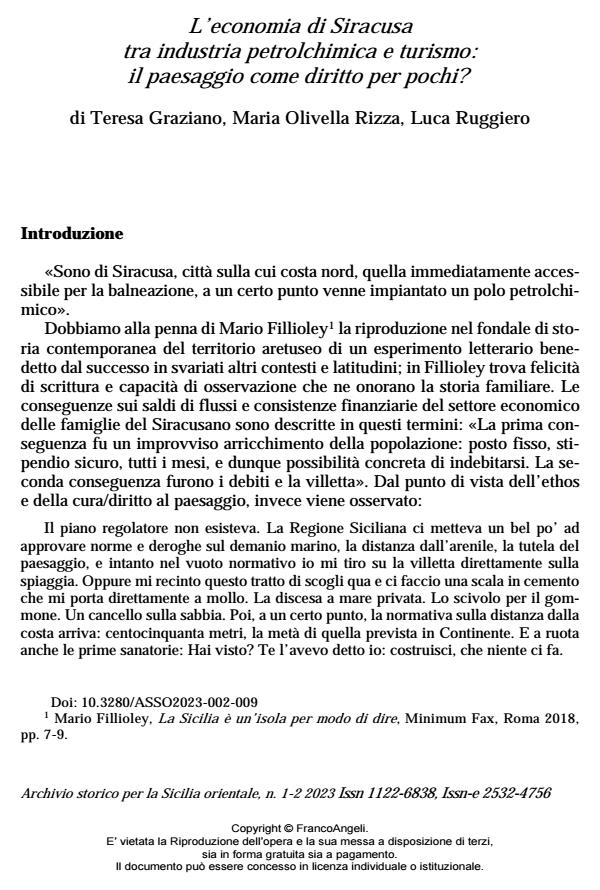
The Economy of Syracuse Between Petrochemical Industry and Tourism: Landscape as a Right for the Few
Journal title ARCHIVIO STORICO PER LA SICILIA ORIENTALE
Author/s Teresa Graziano, Maria Olivella Rizza, Luca Ruggiero
Publishing Year 2025 Issue 2023/1-2
Language Italian Pages 27 P. 192-218 File size 189 KB
DOI 10.3280/ASSO2023-002-009
DOI is like a bar code for intellectual property: to have more infomation
click here
Below, you can see the article first page
If you want to buy this article in PDF format, you can do it, following the instructions to buy download credits
FrancoAngeli is member of Publishers International Linking Association, Inc (PILA), a not-for-profit association which run the CrossRef service enabling links to and from online scholarly content.
The essay examines the economic evolution of the Syracuse area, with a focus on the transition from the petrochemical industry to tourism, and its consequences for the landscape. The study areas include the coastal zone to the north of Syracuse, home to the industrial hub (Priolo, Melilli, Augusta), and the southern coast, with particular attention to the Maddalena Peninsula (Pillirina) and the historic center of Ortigia. The research methodology adopts a critical approach to economic and territorial developments, analyzing inequalities from an economic perspective. The paper focuses on the concepts of "right to the landscape" and "landscape grabbing," interpreting landscape transformations not only from an aesthetic standpoint but also as the result of socio-economic and political processes. The research is based on the analysis of socio-economic data, specialized literature, and interviews, aiming to deconstruct relational and power dynamics.
Keywords: Syracuse; Landscape Grabbing; Extraction policies; Tourism; Right to the Landscape.
Teresa Graziano, Maria Olivella Rizza, Luca Ruggiero, L’economia di Siracusa tra industria petrolchimica e turismo: il paesaggio come diritto per pochi? in "ARCHIVIO STORICO PER LA SICILIA ORIENTALE" 1-2/2023, pp 192-218, DOI: 10.3280/ASSO2023-002-009