Collaborative spaces and place-based policies: organizational practices and challenges in peripheral areas
Journal title STUDI ORGANIZZATIVI
Author/s Stefano Rodighiero, Carlo Fusari, Fabrizio Montanari, Davide Sordi
Publishing Year 2025 Issue 2025/1
Language Italian Pages 31 P. 36-66 File size 271 KB
DOI 10.3280/SO2025-001002
DOI is like a bar code for intellectual property: to have more infomation
click here
Below, you can see the article first page
If you want to buy this article in PDF format, you can do it, following the instructions to buy download credits
FrancoAngeli is member of Publishers International Linking Association, Inc (PILA), a not-for-profit association which run the CrossRef service enabling links to and from online scholarly content.
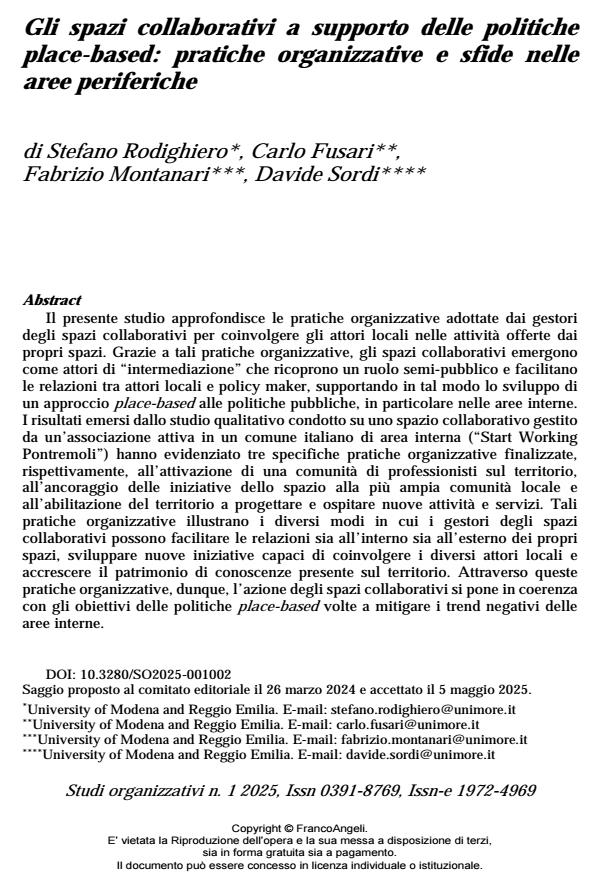
The article focuses on the organizational practices adopted by collaborative spaces’ managers to engage local actors. These organizational practices enable collaborative spaces to emerge as “brokering” actors who undertake a semi-public role and facilitate the relationship between local actors and policy makers. In doing so, collaborative spaces contribute to place-based policies – i.e., context-specific policies tailored to the specific needs, competencies, and resources characterizing one specific territory, which most often cater to peripheral areas. Through a qualitative study of a collaborative space managed by an association based in Italy’s “inner areas” (i.e., Start Working Pontremoli), the article identifies three organizational practices that collaborative spaces’ managers can adopt to facilitate interaction and collaboration both within and outside their spaces, support the definition of new activities and services by local actors, and improve the pool of local talent and knowledge. Implications for both collaborative spaces and place-based policies are also discussed.
Keywords: collaborative spaces; place-based policies; brokering; peripheral areas; organizational practices; qualitative study.
- Kopplin C.S. (2021), “Two heads are better than one: matchmaking tools in coworking spaces”, Review of Managerial Science, 15(4): 1045-1069,
- Adner R., Kapoor R. (2009), “Value creation in innovation ecosystems: How the structure of technological interdependence affects firm performance in new technology generations”, Strategic Management Journal, 31(3): 306-333,
- Autio E., Thomas L.D.W. (2014), “Innovation ecosystems: Implications for Innovation management?”, in Dodgson, M., Gann, D.N., Phillips, N. (eds.), The Oxford Handbook of Innovation Management (pp. 204-229), Oxford, Oxford University Press.
- Avdikos V., Papageorgiou A. (2021), “Public support for collaborative workspaces: Dispersed help to a place-based phenomenon?”, Local Economy, 36(7-8): 669-682, DOI: 10.1177/02690942221074941
- Baldwin C.Y., Bogers M.L., Kapoor R., West J. (2024), “Focusing the ecosystem lens on innovation studies”, Research Policy, 53(3), 104949,
- Barbera F. (2015). “Il terzo stato dei territori: riflessioni a margine di un progetto di policy”, in Meloni B. (eds.), Aree Interne e Progetti d’Area (pp. 36-52), Torino, Rosenberg & Sellier.
- Barbera F., Zabatino A. (2022). “Potere di riconoscimento, diseguaglianze territoriali e politiche pubbliche”. La Rivista delle Politiche Sociali, 2, 17-32.
- Barca F. (2009), An Agenda for a Reformed Cohesion Policy: A Place-Based Approach to Meeting European Union Challenges and Expectations, Bruxelles, Commissione Europea.
- Barca F., McCann P., Rodríguez-Pose A. (2012), “The case for regional development intervention: place-based versus place-neutral approaches”, Journal of Regional Science, 52(1): 134-152,
- Bednár P., Danko L. (2020) “Coworking spaces as a driver of the post-fordist city: A tool for building a creative ecosystem”, European Spatial Research and Policy, 27(1): 105-125.
- Blagoev B., Costas J., Kärreman D. (2019), “‘We are all herd animals’: Community and organizationality in coworking spaces”, Organization, 26(6): 894-916, DOI: 10.1177/1350508418821008
- Brorström S., Willems J. (2023), “Getting integrative urban regeneration strategies done: Insights from Antwerp and Gothenburg”, International Review of Administrative Sciences, 89(2): 346-362, DOI: 10.1177/00208523211029122
- Brown A., O’Connor J., Cohen S. (2000), “Local music policies within a global music industry: Cultural quarters in Manchester and Sheffield”, Geoforum, 31: 437-451, DOI: 10.1016/S0016-7185(00)00007-5
- Brown J. (2017), “Curating the “Third Place”? Coworking and the mediation of creativity”, Geoforum, 82: 112-126,
- Capdevila I. (2019), “Motivating participation in collaborative spaces”, Journal of Business Strategy, 40(2): 14-21, doi.org/10.1108/JBS-09-2017-0140.
- Capdevila I. (2022), “Building communities in rural coworking spaces”, in Mérindol V., Versailles D.W. (eds.), Open Labs and Innovation Management (pp. 146-168), Londra, Routledge.
- Ciccarelli F.C., Mariotti I. (2024), “Remote work, coworking spaces, and wellbeing during the COVID-19 pandemic and beyond: exploring peripheral and rural areas”, in Andres L., Bryson J.R., Ersoy A., Reardon L. (eds.), Pandemic Recovery? Reframing and Rescaling Societal Challenges (pp. 209-220), Cheltenham, Edward Elgar Publishing.
- Eisenhardt K.M. (1989), “Building theories from case study research”, Academy of Management Review, 14(4): 532-550,
- Eriksson E., Fredriksson A., Syssner J. (2022), “Opening the black box of participatory planning: a study of how planners handle citizens’ input”, European Planning Studies, 30(6): 994-1012, DOI: 10.1080/09654313.2021.1895974
- Fai F.M., Tomlinson P.R., Barzotto M. (2024), “Coworking spaces and regional development: a role for policy”, Regional Studies, 1-16, DOI: 10.1080/00343404.2024.2399282
- Gill R., Pratt A.C., Virani T.E., eds. (2019), Creative Hubs in Question: Place, Space and Work in the Creative Economy, Cham, Springer.
- Hassink R. (2020), “Advancing place-based regional innovation policies”, in González-López M., Asheim B.T. (eds.), Regions and Innovation Policies in Europe (pp. 30-45), Cheltenham, Edward Elgar Publishing.
- Heard E., Bartleet B.L., Woolcock G. (2023), “Exploring the role of place-based arts initiatives in addressing social inequity in Australia: A systematic review”, Australian Journal of Social Issues, 58(3): 550-572,
- Hildreth P., Bailey D. (2014), “Place-based economic development strategy in England: Filling the missing space”, Local Economy, 29(4-5): 363-377, DOI: 10.1177/0269094214535712
- Höglund L., Linton G. (2018), “Smart specialization in regional innovation systems: a quadruple helix perspective”, R&D Management, 48(1): 60-72,
- Holgate J. (2015), “Community organising in the UK: A ‘new’ approach for trade unions?”, Economic and Industrial Democracy, 36(3): 431-455, DOI: 10.1177/0143831X13511275
- ISTAT (2020), La Geografia delle Aree Interne nel 2020: Vasti Territori tra Potenzialità e Debolezze, https://www.istat.it/it/files//2022/07/FOCUS-AREE-INTERNE-2021.pdf
- Ivaldi S., Galuppo L., Calvanese E., Scaratti G. (2021), “Coworking space as a practised place between welfare working and managerial challenges”, Journal of Workplace Learning, 33(1): 26-44, DOI: 10.1108/JWL-02-2020-0021
- Löfving L., Kamuf V., Heleniak T., Weck S., & Norlén G. (2022), “Can digitalization be a tool to overcome spatial injustice in sparsely populated regions? The cases of Digital Västerbotten (Sweden) and Smart Country Side (Germany)”, European Planning Studies, 30(5): 917-934, DOI: 10.1080/09654313.2021.1928053
- Mariotti I., Di Vita S., Akhavan M., eds. (2021), New Workplaces–Location Patterns, Urban Effects and Development Trajectories (pp. 53-63). Cham, Springer.
- Mariotti I., Pais I., Ciccarelli F. (2023), “Public support for new working spaces in Italy: The case of Presidi di Comunità”, in Merkel J., Pettas D., Avdikos V. (eds.), Coworking Spaces: Alternative Topologies and Transformative Potentials (pp. 159-173), Cham, Springer.
- Mariotti I., Sasso S. (2024), Revitalizing Rural Areas through Innovation and Entrepreneurship: Public and Private Initiatives to Train, Attract and Retain Human Capital, Lussemburgo, Joint Research Center, Commissione Europea.
- Merkel J. (2019), “‘Freelance isn’t free.’ Co-working as a critical urban practice to cope with informality in creative labour markets”, Urban Studies, 56(3): 526-547, DOI: 10.1177/0042098018782374
- Mizzau L., Montanari F. (2008), “Cultural districts and the challenge of authenticity: the case of Piedmont, Italy”, Journal of Economic Geography, 8(5): 651-673,
- Mizzau L., Montanari F., Rodighiero S., Rinaldini M. (2025). “Urban regeneration projects and the role of municipal officials: A strategy-as-practice perspective”. European Urban and Regional Studies, 1-21, DOI: 10.1177/09697764241306013
- Montanari F., Mattarelli E., Scapolan A.C., eds. (2020), Collaborative Spaces at Work: Innovation, Creativity and Relations, Londra, Routledge.
- Montanari F., Rodighiero S., Fusari C. (2023), “Un modello per la valutazione dell’impatto sociale degli spazi collaborativi”, in Montanari, F. (eds.), L’Impatto Sociale degli Spazi Collaborativi. Modelli, Pratiche ed Esperienze (pp. 17-51), Roma, FrancoAngeli.
- Morrison A., Doussineau M. (2019), “Regional innovation governance and place-based policies: design, implementation and implications”, Regional Studies, Regional Science, 6(1): 101-116, DOI: 10.1080/21681376.2019.1578257
- Nesti G. (2018), “Co-production for innovation: the urban living lab experience”, Policy and Society, 37(3): 310-325, DOI: 10.1080/14494035.2017.1374692
- Neumark D., Simpson H. (2015), “Place-based policies”, in Duranton G., Vernon Henderson J., Strange W.C. (eds.), Handbook of Regional and Urban Economics (pp. 1197-1287), Cham, Springer.
- Pacchi C., Dotti N.F., Barzotto M. (2022), “New working spaces: Policy perspectives before and after the Covid-19 pandemic”, in Mariotti I., Di Marino M., Bednár P. (eds.), The Covid-19 Pandemic and the Future of Working Spaces (pp. 83-94), Londra, Routledge.
- Parrino L. (2015), “Coworking: assessing the role of proximity in knowledge exchange”, Knowledge Management Research & Practice, 13: 261-271,
- Petrakos G., Topaloglou L., Anagnostou A., Cupcea V. (2022), “Geographies of (in)justice and the (in)effectiveness of place-based policies in Greece”, European Planning Studies, 30(5): 899-916, DOI: 10.1080/09654313.2021.1928050
- Rayna T., Striukova L. (2019). “Open social innovation dynamics and impact: exploratory study of a fab lab network”, R&D Management, 49(3): 383-395,
- Redaelli E. (2018), “Creative placemaking and theories of art: Analyzing a place-based NEA policy in Portland, OR”, Cities, 72: 403-410,
- Rinaldini M., Scapolan A.C., Rodighiero S., Montanari F. (2021), “Il time crafting negli spazi di coworking”, Studi Organizzativi, 2: 67-92, DOI: 10.3280/SO2021-002003
- Rodighiero S., Montanari F., Scapolan A.C. (2022), “Gli spazi collaborativi in Italia: stato dell’arte e prospettive future”, in Montanari F. (eds.), Spazi Collaborativi in Azione. Creatività, Innovazione e Impatto Sociale (pp. 23-46), Milano, FrancoAngeli.
- Romeo C., Capdevila I., Da Roit B., Busacca M. (2024), “Nuances of working together: the influence of managerial approaches on collaboration within coworking spaces”, in Tremblay D.-G., Krauss G. (eds.), The Coworking (R)evolution, Cheltenham, Edward Elgar Publishing.
- Sheldon P., Della Torre E., Carollo L., Nacamulli R. (2024), “Employer associations, adaptive innovation and common goods: An integrated framework”, British Journal of Industrial Relations,
- Sorrentino M., Tirabeni L., Toraldo M.L. (2022), “Reintroducing technology to the coworking debate: prospects and problematics”, Studi Organizzativi, 2: 70-94, DOI: 10.3280/SO2022-002003
- Stockdale C., Marmo L. (2023), “Exploring social innovative collaborative workspace assemblages: A comparative study from Athens”, in Merkel J., Pettas D., Avdikos V. (eds.), Coworking spaces: Alternative topologies and transformative potentials (pp. 175-190), Cham, Springer.
- Strauss A., Corbin J. (1990), Basics of Qualitative Research: Techniques and Procedures for Developing Grounded Theory, Thousand Oaks, Sage.
- Ungureanu P. (2023), “Putting Space in Place. Multimodal Translation of the Grand Challenge of Regional Smart Specialization from Policy to Cross-sector Partnerships”, Journal of Business Ethics, 184(4): 895-915,
- Vitale Brovarone E. (2022), “Accessibility and mobility in peripheral areas: a national place-based policy”, European Planning Studies, 30(8): 1444-1463, DOI: 10.1080/09654313.2021.1894098
- Weck S., Madanipour A., Schmitt P. (2022), “Place-based development and spatial justice”, European Planning Studies, 30(5): 791-806, DOI: 10.1080/09654313.2021.1928038
- Yin R.K. (2009), Case Study Research: Design and Methods, Thousand Oaks, Sage.
- Yu K.-H. (2019), “Inclusive unionism: Strategies for retaining idealism in the Service Employees International Union”, Journal of Industrial Relations, 61(1): 33-56, DOI: 10.1177/0022185618780915
Stefano Rodighiero, Carlo Fusari, Fabrizio Montanari, Davide Sordi, Gli spazi collaborativi a supporto delle politiche place-based: pratiche organizzative e sfide nelle aree periferiche in "STUDI ORGANIZZATIVI " 1/2025, pp 36-66, DOI: 10.3280/SO2025-001002