Giovani di tutti i Paesi, unitevi! Il Festival della gioventù del 1953 e l’Italia

Journal title ITALIA CONTEMPORANEA
Author/s Lorenzo Venuti
Publishing Year 2025 Issue 2025/309
Language Italian Pages 26 P. 97-122 File size 255 KB
DOI 10.3280/IC2025-309004
DOI is like a bar code for intellectual property: to have more infomation click here

Below, you can see the article first page

If you want to buy this article in PDF format, you can do it, following the instructions to buy download credits
Article preview

FrancoAngeli is member of Publishers International Linking Association, Inc (PILA), a not-for-profit association which run the CrossRef service enabling links to and from online scholarly content.

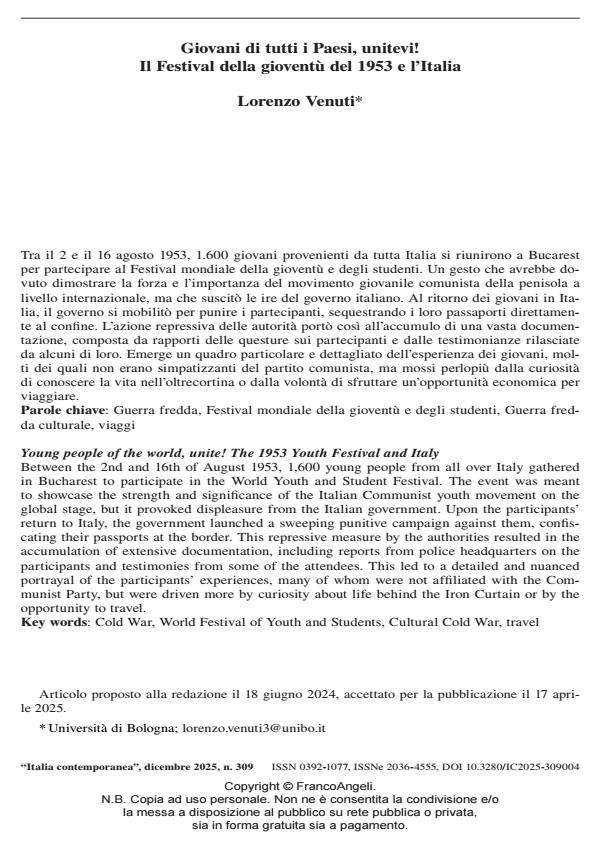
Between the 2nd and 16th of August 1953, 1,600 young people from all over Italy gathered in Bucharest to participate in the World Youth and Student Festival. The event was meant to showcase the strength and significance of the Italian Communist youth movement on the global stage, but it provoked displeasure from the Italian government. Upon the participants’ return to Italy, the government launched a sweeping punitive campaign against them, confiscating their passports at the border. This repressive measure by the authorities resulted in the accumulation of extensive documentation, including reports from police headquarters on the participants and testimonies from some of the attendees. This led to a detailed and nuanced portrayal of the participants’ experiences, many of whom were not affiliated with the Communist Party, but were driven more by curiosity about life behind the Iron Curtain or by the opportunity to travel.

Keywords: Cold War, World Festival of Youth and Students, Cultural Cold War, travel

  1. Agosti Aldo (2005), A Communist of a Special Mould: Umberto Terracini’s Opposition to the Cominform Turn in 1947, in Morgan Kevin, Cohn Gidon, Flinn Andrew (eds.), Agents of Revolution. New Biographical Approaches to the History of International Communism in the Age of Lenin and Stalin, Peter Lang, Bern.
  2. Appelbaum Anne (2012), Iron Curtain. The Crushing of Eastern Europe 1944-1956, Doubleday, New York.
  3. Andreucci Franco (2005), Falce e martello. Identità e linguaggi dei comunisti italiani fra stalinismo e guerra fredda, Bologna, Bononia UP.
  4. Barbagallo Francesco (1990), Il PCI dal Cominform al ’56: I «casi» Terracini, Magnani, Giolitti, “Studi Storici”, n. 1, pp. 89-115.
  5. Bechmann Pedersen Sune, Noack Christian (eds.) (2019), Tourism and Travel during the Cold War. Negotiating Tourist Experiences across the Iron Curtain, London-New York, Routledge.
  6. Békés Csaba (2022), Hungary’s Cold War. International Relations from the End of World War II to the Fall of the Soviet Union, Chapel Hill, University of North Carolina Press.
  7. Chiriu Andrea (2012), Summer 1953, Bucharest: the third world youth congress and the fourth world youth festival. The Italian concerns, “Revista Româna de Studii Eurasiatice”, nn. 1-2, pp. 105-118.
  8. Costantini Emanuela, Zinni Maurizio, Pisu Stefano, Dubrovina Olga (a cura di) (2020), “Mondo Contemporaneo”, nn. 2-3, Le relazioni culturali Est-Ovest durante la Guerra Fredda: diplomazie, propaganda e reti personali in Italia e nel mondo.
  9. Di Nucci Loreto (1988), I Pellegrini politici degli intellettuali italiani, in Hollander Paul, Pellegrini politici. Intellettuali occidentali in Unione Sovietica, Cina e Cuba, Bologna, il Mulino, (ed. or. 1981).
  10. Dogliani Patrizia (2003), Storia dei giovani, Milano, Mondadori.
  11. Dogliani Patrizia (2021), Le due nascite della Federazione giovanile comunista, in Pons Silvio (a cura di), Il comunismo italiano nella storia del Novecento, Viella, Roma.
  12. Dufrasse Sylvain (2019), Les héros du sport. Une histoire des champions soviétiques (années 1930-années 1980), Ceyzérieu, Champ Vallon.
  13. Erren Lorenz (2010), Stalinist Rule and Its Communication Practices. An Overview, in Postoutenko Kirill (ed.), Totalitarian Communication. Hierarchies, Codes and Messages, Bielefeld, Transcript.
  14. Fincardi Marco (2007), C’era una volta il mondo nuovo. La metafora sovietica nello sviluppo emiliano, Roma, Carocci.
  15. Giuntini Sergio (2020), ‘O Cammello. Vita, morti e miracolosi gol di Antonio Bacchetti partigiano-calciatore, Milano, Mimesis.
  16. Graziani Sofia (2018), International Political Activism in the ’50s. The World Federation of Democratic Youth and Bruno Bernini’s Encounter with Mao’s China, in Samarani Guido, Meneguzzi Rostagni Carla, Graziani Sofia (eds.), Roads to Reconciliation. People’s Republic of China, Western Europe and Italy During the Cold War Period (1949-1971), Venezia, Ca’ Foscari.
  17. Guiso Andrea (2006), La colomba e la spada. “Lotta per la pace” e antiamericanismo nella politica del Partito comunista italiano, Soveria Mannelli, Rubbettino.
  18. Koivunen Pia (2020), The World Youth Festival as a Soviet Cultural Product During the Cold War, “Quaestio Rossica”, n. 5, pp. 1612-1628,
  19. Koivunen Pia (2022), Performing Peace and Friendship. The World Youth Festivals and Soviet Cultural Diplomacy, Oldenbourg, De Gruyter.
  20. Kotek Jöel (1996), Students and the Cold War, London, Palgrave.
  21. Lesnykh Lidia (2020), Sport at the World Festival of Youth and Students: Between Olympic Ideals and Socialist Internationalism, “Frontier in Sports and Active Living”, n. 2, https://www.frontiersin.org/articles/10.3389/fspor.2020.567095/full,
  22. Maxim Juliana (2019), The Socialist Life of Modern Architecture. Bucharest, 1949-1964, London-New York, Routledge.
  23. Mariuzzo Andrea (2010), Divergenze parallele. Comunismo e anticomunismo alle origini del linguaggio politico dell’Italia repubblicana (1945-1953), Soveria Mannelli, Rubbettino.
  24. Martinez Oliva Juan C. (2006), La stabilizzazione del 1947. Fattori interni e internazionali, “Quaderni dell’Ufficio Ricerche Storiche”, Roma, Banca d’Italia.
  25. Mikkonen Simo, Koivunen Pia (eds.) (2015), Beyond the Divide. Entangled Histories of Cold War Europe, New York-Oxford, Berghahn.
  26. Péteri György (2004), Nylon Curtain – Transnational and Transsystemic Tendencies in The Cultural Life of State Socialist Russia and East-Central Europe, “Slavonica”, n. 2, pp. 113-123,
  27. Petrangeli Giulio (1999), I Partigiani della pace in Italia 1948-1953, “Italia contemporanea”, n. 217, pp. 667-692.
  28. Piretto Gian P. (2017), Il disgelo/il Festival della Gioventù, in “Doppiozero”, [https://www.doppiozero.com/il-festival-della-gioventu].
  29. Pons Silvio (2021), I comunisti italiani e gli altri. Visioni e legami internazionali nel mondo del Novecento, Einaudi, Torino.
  30. Predescu Magda (2017), Le festival mondial de la jeunesse et des étudiants, moment d’échanges inattendus et mal contrôlés, “Romanian Political Science Review”, n. 1, pp. 131-155.
  31. Romsics Ignác (1999), Hungary in the Twentieth Century, Budapest, Osiris.
  32. Ronci Donatella (1980), I giovani comunisti dalla Liberazione al 1957, Roma, Elengraf.
  33. Sbetti Nicola (2020), Giochi diplomatici. Sport e politica estera nell’Italia del secondo dopoguerra, Treviso-Roma, Fondazione Benetton-Viella.
  34. Scotti Giuseppe (2017), Il grande abbaglio. I festival mondiali della Gioventù democratica. Mosca 1957-2017, Milano, Sedizioni.
  35. Sheffer Edith (2011), Burned Bridge. How East and West Germans Made the Iron Curtain, Oxford, Oxford UP.
  36. Stefan Adelina (2024), Vacationing in Dictatorships: International Tourism in Socialist Romania and Franco’s Spain, Ithaca, Cornell UP.
  37. Tosatti Giovanna (2009), Storia del Ministero dell’Interno. Dall’Unità alla regionalizzazione, Bologna, il Mulino.
  38. Vargha Dóra (2018), Polio Across the Iron Curtain. Hungary’s Cold War with an Epidemic, Cambridge, Cambridge UP.
  39. Venuti Lorenzo (2019), Linguaggi dell’anticomunismo nell’Italia della guerra fredda. La Democrazia Cristiana e la “Mostra dell’Aldilà”, “Memoria e Ricerca”, n. 2, pp. 327-348, DOI: 10.14647/93543
  40. Vonnard Philippe, Sbetti Nicola, Quin Grégory (eds.) (2018), Beyond Boycotts. Sport during the Cold War in Europe, Berlin-Boston, De Gruyter.

Lorenzo Venuti, Giovani di tutti i Paesi, unitevi! Il Festival della gioventù del 1953 e l’Italia in "ITALIA CONTEMPORANEA" 309/2025, pp 97-122, DOI: 10.3280/IC2025-309004