Accessibilità alla comunicazione e alla partecipazione: Il Modello della Partecipazione e l’importanza della formazione
Journal title SALUTE E SOCIETÀ
Author/s Giuseppina Castellano, Federica Aiello, Raffaella Leo
Publishing Year 2025 Issue 2025/3
Language Italian Pages 14 P. 117-130 File size 415 KB
DOI 10.3280/SES2025-003008
DOI is like a bar code for intellectual property: to have more infomation
click here
Below, you can see the article first page
If you want to buy this article in PDF format, you can do it, following the instructions to buy download credits
FrancoAngeli is member of Publishers International Linking Association, Inc (PILA), a not-for-profit association which run the CrossRef service enabling links to and from online scholarly content.
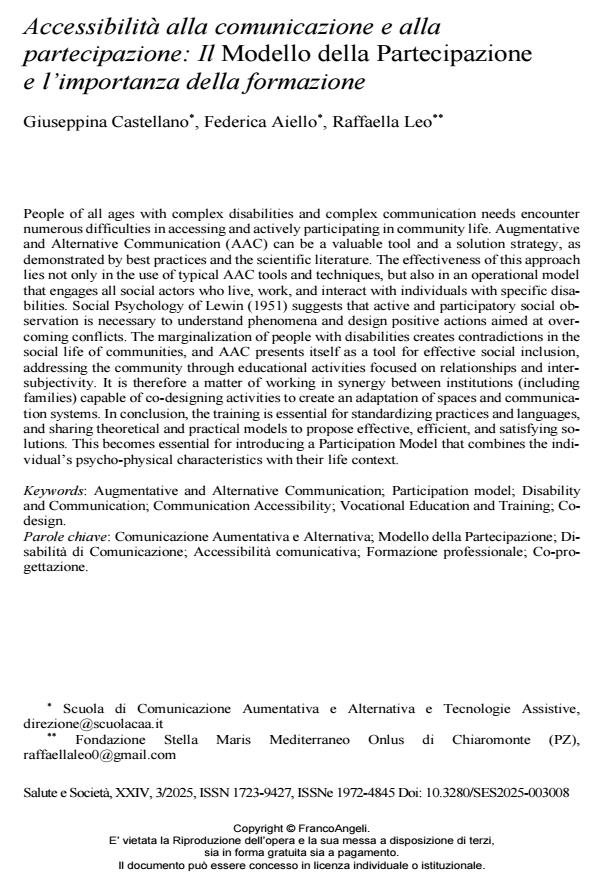
People of all ages with complex disabilities and complex communication needs encounter numerous difficulties in accessing and actively participating in community life. Augmentative and Alternative Communication (AAC) can be a valuable tool and a solution strategy, as demonstrated by best practices and the scientific literature. The effectiveness of this approach lies not only in the use of typical AAC tools and techniques, but also in an operational model that engages all social actors who live, work, and interact with individuals with specific disabilities. Social Psychology of Lewin (1951) suggests that active and participatory social observation is necessary to understand phenomena and design positive actions aimed at overcoming conflicts. The marginalization of people with disabilities creates contradictions in the social life of communities, and AAC presents itself as a tool for effective social inclusion, addressing the community through educational activities focused on relationships and intersubjectivity. It is therefore a matter of working in synergy between institutions (including families) capable of co-designing activities to create an adaptation of spaces and communication systems. In conclusion, the training is essential for standardizing practices and languages, and sharing theoretical and practical models to propose effective, efficient, and satisfying solutions. This becomes essential for introducing a Participation Model that combines the individual’s psycho-physical characteristics with their life context.
Keywords: Augmentative and Alternative Communication; Participation model; Disability and Communication; Communication Accessibility; Vocational Education and Training; Co-design.
- Baer D.M. (1993). A brief, selective history of the Department of Human Development and Family Life at the University of Kansas: The early years. Journal of Applied Behavior Analysis, 26(4): 569-572.
- Barca A., Clementi P., Luciani N., Samec R., Sforzina C., Span S. (2015). Creare opportunità di partecipazione con la CAA a Trieste: Progetti a sostegno della comprensione verbale, della comunicazione funzionale e percorsi di inclusione sociale nei contesti di vita verso un percorso di identità e di qualità di vita secondo il modello bio-psico-sociale. Pubblicazione degli atti. 5^ Conferenza Italiana sulla Comunicazione Aumentativa e Alternativa. Testo disponibile al sito: https://www.terniaccessibile.it/wp-content/uploads/2020/05/05_ATTI-V-CONFERENZA-ISAAC-ROMA-PARTE-B-CAA-1.pdf (01/09/2025).
- Beukelman D.R., Mirenda P. (2014). Manuale di comunicazione aumentativa e alternativa. Interventi per bambini e adulti con complessi bisogni comunicativi. Trento: Erickson.
- Bianco F., Izzo G., a cura di (2015). Ri-annodare i fili. Racconti dalla terra aliena – Esperienze di CAA. Trento: Erickson.
- Blackstone S., Hunt Berg M. (2010). Social Networks. Rilevazione dei dati sulla comunicazione per persone con bisogni comunicativi complessi e i loro partners comunicativi. Torino: Omega Edizioni.
- Bondy A.S., Frost L.A. (1994). The Picture Exchange Communication System. Focus on Autism and Other Developmental Disabilities, 9(3): 1-19. DOI: 10.1177/10883576940090030
- Castellano G. (2019). Comunicazione aumentativa alternativa e tecnologie assistive. Modelli di riferimento, strumenti, esperienze. Bologna: Helpicare.
- Castellano G., Cardinali C. (2021). Augmentative and Alternative Communication (AAC) in educational and school services: socio-pedagogical professional educator and the transdisciplinary approach to complexity. QTimes Journal of Education – webmagazine, Anno XIII, n. 4.
- Di Santo R. (2013). Sociologia della disabilità: Teorie, modelli, attori e istituzioni. Milano: FrancoAngeli.
- Edelman G.M. (1993). Sulla materia della mente. Milano: Adelphi.
- Gaspari P. (2017). Per una pedagogia speciale oltre la medicalizzazione. Milano: Guerini Scientifica.
- Ganzaroli F. (2021). Blissymbolics: il linguaggio mascherato. L’eredità di Mister Symbol Man. Milano: Helpicare.
- Ianes D., Cappello S., Demo H. (2018). Student Voice: Uno strumento per raccogliere il punto di vista degli alunni con Sindrome di Down sull’integrazione scolastica. Italian Journal of Special Education for Inclusion, 6(2): 83-104.
- ISAAC Italy. (2017). Principi e pratiche in CAA. Testo disponibile al sito: https://www.isaacitaly.it/wp-content/uploads/2018/02/PRINCIPI-CAA.pdf (01/09/2025).
- Lewin K. (1972). Teoria e sperimentazione in psicologia sociale. Bologna: Il Mulino.
- Light J. (1997). “Communication is the essence of human life”: Reflections on communicative competence. Augmentative and Alternative Communication, 13(2): 61-70. DOI: 10.1080/0743461971233127784
- Light J., McNaughton D. (2012). The changing face of augmentative and alternative communication: Past, present, and future challenges. Augmentative and Alternative Communication, 28(4): 197-204. DOI: 10.3109/07434618.2012.737024
- Light J., McNaughton D., Beukelman D., Fager S.K., Fried-Oken M., Jakobs T., Jakobs E. (2019). Challenges and opportunities in augmentative and alternative communication: Research and technology development to enhance communication and participation for individuals with complex communication needs. Augmentative and Alternative Communication, 35(1): 1-12. DOI: 10.1080/07434618.2018.155673
- Malcolm M. (2022). Environmental accessibility for autistic individuals: Recommendations for social work practice and spaces. Aotearoa New Zealand Social Work, 34(3): 103-115.
- Morin E. (1993). Introduzione al pensiero complesso. Gli strumenti per affrontare la sfida della complessità. Milano: Sperling & Kupfer.
- National Joint Committee for the Communication Needs of Persons with Severe Disabilities. (1992). Guidelines for meeting the communication needs of persons with severe disabilities [Guidelines]. Testo disponibile al sito: https://www.asha.org/policy/gl1992-00201/?srsltid=AfmBOopzb25mqdaF28sdU_RatwV0U0b8r6TzxmQUDYdMrOSbhA4q49Ek (01/06/2025).
- National Joint Committee for the Communication Needs of Persons with Severe Disabilities. (2024). NJC Communication Bill of Rights, 3rd edition. Testo disponibile al sito: https://www.asha.org/siteassets/njc/njc-communication-bill-rights.pdf (01/06/2025).
- OMS. (2002). ICF. Classificazione internazionale del funzionamento, della disabilità e della salute. Trento: Erickson.
- OMS. (2007). ICF-CY. Classificazione internazionale del funzionamento, della disabilità e della salute. Versione per bambini e adolescenti. Trento: Erickson.
- Pavone M. (2016). Il profilo “mutante” dell’insegnante specializzato. Diversi “vestiti” in diverse “stagioni”? I’integrazione scolastica e sociale, 15(1): 44-53.
- Prigogine I. (1997). La fine delle certezze: il tempo, il caos e le leggi di natura, Torino: Boringhieri.
- Schütz A. (1974). La fenomenologia del mondo sociale. Bologna: Il Mulino.
- Skinner B.F. (1938). The Behavior of organisms: An experimental analysis. New York: Appleton-Century-Crofts.
- Srinivasan S., Mathew S.N., Lloyd L.L. (2010). Insights into communication intervention and AAC in South India: A mixed-methods study. Communication Disorders Quarterly, 32(4): 232-246. DOI: 10.1177/1525740109354775
- Vygotskij L.S. (1974). Storia dello sviluppo delle funzioni psichiche superiori, e altri scritti. Firenze: Giunti–Barbera.
- Watson J.B. (1914). Behavior: An ntroduction to comparative psychology. New York: H. Holt.
Giuseppina Castellano, Federica Aiello, Raffaella Leo, Accessibilità alla comunicazione e alla partecipazione: Il Modello della Partecipazione e l’importanza della formazione in "SALUTE E SOCIETÀ" 3/2025, pp 117-130, DOI: 10.3280/SES2025-003008