Il caregiver come cure-giver: nuove soggettività di cura nella cronicità delle demenze
Journal title SALUTE E SOCIETÀ
Author/s Elisa Castellaccio
Publishing Year 2025 Issue 2025/3
Language Italian Pages 14 P. 146-159 File size 318 KB
DOI 10.3280/SES2025-003010
DOI is like a bar code for intellectual property: to have more infomation
click here
Below, you can see the article first page
If you want to buy this article in PDF format, you can do it, following the instructions to buy download credits
FrancoAngeli is member of Publishers International Linking Association, Inc (PILA), a not-for-profit association which run the CrossRef service enabling links to and from online scholarly content.
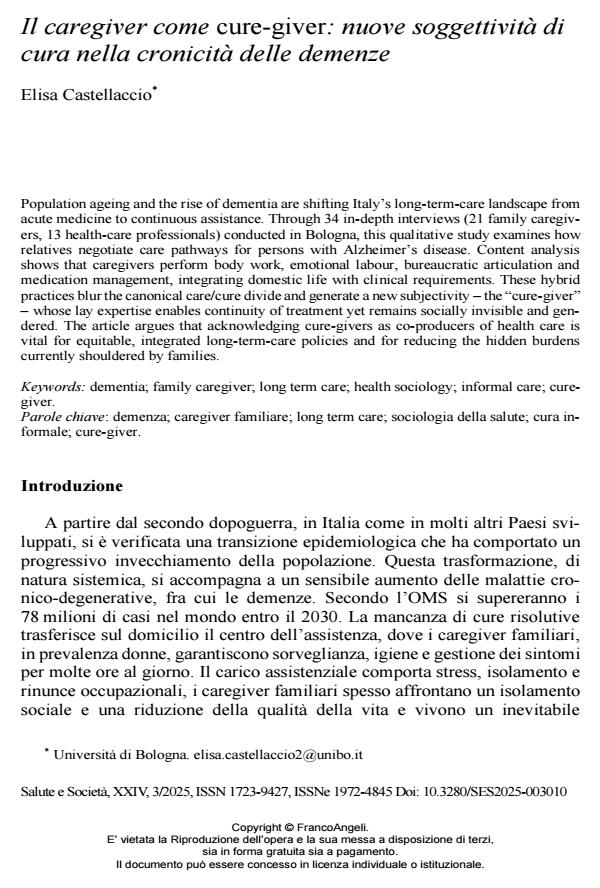
Population ageing and the rise of dementia are shifting Italy’s long-term-care landscape from acute medicine to continuous assistance. Through 34 in-depth interviews (21 family caregivers, 13 health-care professionals) conducted in Bologna, this qualitative study examines how relatives negotiate care pathways for persons with Alzheimer’s disease. Content analysis shows that caregivers perform body work, emotional labour, bureaucratic articulation and medication management, integrating domestic life with clinical requirements. These hybrid practices blur the canonical care/cure divide and generate a new subjectivity – the “cure-giver” – whose lay expertise enables continuity of treatment yet remains socially invisible and gendered. The article argues that acknowledging cure-givers as co-producers of health care is vital for equitable, integrated long-term-care policies and for reducing the hidden burdens currently shouldered by families.
Keywords: dementia; family caregiver; long term care; health sociology; informal care; cure-giver.
- Adams K.B. (2018). The Transition to Caregiving. The Experience of Family Members Embarking on the Dementia Caregiving Career. Journal of Gerontological Social Work, 47(3-4): 3-29.
- Barnes M. (2006). Care, communities and citizens. Harlow: Addison Wesley.
- Bhat K.S., Hall A.K., Kuo T., Kumar N. (2023). “We are half-doctors”: Family Caregivers as Boundary Actors in Chronic Disease Management. Proc. ACM Hum.-Comput. Interact, 7(1): 111. DOI: 10.1145/357954
- Bressan V., Visintini C., Palese A. (2020). What do family caregivers of people with dementia need? A mixed-method systematic review. Health and Social Care, 28(6): 1942-1960.
- Cecchini L. (2023). L’etica della cura e il ruolo dell’assistente sociale nei processi riproduttivi di stereotipi di genere a carico del caregiver familiare. Rivista di servizio sociale, LXII(1): 108-119.
- Colombo G. (2004). Cura, lavoro di cura, relazione: Parole, immagini e concetti in evoluzione. In Colombo G., Cocever E., Bianchi L., a cura di, Il lavoro di cura. Come si impara. Come si insegna. Roma: Carocci.
- Conrad P., Maturo A. (2009). La medicalizzazione della vita. Milano: FrancoAngeli.
- Corbetta P. (2015). La ricerca sociale: metodologia e tecniche. Bologna: Il Mulino.
- Corbin J., Strauss A.L. (1985). Managing chronic illness at home: Three lines of work. Qualitative Sociology, 8(3): 224-247. DOI: 10.1007/BF0098948
- Danely J. (2017). Carer narratives of fatigue and endurance in Japan and England. Subjectivity, 10(4): 411-426.
- Danely J. (2021). “It rips you to bits!”: Woundedness and compassion in carers’ narratives. In: Browne V., Danely J., Rosenow D., a cura di, Vulnerability and the Politics of Care: Transdisciplinary Dialogues. Oxford: University of Oxford Press.
- Eom K., Penkunas M.J., Chan A.W.M. (2017). Effect of caregiving relationship and formal long-term care service use on caregiver well-being. Geriatrics & Gerontology International, 17(10): 1714-1721.
- Fusch P.I., Ness L. (2015). Are We There Yet? Data Saturation in Qualitative Research. The Qualitative Report, 20(9): 1408-1416. DOI: 10.46743/2160-3715/2015.228
- Goffman E. (1974). Frame Analysis: An Essay on the Organization of Experience. Cambridge, MA: Harvard University Press.
- Held V. (2006). The ethics of care. Personal, political, and global. Oxford: Oxford University Press.
- Hochschild A.R. (1983). The managed heart: the commercialization of human feeling. Berkeley: University of California Press.
- Kishita N., Hammond L., Dietrich C.M., Mioshi E. (2018). Which interventions work for dementia family carers?: an updated systematic review of randomized controlled trials of carer interventions. International Psychogeriatric, 18: 1-18. DOI: 10.1017/S104161021800094
- Kittay E.F. (1999). Love’s labor. Essays on women, equality, and dependency. New York: Routledge.
- Maturo A. (2024). Il primo libro di sociologia della salute. Torino: Einaudi.
- Mayring P. (2014). Qualitative content analysis: a step-by-step guide. SAGE publications.
- Miele F., Piras E.M., Bruni A., Coletta C., Zanutto A. (2016). Gestire il fardello della cura: le reti di sostegno agli anziani fuori dalle istituzioni sanitarie. Autonomie locali e servizi sociali, 1: 163-178. DOI: 10.1447/8385
- Minelli M., Redini V. (2015). Vulnerabilità e agentività nella sfera più intima. Una ricerca su operatori socio-sanitari, familiari e badanti nell’assistenza domiciliare alla persona disabile anziana. AM. Rivista della Società Italiana di Antropologia Medica, 15(33-34): 267-313.
- Mol A., Pols J., Moser I. (2010). Care in practice. Bielefeld: Transcript.
- Pols J. (2012). Care at a Distance. Amsterdam: Amsterdam University Press.
- Ponnala S., Block L., Lingg A.J., Kind A.J., Werner N.E. (2020). Conceptualizing caregiving activities for persons with dementia (PwD) through a patient work lens. Applied Ergonomics, 85: 103070.
- Quinn C., Hillman A., Barbosa A., Toms G. (2024). Emotional Labor in Dementia Research. Qualitative Health Research, 0(0). DOI: 10.1177/1049732324127470
- Rocard E., Llena-Nozal A. (2022). Supporting informal carers of older people: Policies to leave no carer behind (OECD Health Working Papers No. 140). OECD Publishing.
- Schwarz J. (2020). Caring when curing is not an option. Narrative Inquiry in Bioethics, 10(2): 139-144.
- Strauss A. (1985). Work and the division of labor. The Sociological Quarterly, 26(1): 1-19.
- Strauss A. (1993). Continual Permutations of Action. New York: Aldine de Gruyter.
- Tronto J.C. (1993). Moral boundaries. A political argument for an ethic of care. New York, London: Routledge.
- Tronto J.C. (2013). Caring democracy. Markets, equality, and justice. New York: NYU Press.
- Twigg J. (2000). Carework as a form of body work. Ageing and Society, 20: 389-411. DOI: 10.1017/S0144686X9900780
- Van der Weele S., Bredewold F., Leget C., Tonkens E. (2021). What is the problem of dependency? Dependency work reconsidered. Nursing Philosophy, 22(2): e12327.
- Wang Y., Shyu Y., Chen M., Yang P. (2010). Reconciling work and family caregiving among adult-child family caregivers of older people with dementia: effects on role strain and depressive symptoms. Journal of Advanced Nursing, 67(4): 829-840.
- WHO (2022). Caregiving impacts on unpaid informal carers’ health and well-being – a gender perspective: factsheet. Ginevra: Organizzazione Mondiale della Sanità.
- Wilkinson R., Pickett K. (2009). The spirit level: Why equality is better for everyone. London: Penguin Books.
Elisa Castellaccio, Il caregiver come cure-giver: nuove soggettività di cura nella cronicità delle demenze in "SALUTE E SOCIETÀ" 3/2025, pp 146-159, DOI: 10.3280/SES2025-003010