«Perché diventino i dottori di loro stessi». Le transizioni mediche e d’età nei percorsi di cura dell’asma cronico

Journal title SALUTE E SOCIETÀ
Author/s Vulca Fidolini
Publishing Year 2025 Issue 2025/3
Language Italian Pages 16 P. 160-175 File size 293 KB
DOI 10.3280/SES2025-003011
DOI is like a bar code for intellectual property: to have more infomation click here

Below, you can see the article first page

If you want to buy this article in PDF format, you can do it, following the instructions to buy download credits
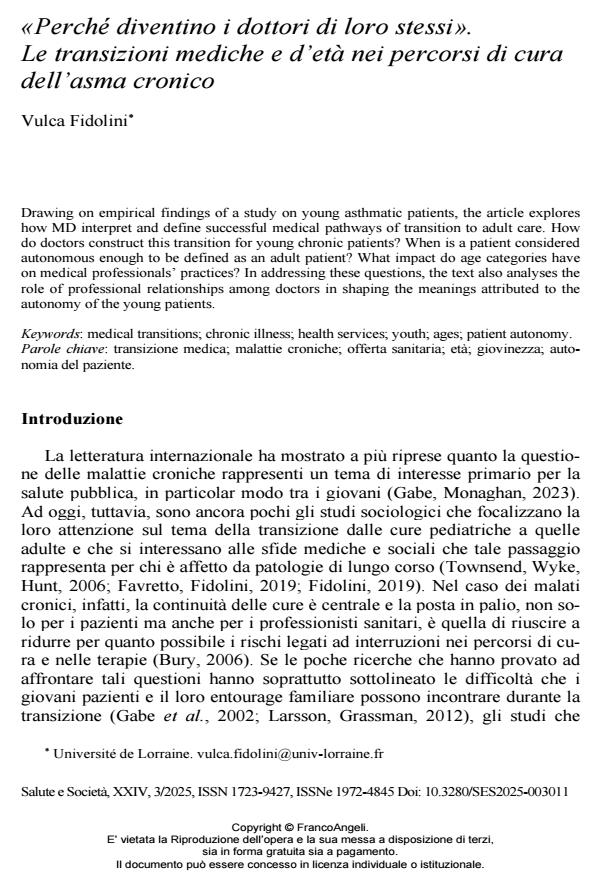
Article preview

FrancoAngeli is member of Publishers International Linking Association, Inc (PILA), a not-for-profit association which run the CrossRef service enabling links to and from online scholarly content.

Drawing on empirical findings of a study on young asthmatic patients, the article explores how MD interpret and define successful medical pathways of transition to adult care. How do doctors construct this transition for young chronic patients? When is a patient considered autonomous enough to be defined as an adult patient? What impact do age categories have on medical professionals’ practices? In addressing these questions, the text also analyses the role of professional relationships among doctors in shaping the meanings attributed to the autonomy of the young patients.

Keywords: medical transitions; chronic illness; health services; youth; ages; patient autonomy.

  1. Achin C., Ouardi S., Rennes J. (2009). Âges, intersectionnalité, rapports de pouvoir. Mouvements, 59 (3): 91-101.
  2. Airoldi C., Pagnoni F., Cena T., Ceriotti D., De Ambrosi D., De Vito M., Faggiano F. (2023). Estimate of the prevalence of subjects with chronic diseases in a province of Northern Italy: a retrospective study based on administrative databases. BMJ Open, 13: e070820.
  3. Bichet L. (2022). Les négociations de l’équipement qui convient : enjeux relationnels dans la prise en charge du diabète de l’enfant. Anthropologie & Santé, 25.
  4. Bury M. (1982). Chronic illness as biographical disruption. Sociology of Health and Illness, 4(2): 167-182.
  5. Bury M. (2006). The Sociology of Chronic Illness: A Review of Research and Prospects. Sociology of Health & Illness, 13(4): 451-468.
  6. Corbin J., Strauss A.L. (1991). A Nursing Model for Chronic Illness Management Based upon the Trajectory Framework. Scholarly Inquiry for Nursing Practice, 5(3): 155-174.
  7. Delmas M.-C., Guignon N., Leynaert B., Moisy M., Marguet C., Fuhrman C. (2017). Augmentation de la prévalence de l’asthme chez le jeune enfant en France. Revue des Maladies Respiratoires, 34(5): 525-534.
  8. Demoly P. (2018). Allergologie aujourd’hui. Un livre blanc pour enseignement et pratiques. Bulletin de l’Académie Nationale de Médecine, 202 (5-6): 1139-1145. DOI: 10.1016/S0001-4079(19)30279-
  9. Favretto A.R., Fidolini V. (2019). Childhood, youth and health. International and contemporary perspectives. Introduction. Salute e Società, XVIII(3): 5-9. DOI 10.3280/SES2019-003001
  10. Fegran L., Hall E.O., Uhrenfeldt L., Aagaard H., Ludvigsen M.S. (2014). Adolescents’ and young adults’ transition experiences when transferring from paediatric to adult care: A qualitative metasynthesis. International Journal of Nursing Studies, 51(1): 123-135.
  11. Fidolini V. (2019). Youth and chronic illness. Thinking age and health care trajectories among asthmatic patients. Salute e Società, XVIII(3): 59-71. DOI 10.3280/SES2019-003006
  12. Fidolini V. (2021). Lasciare casa, diventare grandi. L’uscita dal domicilio genitoriale tra i malati d’asma cronico. Studi di sociologia, 59(3): 211-225. DOI 10.26350/000309_000121
  13. Fidolini V. (2023). Parcours de décohabitation et maladie chronique. L’autonomie sous contrôle parental de jeunes asthmatiques sévères. Agora – Débats/Jeunesses, 93(1): 23-36.
  14. Fidolini V., Merienne A. (2022). Le genre de l’asthme. Filles et garçons face à une maladie chronique. Territoires Contemporains, 16. Testo disponibile al sito: http://tristan.u-bourgogne.fr/CGC/publications/elements-sociologie-genre-sante/Vulca-Fidolini-Alexandra-Merienne.html (16/10/2025).
  15. Gabe J., Bury M., Ramsay R. (2002). Living with asthma: The experiences of young people at home and at school. Social Science and Medicine, 55(9): 1619-1633.
  16. Gabe J., Monaghan, L.F. (2023). Young people and the sociology of chronic illness: meanings, management and consequences. In: Petersen A., a cura di, Handbook on the Sociology of Health and Medicine. Cheltenham: Edward Elgar Publishing. DOI: 10.4337/9781839104756.00018
  17. Larsson A.T., Grassman E.J. (2012). Bodily changes among people living with physical impairments and chronic illnesses: Biographical disruption or normal illness? Sociology of Health and Illness, 34(8): 1156-1169.
  18. Mahlaoui N., Langellier-Bellevue B. (2017). Les enjeux de la transition de la pédiatrie vers la médecine d’adultes. Soins Pediatrie/Puériculture, 38(297): 12-15.
  19. Mellerio H., Jacquin P., Le Roux E. (2021). Accompagner la transition des jeunes avec une maladie chronique. Médecine/Sciences, 37(10): 888-894.
  20. Monaghan L.F., Gabe J. (2015). Chronic illness as biographical contingency? Young people’s experiences of asthma. Sociology of Health and Illness, 37(8): 1236-1253. DOI: 10.1111/1467-9566.1230
  21. Prout A., Hayes L., Gelder L. (1999). Medicines and Maintenance of Ordinariness in the Household Management of childhood Asthma. Sociology of Health & Illness, 21(2): 137-162. DOI: 10.1111/1467-9566.0014
  22. Townsend A., Wyke S., Hunt K. (2006). Self-managing and managing self: Practical and moral dilemmas in accounts of living with chronic illness. Chronic Illness, 2(3): 185-194. DOI: 10.1177/1742395306002003130
  23. Williams C. (2000). Doing health, doing gender: teenagers, diabetes and asthma, Social science & medicine, 50(3): 387-396.

Vulca Fidolini, «Perché diventino i dottori di loro stessi». Le transizioni mediche e d’età nei percorsi di cura dell’asma cronico in "SALUTE E SOCIETÀ" 3/2025, pp 160-175, DOI: 10.3280/SES2025-003011