Navigating the challenges of renewable energy transition in emerging economies: Insights from Brazil

Journal title ECONOMICS AND POLICY OF ENERGY AND THE ENVIRONMENT
Author/s Laura Visintainer Lerman, Daisy Valle Enrique, Wolfgang Gerstlberger
Publishing Year 2025 Issue 2025/2
Language English Pages 24 P. 5-28 File size 483 KB
DOI 10.3280/EFE2025-002001
DOI is like a bar code for intellectual property: to have more infomation click here

Below, you can see the article first page

If you want to buy this article in PDF format, you can do it, following the instructions to buy download credits
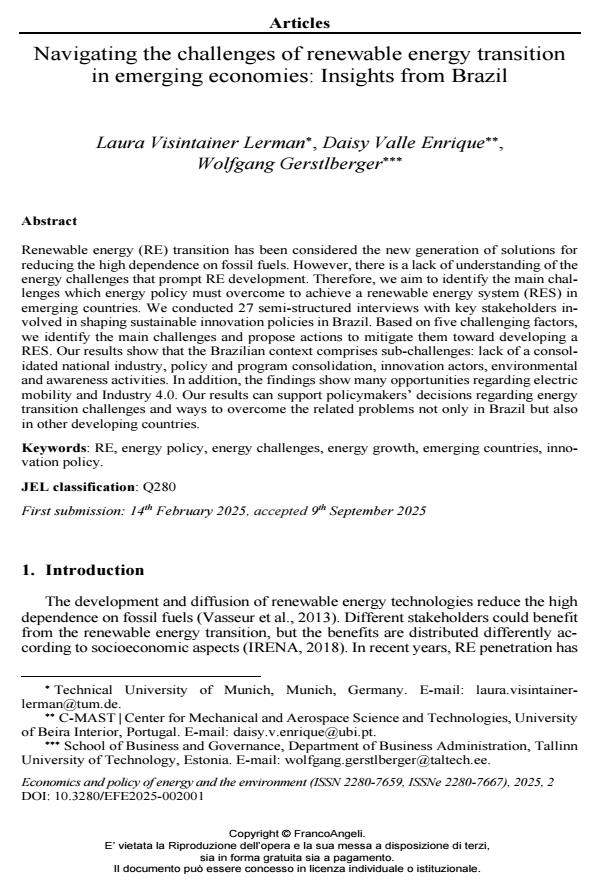
Article preview

FrancoAngeli is member of Publishers International Linking Association, Inc (PILA), a not-for-profit association which run the CrossRef service enabling links to and from online scholarly content.

Renewable energy (RE) transition has been considered the new generation of solutions for reducing the high dependence on fossil fuels. However, there is a lack of understanding of the energy challenges that prompt RE development. Therefore, we aim to identify the main challenges which energy policy must overcome to achieve a renewable energy system (RES) in emerging countries. We conducted 27 semistructured interviews with key stakeholders involved in shaping sustainable innovation policies in Brazil. Based on five challenging factors, we identify the main challenges and propose actions to mitigate them toward developing a RES. Our results show that the Brazilian context comprises subchallenges: lack of a consolidated national industry, policy and program consolidation, innovation actors, environmental and awareness activities. In addition, the findings show many opportunities regarding electric mobility and Industry 4.0. Our results can support policymakers’ decisions regarding energy transition challenges and ways to overcome the related problems not only in Brazil but also in other developing countries.

Keywords: RE, energy policy, energy challenges, energy growth, emerging countries, innovation policy.

Jel codes: Q280 Q280

  1. Akella, A. K., Saini, R. P., Sharma, M. P. (2009). Social, economic and environmental impacts of RESs. RE, 34(2), 390-396.
  2. ANEEL (2024). Banco de Informações de Geração. Retrieved from -- https://www.gov.br/ aneel/pt-br/centrais-de-conteudos/relatorios-e-indicadores/geracao.
  3. Arzova, S. B., Sahin, B. S. (2024). Macroeconomic and financial determinants of green growth: an empirical investigation on BRICS-T countries. Management of Environmental Quality, 35(3), 506-524. DOI: 10.1108/MEQ-07-2023-0210
  4. Bamati, N., Raoofi, A. (2019). Development level and the impact of technological factor on RE production. RE, 151, 946-955.
  5. BMUB (2016). Climate Protection Plan 2050. Federal Ministry for the Environment, Nature Conservation and Nuclear Safety. Retrieved from -- http://www.bmub.bund.de/fileadmin/Daten_BMU/Download_PDF/Klimaschutz/klimaschutzplan_2050_bf.pdf.
  6. Bradshaw, A., de Martino Jannuzzi, G. (2019). Governing energy transitions and regional economic development: Evidence from three Brazilian states. Energy Policy, 126, 1-11.
  7. de Melo, C. A., de Martino Jannuzzi, G., Bajay, S. V. (2016). Nonconventional RE govern-ance in Brazil: Lessons to learn from the German experience. Renewable and Sustainable Energy Reviews, 61, 222-234.
  8. de Oliveira, L. P. N., Rochedo, P. R. R., Portugal-Pereira, J., Hoffmann, B. S., Aragão, R., Milani, R., ... and Schaeffer, R. (2016). Critical technologies for sustainable energy de-velopment in Brazil: Technological foresight based on scenario modelling. Journal of Cleaner Production, 130, 12-24.
  9. Eisenhardt, K. M., and Graebner, M. E. (2007). Theory building from cases: Opportunities and challenges. Academy of Management Journal, 50(1), 25-32.
  10. Falcone, P. M. (2023). Sustainable energy policies in developing countries: a review of chal-lenges and opportunities. Energies, 16(18), 6682.
  11. Fobissie, E. N. (2019). The role of environmental values and political ideology on public sup-port for RE policy in Ottawa, Canada. Energy Policy, 134, 110918.
  12. Frank, A. G., Gerstlberger, W., Paslauski, C. A., Lerman, L. V., Ayala, N. F. (2018). The contribution of innovation policy criteria to the development of local RESs. Energy Pol-icy, 115, 353-365.
  13. Furtado, A. T., Hekkert, M. P., Negro, S. O. (2020). Of actors, functions, and fuels: Exploring a second-generation ethanol transition from a technological innovation systems perspec-tive in Brazil. Energy Research & Social Science, 70, 101706.
  14. Ghimire, L. P., Kim, Y. (2018). An analysis on barriers to RE development in the context of Nepal using AHP. RE, 129, 446-456.
  15. Herrera, M. M., Dyner, I., Cosenz, F. (2020). Benefits from energy policy synchronisation of Brazil’s North-Northeast interconnection. RE, 162, 427-437.
  16. Howard, D. B., Soria, R., Thé, J., Schaeffer, R., Saphores, J. D. (2020). The energy-climate-health nexus in energy planning: A case study in Brazil. Renewable and Sustainable En-ergy Reviews, 132, 110016.
  17. IRENA (2018). Global energy transformation: A roadmap to 2050. Retrieved from --https://www.irena.org/-/media/Files/IRENA/Agency/Publication/2019/Apr/IRENA_ Global_Energy_Transformation_2019.pdf.
  18. IRENA (2019). Renewables 2019 Global Status Report. Retrieved from --https://wedocs.unep.org/bitstream/handle/20.500.11822/28496/REN2019.pdf?sequence= 1andisAllowed=y%0Ahttp://www.ren21.net/cities/wp-content/uploads/2019/05/REC-GSR-Low-Res.pdf.
  19. Jordaan, S. M., Romo-Rabago, E., McLeary, R., Reidy, L., Nazari, J., Herremans, I. M. (2017). The role of energy technology innovation in reducing greenhouse gas emissions: A case study of Canada. Renewable and Sustainable Energy Reviews, 78, 1397-1409.
  20. Kamalu, K., Wan Ibrahim, W. H. B. (2023). Towards full decarbonization: does environmen-tal tax and renewable energy matters in developing countries?. Journal of Environmental Economics and Policy, 13(4), 404-419. DOI: 10.1080/21606544.2023.2279963
  21. Lerman, L. V., Gerstlberger, W., Lima, M. F., Frank, A. G. (2021a). How governments, uni-versities, and companies contribute to RE development? A municipal innovation policy perspective of the triple helix. Energy Research & Social Science, 71, 101854.
  22. Lerman, L. V., Benitez, G. B., Gerstlberger, W., Rodrigues, V. P., Frank, A. G. (2021b). Sus-tainable conditions for the development of RESs: a triple bottom line perspective. Sus-tainable Cities and Society, 103362.
  23. Liu, W., Zhang, X., Feng, S. (2019). Does RE policy work? Evidence from a panel data anal-ysis. RE, 135, 635-642.
  24. Mayring, P. (2000). Qualitative Inhaltsanalyse. Grundlagen und Techniken (1983). Mazzucato, M., Semieniuk, G. (2018). Financing RE: Who is financing what and why it mat-
  25. ters. Technological Forecasting and Social Change, 127, 8-22.
  26. Mendonça, H. L., Macedo-soares, T. D. L. V. A. De, Vinicius, M., Fonseca, D. A. (2018). Working towards a framework based on mission-oriented practices for assessing RE inno-vation policies. Journal of Cleaner Production, 193, 709-719.
  27. Moallemi, E. A., Ahamdi, A., Afrazeh, A., Moghaddam, N. B. (2014). Understanding sys-temic analysis in the governance of sustainability transition in renewable energies: the case of fuel cell technology in Iran. Renewable and Sustainable Energy Reviews, 33, 305-315.
  28. Moreira, J. M., Cesaretti, M. A., Carajilescov, P., Maiorino, J. R. (2015). Sustainability dete-rioration of electricity generation in Brazil. Energy Policy, 87, 334-346.
  29. Negro, S. O., Alkemade, F., Hekkert, M. P. (2012). Why does RE diffuse so slowly? A review of innovation system problems. Renewable and Sustainable Energy Reviews, 16(6), 3836-3846.
  30. Nguyen, V. C. T., Le, H. Q. (2024). The impact of ICT infrastructure, technological innova-tion, renewable energy consumption and financial development on carbon dioxide emis-sion in emerging economies: new evidence from Vietnam. Management of Environmental Quality, 35(6), 1233-1253. DOI: 10.1108/MEQ-09-2023-0325
  31. Newell, D., Sandström, A., Söderholm, P. (2017). Energy Research and Social Science Net-work management and RE development: An analytical framework with empirical illus-trations. Chemical Physics Letters, 23, 199-210.
  32. Njoh, A. J., Etta, S., Ngyah-Etchutambe, I. B., Enomah, L. E. D., Tabrey, H. T., Essia, U. (2019). Opportunities and challenges to rural RE projects in Africa: Lessons from the Esaghem Village, Cameroon solar electrification project. RE, 131, 1013-1021.
  33. Orlovic-Lovren, V. (2011). The role of education in protected area sustainable governance. Management of Environmental Quality: An International Journal, 22(1), 48-58. DOI: 10.1108/14777831111098471
  34. Paim, M. A., Dalmarco, A. R., Yang, C. H., Salas, P., Lindner, S., Mercure, J. F., Viñuales, J.
  35. E. (2019). Evaluating regulatory strategies for mitigating hydrological risk in Brazil through diversification of its electricity mix. Energy Policy, 128, 393-401.
  36. Painuly, J. P. (2001). Barriers to RE penetration: a framework for analysis. RE, 24(1), 73-89. DOI: 10.1016/S0960-1481(00)00186-5
  37. Pischke, E. C., Solomon, B., Wellstead, A., Acevedo, A., Eastmond, A., De Oliveira, F., Lu-con, O. (2019). From Kyoto to Paris: Measuring RE policy regimes in Argentina, Brazil, Canada, Mexico and the United States. Energy Research and Social Science, 50, 82-91.
  38. Plank, J., Doblinger, C. (2018). The firm-level innovation impact of public R&D funding: Evidence from the German RE sector. Energy Policy, 113, 430-438.
  39. Przychodzen, W., Przychodzen, J. (2020). Determinants of RE production in transition econ-omies: A panel data approach. Energy, 191, 116583. 292-306.
  40. Rogge, K. S., Reichardt, K. (2016). Policy mixes for sustainability transitions: An extended concept and framework for analysis. Research Policy, 45(8), 1620-1635.
  41. Ruppert-Winkel, C. (2018). Leaders, networks and the social context: A relational leadership approach to regional RE self-sufficiency. Journal of Cleaner Production, 193, 811-832.
  42. Samant, S., Thakur-Wernz, P., Hatfield, D. E. (2020). Does the focus of RE policy impact the nature of innovation? Evidence from emerging economies. Energy Policy, 137, 111119.
  43. Scharl, S., Praktiknjo, A. (2019). The role of a digital industry 4.0 in a RES. International Journal of Energy Research, 43(8), 3891-3904.
  44. Seyfang, G., Smith, A. (2007). Grassroots innovations for sustainable development: Towards a new research and policy agenda. Environmental Politics, 16(4), 584-603. DOI: 10.1080/09644010701419121
  45. Sinsel, S. R., Riemke, R. L., Hoffmann, V. H. (2019). Challenges and solution technologies for the integration of variable RE sources – a review. RE, 145, 2271-2285.
  46. Sperling, K., Hvelplund, F., Mathiesen, B. V. (2011). Centralisation and decentralisation in strategic municipal energy planning in Denmark. Energy Policy, 39(3), 1338-1351.
  47. Vasseur, V., Kamp, L. M., Negro, S. O. (2013). A comparative analysis of Photovoltaic Tech-nological Innovation Systems including international dimensions: the cases of Japan and The Netherlands. Journal of Cleaner Production, 48, 200-210.
  48. Vazquez, M., Hallack, M. (2018). The role of regulatory learning in energy transition: The case of solar PV in Brazil. Energy Policy, 114, 465-481.
  49. Voss, C., Tsikriktsis, N., Frohlich, M. (2002). Case research in operations management. In-ternational Journal of Operations & Production Management. DOI: 10.1108/01443570210414329
  50. Yin, R. K. (2009). Case study research: Design and methods (Vol. 5). Sage.
  51. Zeng, S., Liu, Y., Liu, C., Nan, X. (2017). A review of RE investment in the BRICS countries: History, models, problems and solutions. Renewable and Sustainable Energy Reviews, 74, 860-872.

Laura Visintainer Lerman, Daisy Valle Enrique, Wolfgang Gerstlberger, Navigating the challenges of renewable energy transition in emerging economies: Insights from Brazil in "ECONOMICS AND POLICY OF ENERGY AND THE ENVIRONMENT" 2/2025, pp 5-28, DOI: 10.3280/EFE2025-002001