Bridging quality and sustainability: A bibliometric and systematic exploration of ESG scores in quality anomalies

Journal title ECONOMICS AND POLICY OF ENERGY AND THE ENVIRONMENT
Author/s Piyalee Bhattacharya, Asheesh Pandey
Publishing Year 2025 Issue 2025/2
Language English Pages 26 P. 67-92 File size 561 KB
DOI 10.3280/EFE2025-002004
DOI is like a bar code for intellectual property: to have more infomation click here

Below, you can see the article first page

If you want to buy this article in PDF format, you can do it, following the instructions to buy download credits
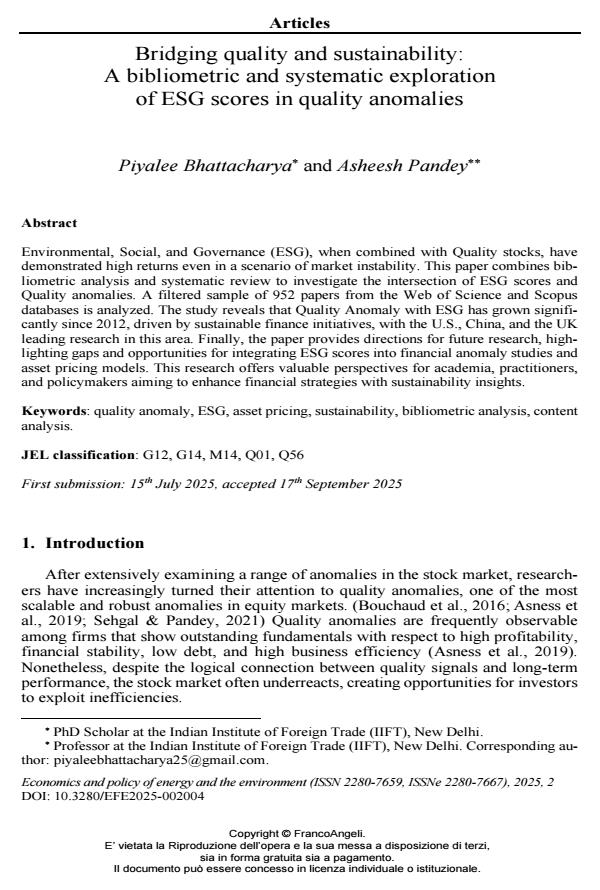
Article preview

FrancoAngeli is member of Publishers International Linking Association, Inc (PILA), a not-for-profit association which run the CrossRef service enabling links to and from online scholarly content.

Environmental, Social, and Governance (ESG), when combined with Quality stocks, have demonstrated high returns even in a scenario of market instability. This paper combines bibliometric analysis and systematic review to investigate the intersection of ESG scores and Quality anomalies. A filtered sample of 952 papers from the Web of Science and Scopus databases is analyzed. The study reveals that Quality Anomaly with ESG has grown significantly since 2012, driven by sustainable finance initiatives, with the U.S., China, and the UK leading research in this area. Finally, the paper provides directions for future research, highlighting gaps and opportunities for integrating ESG scores into financial anomaly studies and asset pricing models. This research offers valuable perspectives for academia, practitioners, and policymakers aiming to enhance financial strategies with sustainability insights.

Keywords: quality anomaly, ESG, asset pricing, sustainability, bibliometric analysis, content analysis.

Jel codes: G12, G14, M14, Q01, Q56

  1. Abdi, Y., Li, X., CàmaraTurull, X. (2022). Exploring the impact of sustainability (ESG) disclosure on firm value and financial performance (FP) in airline industry: The moderating role of size and age. Environment, Development and Sustainability, 24(4), 50525079.
  2. Abdulrasool, H. D., Othman, R. (2022). Analysing Global Research on Stock Market Anomalies: A Behavioural Finance Perspective. International Journal of Academic Research in Business and Social Sciences, 12(6), 18911913.
  3. Asness, C. S., Frazzini, A., Pedersen, L. H. (2019). Quality minus junk. Review of Accounting Studies, 24(1), 34112.
  4. Bag, D., Mohanty, S. (2021). Impact of environmental, social & governance (ESG) factors on stock returns of emerging markets. Cleaner and Responsible Consumption, 8.
  5. Bali, T. G., Cakici, N., Whitelaw, R. F. (2011). Maxing out: Stocks as lotteries and the crosssection of expected returns. Journal of Financial Economics, 99(2), 427446.
  6. Ball, R., Brown, P. (1968). An Empirical Evaluation of Accounting Income Numbers. Journal of Accounting Research, 6(2), 159178. DOI: 10.2307/2490232
  7. Banz, R. W. (1981). The relationship between return and market value of common stocks. Journal of Financial Economics, 9(1), 318. DOI: 10.1016/0304405X(81)900180
  8. Blitz, D. C., van Vliet, P. (2007). The volatility effect: Lower risk without lower return. Journal of Portfolio Management, 34(1), 102113.
  9. Bolton, P., Kacperczyk, M. (2021). Do investors care about carbon risk?, Journal of Financial Economics, 142(2), 517549.
  10. Bouchaud, J.P., Ciliberti, S., Landier, A., Simon, G., Thesmar, D. (2016). The Excess Returns of “Quality” Stocks: A Behavioral Anomaly (arxiv:1601.04478). Arxiv. http://arxiv.org/abs/1601.04478.
  11. Buallay, A. (2018). Is sustainability reporting (ESG) associated with performance? Evidence from the European banking sector. Management of Environmental Quality: An International Journal, 30(1), 98115. DOI: 10.1108/MEQ1220170149
  12. Cakici, N., Fabozzi, F. J., Tan, S. (2013). Size, value, and momentum in emerging market stock returns, Emerging Markets Review, 16, 4665.
  13. Campbell, J. Y., Hilscher, J., Szilagyi, J. (2008). In Search of Distress Risk. The Journal of Finance, 63(6), 28992939.
  14. Cardillo, G., Bendinelli, E., Torluccio, G. (2023). COVID19, ESG investing, and the resilience of more sustainable stocks: Evidence from European firms. Business Strategy and the Environment, 32(1), 602623.
  15. Carhart, M. M. (1997). On Persistence in Mutual Fund Performance. The Journal of Finance, 52(1), 5782.
  16. Christensen, H. B., Hail, L., Leuz, C. (2021). Mandatory CSR and sustainability reporting: Economic analysis and literature review. Review of Accounting Studies, 26(3), 11761248.
  17. Cochrane, J. H. (2005). Asset pricing: Liquidity, trading, and asset prices. NBER Reporter Online, National Bureau of Economic Research (NBER). Cambridge, MA, Iss. Winter 2004/05, pp. 112. https://hdl.handle.net/10419/61850.
  18. Consolandi, C., JaiswalDale, A., Poggiani, E., Vercelli, A. (2009). Global Standards and Ethical Stock Indexes: The Case of the Dow Jones Sustainability Stoxx Index. Journal of Business Ethics, 87(S1), 185197.
  19. Covachev, S., Martel, J., BritoRamos, S. (2025). Are ESG factors truly unique? The North American Journal of Economics and Finance, 77, 102386.
  20. Daniel, K., Titman, S. (2006). Market Reactions to Tangible and Intangible Information. The Journal of Finance. 4. https://ssrn.com/abstract=414701.
  21. De Area Leão Pereira, E. J., Da Silva, M. F., Pereira, H. B. B. (2017). Econophysics: Past and present. Physica A: Statistical Mechanics and Its Applications, 473, 251261.
  22. Demers, E., Hendrikse, J., Joos, P., Lev, B. I. (2021). ESG didn’t immunize stocks during the COVID19 crisis, but investments in intangible assets did. Journal of Business Finance & Accounting.
  23. Dhingra, B., Batra, S., Aggarwal, V., Yadav, M., Kumar, P. (2024). Stock market volatility: A systematic review. Journal of Modelling in Management, 19(3), 925952. DOI: 10.1108/JM20420230080
  24. Donthu, N., Kumar, S., Mukherjee, D., Pandey, N., Lim, W. M. (2021). How to conduct a bibliometric analysis: An overview and guidelines. Journal of Business Research, 133, 285296.
  25. Eccles, R., Ioannou, I., Serafeim, G. (2014). The Impact of Corporate Sustainability on Organizational Processes and Performance. Management Science, 60, 28352857.
  26. Edmans, A. (2011). Does the stock market fully value intangibles? Employee satisfaction and equity prices. Journal of Financial Economics, 101(3), 621640.
  27. Fama, E. F. (1970). Efficient Capital Markets: A Review of Theory and Empirical Work. The Journal of Finance, 25(2), 2830. https://www.jstor.org/stable/2325486.
  28. Fama, E. F., French, K. R. (1992). The CrossSection of Expected Stock Returns. The Journal of Finance, 47(2), 427465.
  29. Fama, E. F., French, K. R. (1993). Common risk factors in the returns on stocks and bonds.Journal of Financial Economics, 33(1), 356. DOI: 10.1016/0304405X(93)900235
  30. Fama, E. F., French, K. R. (1996). Multifactor Explanations of Asset Pricing Anomalies. The Journal of Finance, 51(1), 5584.
  31. Fama, E. F., French, K. R. (2012). Size, value, and momentum in international stock returns.
  32. Journal of Financial Economics, 105(3), 457472. Economics, 116(1), 122.
  33. Fama, E. F., French, K. R. (2017). International tests of a fivefactor asset pricing model. Journal of Financial Economics, 123(3), 441463.
  34. Fan, S., Linda, Y. (2017). Stock Market Anomalies. Financial Markets and Investments, 460 480.
  35. Frazzini, A., Pedersen, L. H. (2014). Betting against beta. Journal of Financial Economics, 111(1), 125.
  36. Friede, G., Busch, T., Bassen, A. (2015). ESG and financial performance: Aggregated evidence from more than 2000 empirical studies. Journal of Sustainable Finance & Investment, 5(4), 210233. DOI: 10.1080/20430795.2015.1118917
  37. Fu, J. (2024). ESG, Stock Returns and Stock Volatility: Evidence from Chinese Listed Companies. SHS Web of Conferences, 181, 02002.
  38. Fu, T., Tang, H., Loang, O. K., Wu, W. (2023). Bibliometricsbased and systematic literature analysis of ESG practices and implications to firm performance. International Journal of Accounting, 8(50), 529549. DOI: 10.55573/IJAFB.085037
  39. Galletta, S., Mazzù, S., Naciti, V. (2022). A bibliometric analysis of ESG performance in the banking industry: From the current status to future directions. Research in International Business and Finance, 62, 101684.
  40. Grant, M. J., Booth, A. (2009). A typology of reviews: An analysis of 14 review types and associated methodologies. Health Information & Libraries Journal, 26(2), 91108.
  41. Green, B. N., Johnson, C. D., Adams, A. (2006). Writing narrative literature reviews for peerreviewed journals: Secrets of the trade. Journal of Chiropractic Medicine, 5(3), 101117. DOI: 10.1016/S08993467(07)601426
  42. Gupta, S., Walia, N., Singh, S., Gupta, S. (2023). A systematic literature review and bibliometric analysis of noise trading. Qualitative Research in Financial Markets, 15(1), 190 215. DOI: 10.1108/QRFM0920210154
  43. Hartzmark, S. M., Sussman, A. B. (2019). Do Investors Value Sustainability? A Natural Experiment Examining Ranking and Fund Flows. ECGI Working Paper Series in Finance, 565/2018. http://ssrn.com/abstract_id=3016092.
  44. Hawn, O., Chatterji, A., Mitchell, W. (2017). Do Investors Actually Value Sustainability? New Evidence from Investor Reactions to the Dow Jones Sustainability Index (DJSI). Strategic Management Journal, 39.
  45. Hirshleifer, D., Kewei, H., Teoh, S. H., Yinglei, Z. (2004). Do investors overvalue firms with bloated balance sheets?, Journal of Accounting and Economics, 38, 297331.
  46. Hou, K., Xue, C., Zhang, L. (2015). Digesting Anomalies: An Investment Approach. Review of Financial Studies, 28(3), 650705.
  47. Jagannathan, R., Wang, Z. (1996). The conditional CAPM and the crosssection of expected returns. The Journal of Finance, 51(1), 353. DOI: 10.2307/2329301
  48. Jegadeesh, N. (1990). Evidence of predictable behaviour of security returns. The Journal of Finance, 45(3), 881898. DOI: 10.2307/2328797
  49. Jegadeesh, N., Titman, S. (1993). Returns to Buying Winners and Selling Losers: Implications for Stock Market Efficiency. The Journal of Finance, 48(1), 6591.
  50. Keshari, A., Gautam, A. (2023). Asset pricing in global scenario: A bibliometric analysis. IIM Ranchi Journal of Management Studies, 2(1), 4869. DOI: 10.1108/IRJMS0220220025
  51. Khan, M., Serafeim, G., Yoon, A. (2016). Corporate Sustainability: First Evidence on Materiality. The Accounting Review, 91(6), 16971724.
  52. La Torre, M., Mango, F., Cafaro, A., Leo, S. (2020). Does the ESG Index Affect Stock Return? Evidence from the Eurostoxx50. Sustainability, 12(16), 6387.
  53. Lakonishok, J., Shleifer, A., Vishny, R. W. (1994). Contrarian Investment, Extrapolation, and Risk. The Journal of Finance, 49(5), 15411578.
  54. Loughran, T., Ritter, J. R. (1995). The New Issues Puzzle. The Journal of Finance, 50(1), 23 51. DOI: 10.2307/2329238
  55. Lu, C.W., Wu, H.L., & Su, Y.H. (2024). The icing on the cake: ESG effect on the quality factor portfolios. Finance Research Letters, 70, 106304.
  56. Magiera, F. T. (1997). Do Stock Prices Fully Reflect Information in Accruals and Cash Flows about Future Earnings, CFA Digest, 27(1), 1416.
  57. Mittal, D. A., Enclave, V., Agarwal, R., College, S. (2015). Corporate governance in India: an emerging trend towards global market economy. XVI Annual Conference Proceedings, 177185. http://www.internationalconference.in/XVI_AIC/INDEX.HTM.
  58. Moolkham, M. (2025). How do firm characteristics amplify the importance of ESG ratings for investors?. Economics and Sociology, 18(1), 90115. DOI: 10.14254/2071789X.2025/181/5
  59. Moraes, A. K., Furtini, A. A. S., Prado, J. W., Junior, L. G. C., Ceretta, P. S. (2024). Evolution of scientific production on the Efficient Market: Bibliometric study. Contextus – Revista Contemporânea de Economia e Gestão, 22, e92462.
  60. Nelson D. B. (1991). Conditional Heteroskedasticity in Asset Returns: A New Approach. Econometrica, 59(2), 347370. https://www.jstor.org/stable/2938260.
  61. NovyMarx, R. (2013). The other side of value: The gross profitability premium. Journal of Financial Economics, 108(1), 128.
  62. Otinga, N. K., Obi, P., MugoWaweru, F. (2024). Stock market participation puzzle: A systematic review and bibliometric analysis. Cogent Business & Management, 11(1), 2396531. DOI: 10.1080/23311975.2024.2396531
  63. Robinson, M., Kleffner, A., Bertels, S. (2011). Signaling Sustainability Leadership: Empirical Evidence of the Value of DJSI Membership. Journal of Business Ethics, 101(3), 493505.
  64. Rudkin, W., Cai, C. X., Zhou, Y. (2025). Can we enhance investment with ESG? International Review of Financial Analysis, 97, 103776.
  65. Saka, C., Oshika, T. (2014). Disclosure effects, carbon emissions, and corporate value. Sustainability Accounting, Management and Policy Journal, 5(1), 2245. DOI: 10.1108/SAMPJ0920120030
  66. Sehgal, S., Pandey, A. (2021). Firm quality and stock returns: Evidence from India. Investment Analysts Journal, 50(3), 189208. DOI: 10.1080/10293523.2021.1991130
  67. Sharpe, W. (1964). Capital Asset Prices: A Theory of Market Equilibrium under Conditions of Risk. The Journal of Finance, 19(3), 425442. DOI: 10.2307/2977928
  68. Snyder, H. (2019). Literature review as a research methodology: An overview and guidelines. Journal of Business Research, 104, 333339.
  69. Stambaugh, R. F., Yu, J., Yuan, Y. (2012). The short of it: Investor sentiment and anomalies. Journal of Financial Economics, 104, 288302.
  70. Stambaugh, R. F., Yuan, Y. (2017). Mispricing Factors. Review of Financial Studies, 30, April, 12701315.
  71. Toonen, W. M. (2021, August 23). Dissecting Anomaly Returns Among High and Low ESG Stocks. Business Economics. http://hdl.handle.net/2105/59188.
  72. Wai Kong Cheung, A. (2011). Do Stock Investors Value Corporate Sustainability? Evidence from an Event Study. Journal of Business Ethics, 99(2), 145165.
  73. White, H. (1980). A HeteroskedasticityConsistent Covariance Matrix Estimator and a Direct Test for Heteroskedasticity. Econometrica, 48(4), 817. DOI: 10.2307/1912934
  74. Xing, Y. (2008). Interpreting the Value Effect Through the QTheory: An Empirical Investigation. Review of Financial Studies, 21(4), 17671795.
  75. Zerbib, O. D. (2022). A Sustainable Capital Asset Pricing Model (SCAPM): Evidence from Environmental Integration and Sin Stock Exclusion. Review of Finance, 26(6), 13451388.
  76. Zhang, L. (2005). The Value Premium. The Journal of Finance, 60(1), 67103.
  77. Zhou, G., Liu, L., Luo, S. (2022). Sustainable development, ESG performance, and company market value: Mediating effect of financial performance. Business Strategy and the Environment, 31(7), 33713387.
  78. Zulfikar, Z. (2022). Bibliometric analysis of stock market performance throughout the COVID19 outbreak. Investment Management and Financial Innovations, 19(2), 1423.

Piyalee Bhattacharya, Asheesh Pandey, Bridging quality and sustainability: A bibliometric and systematic exploration of ESG scores in quality anomalies in "ECONOMICS AND POLICY OF ENERGY AND THE ENVIRONMENT" 2/2025, pp 67-92, DOI: 10.3280/EFE2025-002004