Lavoro eco-sociale e giustizia ambientale: riflessioni professionali, pratiche territoriali e sfide trasformative
Journal title ECONOMIA E SOCIETÀ REGIONALE
Author/s Elisa Matutini, Sonia Brondi
Publishing Year 2025 Issue 2025/2
Language Italian Pages 11 P. 25-35 File size 266 KB
DOI 10.3280/ES2025-002003
DOI is like a bar code for intellectual property: to have more infomation
click here
Below, you can see the article first page
If you want to buy this article in PDF format, you can do it, following the instructions to buy download credits
FrancoAngeli is member of Publishers International Linking Association, Inc (PILA), a not-for-profit association which run the CrossRef service enabling links to and from online scholarly content.
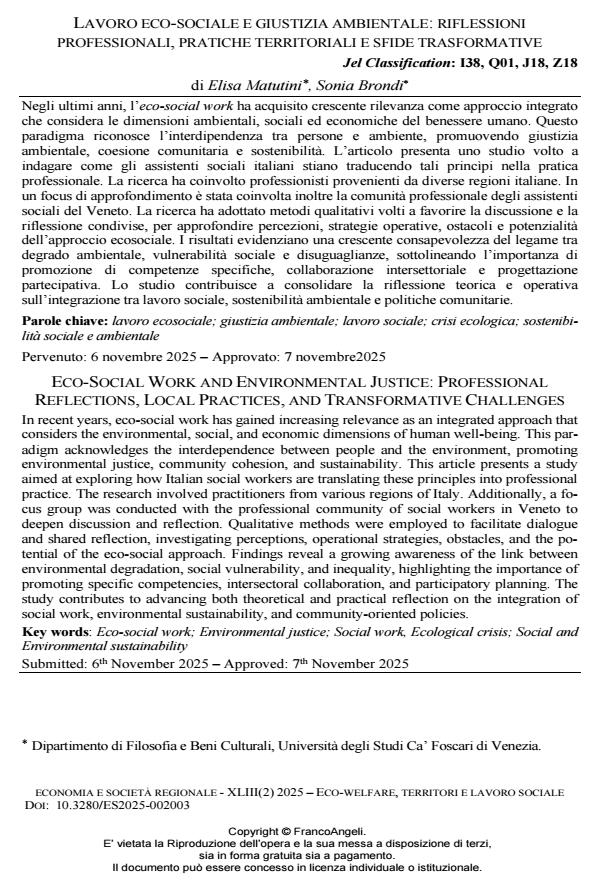
In recent years, ecosocial work has gained increasing relevance as an integrated approach that considers the environmental, social, and economic dimensions of human wellbeing. This paradigm acknowledges the interdependence between people and the environment, promoting environmental justice, community cohesion, and sustainability. This article presents a study aimed at exploring how Italian social workers are translating these principles into professional practice. The research involved practitioners from various regions of Italy. Additionally, a focus group was conducted with the professional community of social workers in Veneto to deepen discussion and reflection. Qualitative methods were employed to facilitate dialogue and shared reflection, investigating perceptions, operational strategies, obstacles, and the potential of the ecosocial approach. Findings reveal a growing awareness of the link between environmental degradation, social vulnerability, and inequality, highlighting the importance of promoting specific competencies, intersectoral collaboration, and participatory planning. The study contributes to advancing both theoretical and practical reflection on the integration of social work, environmental sustainability, and communityoriented policies.
Keywords: Ecosocial work; Environmental justice; Social work, Ecological crisis; Social and Environmental sustainability
Jel codes: I38, Q01, J18, Z18
- Arora N.K., Mishra I. (2019). United Nations Sustainable Development Goals 2030 and environmental sustainability: Race against time. Environmental Sustainability, 2: 339.
- Calbucci R., Deiedda M., De Santi M., Di Rosa R.T., Fiorentini A., Giuliano E., Gui L., Mordeglia S., Pelosio S., Sartori F. (2016). Servizio Sociale e Calamità Naturali. Interventi di Servizio Sociale. Roma: Edizioni EISS.
- Coates J., Gray M. (2012). The Environment and Social Work: An Overview and Introduction. International Journal of Social Work, 21(3): 230238.
- Dominelli L. (2012). Green Social Work. Cambridge (UK): Polity Press.
- Hoff M.D., Mc Nutt J.G. (1995). The Global Environmental Crisis: Implications for Social Welfare and Social Work. Journal of Sociology & Social Welfare, 22: 17. DOI: 10.15453/01915096.2253
- Iofrida M. (2019). Per un paradigma del corpo: una rifondazione filosofica dell’ecologia. Roma: Quodlibet.
- Jones P. (2010). Responding to the ecological crisis: Transformative pathways for social work education. Journal of Social Work Education, 46(1): 6784. DOI: 10.5175/JSWE.2010.200800073
- Kemp S.P. (2011). Recentring Environment in Social Work Practice: Necessity, Opportunity, Challenge. The British Journal of Social Work, 41(6): 11981210.
- Landi C. (2024). Prospettive di EcoSocial Work nel lavoro sociale di comunità. Welfare & Ergonomia, 2: 225240. DOI: 10.3280/WE2023002016
- Matutini E., a cura di (2023). EcoSocial Work. Politica e lavoro sociale nella crisi ecologica. Varazze: PM.
- Matutini E., Busacca M., Da Roit B. (2023). Ready, steady, go? Obstacles to the spread of ecosocial work approaches: An Italian case study. Sustainability, 15(4), 3050.
- Matutini E., Chiara G., Brondi S. (2025). Agency and Advocacy in Social Work: Promoting Social and Environmental Justice Through Professional Practice. Sustainability, 17(20), 9208.
- McGregor D.P. (2004). Traditional Ecological Knowledge and Sustainable Development: Towards coexistence. In The Way of Development: Indigenous Peoples, Life Projects and Globalisation. In: Blaser M., Feit H.A., McRae G., Eds. In the Way of Development: Indigenous Peoples, Life Projects and Globalization. London: Zed Book.
- Mugumbate J., Nyanguru A. (2013). Exploring African philosophy: The value of Ubuntu in social work. African Journal of Social Work, 3(2): 82.
- Mwansa L.K.J. (2010). Challenges Facing Social Work Education in Africa. International Social Work, 53(1): 129136.
- Rambaree K., Powers M.C.F., Smith R.J. (2019). Ecosocial work and social change in community practice. Journal of Community Practice, 27(3/4): 205212. DOI: 10.1080/10705422.2019.1660516
- Volturo S. (2023). Verso un welfare sostenibile? Il contributo del lavoro sociale nella lotta alla povertà in prospettiva ecosociale. Politiche Sociali, 1: 123 142. DOI: 10.7389/107142
- Zapf M.K. (2010). Social Work and the Environment: Understanding People and Place. Critical Social Work, 11(3).
Elisa Matutini, Sonia Brondi, Lavoro eco-sociale e giustizia ambientale: riflessioni professionali, pratiche territoriali e sfide trasformative in "ECONOMIA E SOCIETÀ REGIONALE " 2/2025, pp 25-35, DOI: 10.3280/ES2025-002003