Interconnessioni tra città e aree interne. Ripensare il territorio per una nuova idea di sviluppo

Journal title ECONOMIA E SOCIETÀ REGIONALE
Author/s Arianna Cattalini, Antonello Podda
Publishing Year 2025 Issue 2025/2
Language Italian Pages 18 P. 37-54 File size 317 KB
DOI 10.3280/ES2025-002004
DOI is like a bar code for intellectual property: to have more infomation click here

Below, you can see the article first page

If you want to buy this article in PDF format, you can do it, following the instructions to buy download credits
Article preview

FrancoAngeli is member of Publishers International Linking Association, Inc (PILA), a not-for-profit association which run the CrossRef service enabling links to and from online scholarly content.

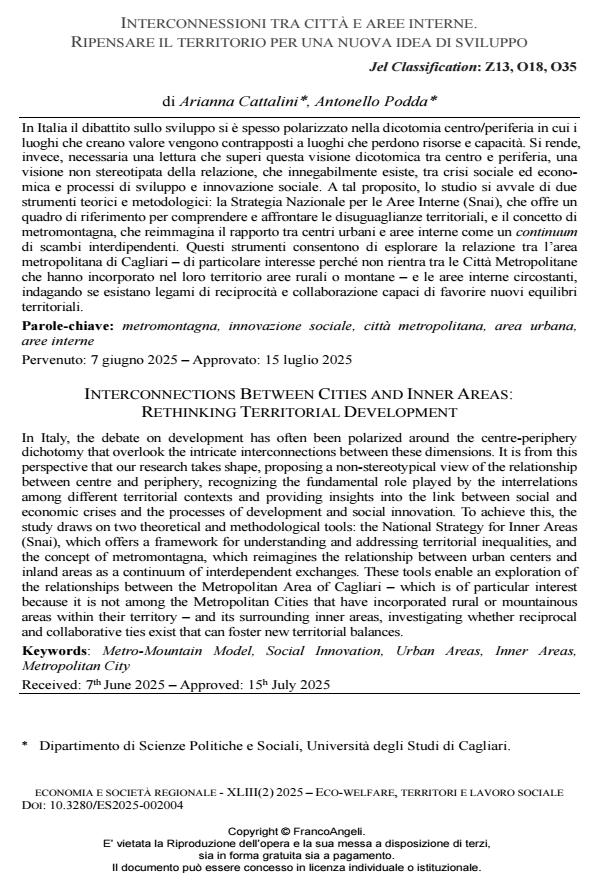
In Italy, the debate on development has often been polarized around the centreperiphery dichotomy that overlook the intricate interconnections between these dimensions. It is from this perspective that our research takes shape, proposing a nonstereotypical view of the relationship between centre and periphery, recognizing the fundamental role played by the interrelations among different territorial contexts and providing insights into the link between social and economic crises and the processes of development and social innovation. To achieve this, the study draws on two theoretical and methodological tools: the National Strategy for Inner Areas (Snai), which offers a framework for understanding and addressing territorial inequalities, and the concept of metromontagna, which reimagines the relationship between urban centers and inland areas as a continuum of interdependent exchanges. These tools enable an exploration of the relationships between the Metropolitan Area of Cagliari – which is of particular interest because it is not among the Metropolitan Cities that have incorporated rural or mountainous areas within their territory – and its surrounding inner areas, investigating whether reciprocal and collaborative ties exist that can foster new territorial balances.

Keywords: MetroMountain Model, Social Innovation, Urban Areas, Inner Areas, Metropolitan City

  1. Barbera F. (2018). Il noi mancante. Rivista il Mulino, 22 ottobre <https://www. rivistailmulino.it/a/ilnoimancante>.
  2. Barbera F., De Rossi A., a cura di (2021). Mentromontagna. Un progetto per riabitare l’Italia. Roma: Donzelli Editore.
  3. Barbera F., Parisi T. (2019). Innovatori sociali. La sindrome di Prometeo nell’Italia che cambia. Bologna: il Mulino.
  4. Barca F., Carrosio G., Lucatelli S. (2018). Le aree interne da luogo di disuguaglianza a opportunità per il paese. In: Paolazzi L., Gargiulo T., Sylos Labini M., a cura di. Le sostenibili carte dell’Italia. Venezia: Marsilio.
  5. Busacca M. (2013). Oltre la retorica della Social Innovation. Impresa Sociale, 2(11): 3954.
  6. Carrosio G. (2019). I margini al centro. L’Italia delle aree interne tra fragilità e innovazione. Roma: Donzelli Editore.
  7. Combes P., Duranton G., Gobillon L., Puga D., Roux S. (2012). The productivity advantages of large cities: Distinguishing agglomeration from firm selection. Econometrica, 80(6): 25432594. DOI: 10.3982/ECTA8442
  8. De Rossi A., a cura di (2018). Riabitare l’Italia. Le aree interne tra abbandoni e riconquiste. Roma: Donzelli Editore.
  9. Dijkstra L., Poelman H., RodríguezPose A. (2019) The geography of EU discontent. Regional Studies, 54(6): 737753. DOI: 10.1080/00343404.2019.1654603
  10. Florida R. (2002). The Rise of the Creative Class. New York: Basic Books. Trad. it. (2003). L’ascesa della nuova classe creativa. Stile di vita, valori e professioni. Milano: Mondadori.
  11. Florida R. (2005). Cities and the Creative Class. New YorkLondra: Routledge. Fuguitt G.V. (1971). The Places Left Behind: Population Trends and Policy for Rural America. Rural Sociology, 36(4): 449470.
  12. Glaeser E.L. (2011). Triumph of the city: How our greatest invention makes us richer, smarter, greener, healthier and happier. New York: Penguin.
  13. Montanari M., Ferreri F., Avola M., Panichella N. (2024). Giovani e aree marginali in Italia. La scelta di restare tra aspirazioni individuali e contesto. la Rivista delle Politiche Sociali, 2: 111128 <https://www.futuraeditrice.it/prodotto/ rpsn22024/>.
  14. Moralli M. (2022). L’ABC dell’innovazione sociale. Tra sostenibilità, creatività e sviluppo. Bologna: Bologna University Press.
  15. Morelli N., Pratschke J., Vitale T., Cousin B., Del Fabbro M., Piolatto M. (2019). Perché il Movimento 5 Stelle non ha sfondato a Milano? Un’analisi strutturale a scala metropolitana. Meridiana, 96: 159184.
  16. Osti G. (2016). Territori fragili e servizi di welfare: l’Italia come mediana dell’Europa. Culture della sostenibilità, 9(17): 512.
  17. Perra S., a cura di (2023). Strumenti e azioni pubbliche contro lo sfruttamento del lavoro migrante in Sardegna. Proposte metodologiche per l’analisi del fenomeno e la progettazione dell’osservatorio regionale contro lo sfruttamento. Torino: Rosenberg&Sellier.
  18. Podda A., Loconto A.M., Arcidiacono D., Maestripieri L. (2021). Exploring prosumption: Reconfiguring labor through ruralurban food networks?. Journal of Rural Studies, 82(February): 442446.
  19. RodríguezPose A. (2018). The revenge of the places that don’t matter (and what to do about it). Cambridge Journal of Regions, Economy and Society, 11(1): 189209.
  20. RodríguezPose A. (2019). La geografia del malcontento e la vendetta dei luoghi che non contano. Territori abbandonati dalle politiche. Forum Disuguaglianze Diversità. Palazzo delle Esposizioni. Roma, 28 maggio <https:// www.forumdisuguaglianzediversita.org/lavendettadeiluoghichenonco ntano/>.
  21. Sassen S. (2000). Cities in a World Economy. Newbury Park (CA): Pine Forge Press.
  22. Sen A.K. (1992). Inequality Reexamined. Oxford: Oxford University Press.

Arianna Cattalini, Antonello Podda, Interconnessioni tra città e aree interne. Ripensare il territorio per una nuova idea di sviluppo in "ECONOMIA E SOCIETÀ REGIONALE " 2/2025, pp 37-54, DOI: 10.3280/ES2025-002004