From “as if” to “why not?”. Notes on transference, violations and transmission of knowledge starting from the Godley case

Journal title PSICOTERAPIA E SCIENZE UMANE
Author/s Davide Cavagna
Publishing Year 2025 Issue 2025/4
Language Italian Pages 22 P. 600-621 File size 404 KB
DOI 10.3280/PU2025-004002
DOI is like a bar code for intellectual property: to have more infomation click here

Below, you can see the article first page

If you want to buy this article in PDF format, you can do it, following the instructions to buy download credits
Article preview

FrancoAngeli is member of Publishers International Linking Association, Inc (PILA), a not-for-profit association which run the CrossRef service enabling links to and from online scholarly content.

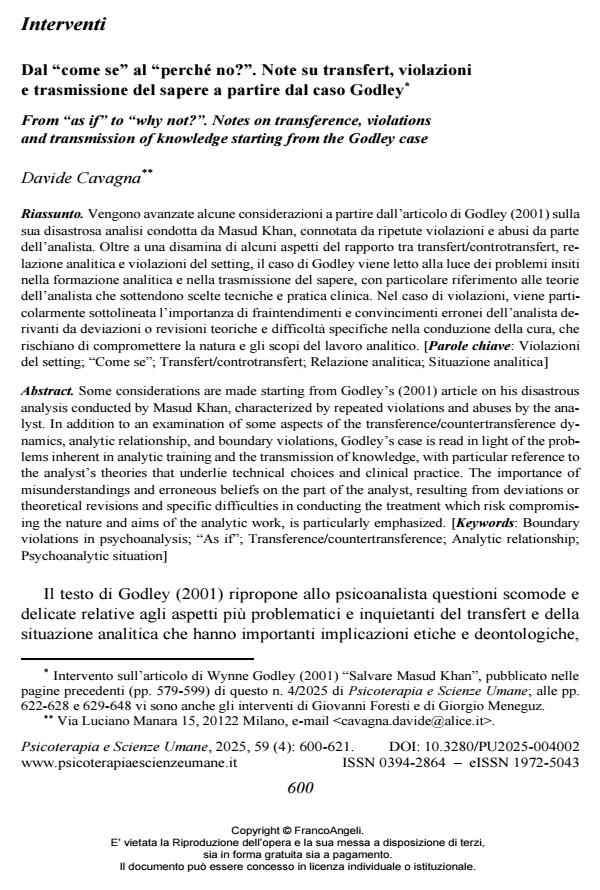
Some considerations are made starting from Godley’s (2001) article on his disastrous analysis conducted by Masud Khan, characterized by repeated violations and abuses by the analyst. In addition to an examination of some aspects of the transference/countertransference dynamics, analytic relationship, and boundary violations, Godley’s case is read in light of the problems inherent in analytic training and the transmission of knowledge, with particular reference to the analyst’s theories that underlie technical choices and clinical practice. The importance of misunderstandings and erroneous beliefs on the part of the analyst, resulting from deviations or theoretical revisions and specific difficulties in conducting the treatment which risk compromising the nature and aims of the analytic work, is particularly emphasized.

Keywords: Boundary violations in psychoanalysis; “As if”; Transference/countertransference; Analytic relationship; Psychoanalytic situation

  1. Freud S. (1904 [1905]). Psicoterapia. Opere, 4: 429-239. Torino: Boringhieri, 1970.
  2. Aulagnier P. (1979). Les destins du plaisir: aliénation, amour, passion. Paris: PUF (trad. it.: I destini del piacere. Alienazione, amore, passione. Roma: La Biblioteca, 2002).
  3. Baldini F. (2024). Il problema della realtà nella metapsicologia freudiana. Metapsychologica, VI, 1: 169-215.
  4. Bollas C. (1987). The Shadow of the Object: Psychoanalysis of the Unthought Known. London: Free Association (trad. it.: L’ombra dell’oggetto. Psicoanalisi del conosciuto non pensato. Roma: Borla, 1989).
  5. Borgogno F. (2009). Ferenczi e Winnicott: “a partially missing link”. Richard e Piggle, 17, 2: 129-142. DOI: 10.1711/434.5099
  6. Braunschweig D. (1971). Psychanalyse et réalité: À propos de la théorie de la technique psychanalytique. Revue Française de Psychanalyse, 35, 5/6: 655-828. Ristampa: Revue Française de Psychanalyse, 2020, 84, 5: 1359-1374:
  7. Britton R. (1998). Belief and Imagination. Explorations in Psuychoanalysis. London: Routledge (trad. it.: Credenza e immaginazione. Roma: Borla, 2006).
  8. Burroughs W.S. (1959). Naked Lunch. New York: Grove Press (trad. it.: Il pasto nudo. Milano: SugarCo, 1959; Milano: Adelphi, 2001).
  9. Canestri J. (1993). A cry of fire: Some considerations on transference love. In: Person, Hagelin & Fonagy, 1993, pp. 156-164 (trad. it.: Allarme d’incendio: alcune considerazioni sull’amore di transfert, pp. 131-148).
  10. Castiello d’Antonio A. (2017). Recensione: “Glen O. Gabbard, Violazioni del setting (2016). Seconda edizione. Milano: Raffaello Cortina, 2017”. Psicoterapia e Scienze Umane, 51, 3: 496-497. DOI: 10.3280/PU2017-003015
  11. Cavagna D. (2004a). La china “scivolosa”: note su neutralità e passione nel transfert. Setting, XIV, 18: 119-130.
  12. Cavagna D. (2004b). Corpo, inconscio, coscienza: i fondamenti della vita psichica. In: Oasi O. & Cavagna D., a cura di, Percorsi di psicologia dinamica. Milano: FrancoAngeli, 2004, pp. 91-108.
  13. Cavagna D. (2010). I segni ambigui: psicoanalisi del soggetto etico. Setting, XX, 29: 77-99.
  14. Cavagna D. (2021). La Società Psicologica del Mercoledì e la nascita del movimento psicoanalitico. In: Oasi, Cavagna & Paolicelli, 2021, pp. 3-25.
  15. Cavagna D. (2022). Krìsis: considerazioni epistemologiche su psicoanalisi e psicoterapia psicoanalitica. In: Benetti R.G., Cavicchioli G. & Scalvini T., a cura di, Il legame che trasforma. Pensieri e strumenti per una psicoterapia psicoanalitica orientata all’intersoggetività. Milano: FrancoAngeli, 2022, pp. 87-101.
  16. Chasseguet-Smirgel J. (1984). Creativity and Perversion. London: Free Association (trad. it.: Creatività e perversione. Milano: Raffaello Cortina, 1990).
  17. Cima G. (2025). Leggere Kant con Sade. Lo scritto maledetto di Jacques Lacan. Teramo: Galaad.
  18. Contardi R. (2025). La tela di Penelope. Psicoanalisi, etica e religione. Roma: Alpes.
  19. Cremerius J. (1992). “Liebe” in der Psychotherapie. Praxis der Psychotherapie und Psychosomatik, 37, 2: 92-100. Anche in: Arbeitsberichte aus der psychoanalytischen Praxis. Tübingen: Diskord, 1998, pp. 195-204 (trad. it.: L’amore in psicoterapia. In: Il futuro della psicoanalisi. Roma: Armando, 2000, pp. 68-76).
  20. Doi T. (1973). The Anatomy of Dependence. Tokyo: Kodansha International (trad. it. Anatomia della dipendenza. Un’interpretazione del comportamento sociale dei giapponesi. Milano: Raffaello Cortina, 1991).
  21. Eagle M.N. (2011). From Classical to Contemporary Psychoanalysis. A Critique and Integration. New York: Routledge (trad. it.: Da Freud alla psicoanalisi contemporanea. Critica e integrazione. Milano: Raffaello Cortina, 2012; trad. it. delle pp. 131-143: La natura sociale della mente. Psicoterapia e Scienze Umane, 2011, 45, 1: 7-22).
  22. Eagle M.N. (2015). Il controtransfert rivisitato. Psicoterapia e Scienze Umane, 49, 4: 535-572.
  23. Fattori L. & Vandi G., a cura di (2022). Etiche della psicoanalisi. Roma: Alpes.
  24. Ferenczi S. (1923). Der Traum vom gelehrten Säugling. In: Bausteine zur Psychoanalyse, Bd. 3. Bern: Huber, 1964, pp. 218-219 (trad. it: Il sogno del “poppante saggio”. In: Opere, Volume III: 1919-1926. Milano: Raffaello Cortina, 1992, p. 184).
  25. Ferenczi S. (1924). Thalassa. Versuch einer Genitaltheorie. Wien: Internationaler Psychoanalytischer Verlag (trad. it.: Thalassa. Psicoanalisi delle origini della vita sessuale. Roma: Astrolabio, 1965; Thalassa. Saggio sulla teoria della genialità. In: Opere, Volume III: 1919-1926. Milano: Raffaello Cortina, 1992, pp. 230-302).
  26. Ferenczi S. (1931). Kinderanalysen mit Erwachsenen. Internationale Zeitschrift für Psychoanalyse, 17, 2: 161-175 (trad. it. L’analisi infantile negli adulti. In: Opere, Volume IV: 1927-1933. Milano: Raffaello Cortina, 2002, pp. 65-78).
  27. Ferenczi S. (1932). Sprachverwirrung zwischen den Erwachsenen und dem Kind. Internationale Zeitschrift für Psychoanalyse, 1933, 19, 1/2: 5-15 (Relazione al 12° Congresso dell’International Psychoanalytic Association [IPA], Wiesbaden, 4-7 settembre 1932) (trad. it.: Confusione delle lingue tra adulti e bambini. Il linguaggio della tenerezza e il linguaggio della passione. In: Opere, Volume IV: 1927-1933. Milano: Raffaello Cortina, 2002, pp. 91-100).
  28. Ferenczi S. (1932 [1985]). Journal clinique: janvier-octobre 1932. Paris: Payot, 1985 (trad. it.: Diario clinico. Gennaio-Ottobre 1932. Milano: Raffaello Cortina, 1988).
  29. Ferenczi S. & Rank O. (1923 [1924]). Entwicklungsziele der Psychoanalyse. Wien: Internationaler Psychoanalytischer Verlag, 1924 (nuova trad. it. completa, con una Postfazione di Michael Turnheim: Prospettive di sviluppo della psicoanalisi. Psicoterapia e Scienze Umane, 2012, 46, 4: 487-538. DOI: 10.3280/PU2012-004001)
  30. Freud S. (1901 [1905]). Frammento di un’analisi di isteria (Caso clinico di Dora). Opere, 4: 301-402. Torino: Boringhieri, 1970.
  31. Freud S. (1906-13). The Freud/Jung Letters: The Correspondence Between Sigmund Freud and C.G. Jung. Edited by W. McGuire. Princeton, NJ: Princeton University Press, 1974 (trad. it: Lettere tra Freud e Jung. Torino: Bollati Boringhieri, 1990).
  32. Freud S. (1910a). Psicoanalisi “selvaggia”. Opere, 6: 325-331. Torino: Boringhieri, 1974.
  33. Freud S. (1910b). Su un tipo particolare di scelta oggettuale nell’uomo. Opere, 6: 411-430. Torino: Boringhieri, 1974.
  34. Freud S. (1913a). Il motivo della scelta degli scrigni. Opere, 7: 207-218. Torino: Boringhieri, 1975.
  35. Freud S. (1913b). La disposizione alla nevrosi ossessiva. Contributo al problema della scelta della nevrosi. Opere, 7: 235-244. Torino: Boringhieri, 1975.
  36. Freud S. (1914), Osservazioni sull’amore di traslazione. Opere, 7: 362-374. Torino: Boringhieri, 1975.
  37. Freud S. (1916). Alcuni tipi di carattere tratti dal lavoro psicoanalitico. Opere, 8: 629-652. Torino: Boringhieri, 1976.
  38. Freud S. (1918 [1919]). Vie della terapia psicoanalitica. Opere, 9: 19-28. Torino: Boringhieri, 1977.
  39. Freud S. (1926). Il problema dell’analisi condotta da non medici. Conversazione con un interlocutore imparziale. Opere, 10: 351-423. Torino: Boringhieri, 1978.
  40. Freud S. (1937). Costruzioni nell’analisi. Opere, 11: 541-552. Torino: Boringhieri, 1979.
  41. Gabbard G.O. (1995). The early history of boundary violations in psychoanalysis. Journal of the American Psychoanalytic Association, 43, 4: 1115-1136. DOI: 10.1177/000306519504300408
  42. Gabbard G.O. (1996). Love and Hate in the Analytic Setting. Northvale, NJ: Aronson (trad. it.: Amore e odio nel setting analitico. Roma: Astrolabio, 2003).
  43. Gabbard G. O. (1999). Boundary violations and the psychoanalytic training system. Journal of Applied Psychoanalytic Studies, 1, 3: 207-221.
  44. Gabbard G.O. & Lester E.P. (1995). Boundaries and Boundary Violations in Psychoanalysis. Arlington, VA: American Psychiatric Publishing (trad. it.: Violazioni del setting. Milano: Raffaello Cortina, 1999).
  45. Godley W. (2001). Saving Masud Khan. London Review of Books, 23, 4: 3-7 (trad. it.: Salvare Masud Khan. Con una Nota introduttiva di Paolo Migone. Psicoterapia e Scienze Umane, 2025, 59, 4: 579-599. DOI: 10.3280/PU2025-004001)
  46. Green A. (1980). Passions et destins des passions. In: La folie privée: psychanalyse des cas-limites. Paris: Gallimard (trad. it.: Passioni e loro destini. In: Psicoanalisi degli stati limite. La follia privata. Milano: Raffaello Cortina, 1991, pp. 123-167).
  47. Green A. (2002). Idées directrices pour une psychanalyse contemporaine. Paris: PUF (trad. it.: Idee per una psicoanalisi contemporanea. Milano: Raffaello Cortina, 2004).
  48. Gutheil T.G. & Brodsky A. (2008). Preventing Boundary Violations in Clinical Practice. New York: Guilford.
  49. Haynal A. (1994). Introduction. In: Brabant E., Falzeder E. & Giampieri-Deutsch P., editors, The Correspondence of Sigmund Freud and Sandor Ferenczi, Vol. 1: 1908-1914. Cambridge, MA: Harvard University Press (trad. it.: Introduzione. In: Freud S. & FerencziS., Lettere (1908-1919). Milano: Raffaello Cortina, 1994).
  50. Hopkins L. (2006). False Self: The Life of Masud Khan. New York: Other Press.
  51. Khan L. (2014). Le psychanalyste apathique et le patient postmoderne. Paris: Editions de l’Olivier.
  52. Khan M.M.R. (1972). The use and abuse of dream in psychic experience. In: The Privacy of the Self. London: Hogarth, 1974 (trad. it.: Uso e abuso del sogno nell’esperienza psichica. In: Lo spazio privato del Se´. Boringhieri, Torino 1979, pp. 293-301).
  53. King P. & Steiner R., editors (1991). The Freud-Klein Controversies. London: Routledge.
  54. Lacan J. (1966). Ecrits. Paris: Seuil (trad. it.: Scritti. Torino: Einaudi, 1974, 2 volumi).
  55. Lacan J. (1960). Subversion du sujet et dialectique du désir dans l’inconscient freudien. In: Lacan, 1966, pp. 793-827 (trad. it.: Sovversione del soggetto e dialettica del desiderio nell’inconscio freudiano. In: Lacan, 1966, vol. II, pp. 795-831).
  56. Lacan J. (1963). Kant avec Sade. In: Lacan, 1966, pp. 765-90 (trad. it.: Kant con Sade. In: Lacan, 1966, vol. II, pp. 764-791).
  57. Lacan J. (1986). Le séminaire. Livre VII: L’Éthique de la psychanalyse (1959-1960). Paris: Seuil (trad. it.: Il seminario. Libro VII: L’etica della psicoanalisi, 1959-1960. Torino: Einaudi, 1994).
  58. Lachmann F.M. (2005). Creativity, perversion and the violations of expectations. International Forum of Psychoanalysis, 14, 3/4: 162-165. DOI: 10.1080/08037060510044958
  59. Lagache D. (1962). La sublimation et les valeurs. In: Œuvres, 5 (1961-1964): De la faintaisie à la sublimation. Paris: PUF, 1962, pp. 1-72.
  60. Levine H.B. (2010a). The sins of the fathers: Freud, narcissistic boundary violations, and their effects on the politics of psychoanalysis. International Forum of Psychoanalysis, 19, 1: 43-50. DOI: 10.1080/08037060902815392
  61. Levine H.B. (2010b). Sexual boundary violations: A psychoanalytic perspective. British Journal of Psychotherapy, 26, 1: 50-63.
  62. Manghi M. (2009). La Versagung nell’insegnamento di Lacan: https://lacan-con-freud.it/ar/mm_versagung_EAR.pdf
  63. Miller J-.A. (2003). Lakant: que puis-je savoir? Que dois-je faire? Que m’est-il permis d’esperer? Paris: École de la Cause Freudienne (trad. it.: Lakant (per leggere). Roma: Borla, 2004).
  64. Nunberg H. & Federn E., editors (1962-75), Protokolle des Wiener Psychoanalytischen Vereinigung. Frankfurt a.M.: Fischer, quattro volumi (trad. it. del vol. I: Dibattiti della Società psicoanalitica di Vienna: 1906-1908. Torino: Boringhieri, 1973).
  65. Oasi O., Cavagna D. & Paolicelli S., a cura di (2021), L’eredità di Freud. Milano: Edra.
  66. Ogden T.H. (2016). Destruction reconceived: On Winnicott’s “The use of an object and relating through identifications”. International Journal of Psychoanalysis, 97, 5: 1243-1262.
  67. Ogden T.H. (2024). What Alive Means: Psychoanalytic Explorations. London: Routledge (trad. it.: Essere vivi. Esperienze psicoanalitiche. Milano: Raffaello Cortina, 2025).
  68. Paolicelli S. & Cavagna D. (2021). Sa´ndor Ferenczi e la psicoanalisi ungherese. In: Oasi, Cavagna & Paolicelli, 2021, pp. 51-78.
  69. Person E., Hagelin A. & Fonagy P., editors (1993). On Freud’s Observations on Transference-Love. London: Karnac (trad. it.: Studi critici su “L’amore di transfert”. Milano: Raffaello Cortina, 1994).
  70. Rayner E. (1991), The Independent Mind in British Psychoanalysis. Northvale, NJ: Aronson (trad. it.: Gli Indipendenti nella psicoanalisi britannica. Milano: Raffaello Cortina, 1995).
  71. Sandler A.-M. (2004). Institutional responses to boundary violations: The case of Masud Khan. International Journal of Psychoanalysis, 85, 1: 27-42.
  72. Stern D.N. (1993). Acting versus remembering in transference love and infantile love. In: Person, Hagelin & Fonagy, 1993, pp. 172-185 (trad. it.: Agire e ricordare nell’amore di transfert e nell’amore infantile, pp. 157-170).
  73. Tylim I. (2017). On transference, passion, and analysts’ sexual boundary violations. Psychoanalytic Psychology, 34, 2: 182-185.
  74. Vaihinger H. (1911). Die Philosophie des Als Ob (1877). Berlin: Reuther & Reichard (trad. it.: La filosofia del come se. Roma: Astrolabio, 1967).
  75. Wharton B. (2004). Journal review: “Sandler, 2004”. Journal of Analytical Psychology, 49, 4: 596-600.
  76. Winnicott D.W. (1931-56 [1958]). Collected Papers. Through Pediatrics to Psychoanalysis. New York: Basic Books, 1958 (trad. it.: Dalla pediatria alla psicoanalisi. Scritti scelti. Firenze: Martinelli, 1975).
  77. Winnicott D.W. (1947). Hate in the countertransference. International Journal of Psychoanalysis, 1949, 30, 2: 69-75. Anche in: Winnicott, 1931-56, pp. 194-203 (trad. it.: L’odio nel controtransfert, pp. 234-245. Anche in: Albarella C. & Donadio M., a cura di, Il controtransfert. Napoli: Liguori, 1986, pp. 123-133).
  78. Winnicott D.W. (1954). Metapsychological and clinical aspects of regression within the psycho-analytical set-up. In: Winnicott, 1931-56, pp. 278-294 (trad. it.: Gli aspetti metapsicologici e clinici della regressione nell’ambito della situazione analitica, pp. 372-393).
  79. Winnicott D.W. (1955). Clinical varieties of transference. In: Winnicott, 1931-56, pp. 295-299 (trad. it.: Le forme cliniche del transfert, pp. 393-399).
  80. Winnicott D.W. (1969). The use of an object and relating through identifications. International Journal of Psychoanalysis, 50, 4: 711-716 (trad. it.: L’uso di un oggetto e l’entrare in rapporto attraverso identificazioni. In: Gioco e realtà. Roma: Armando, 1974, pp. 151-164).

Davide Cavagna, Dal “come se” al “perché no?”. Note su transfert, violazioni e trasmissione del sapere a partire dal caso Godley in "PSICOTERAPIA E SCIENZE UMANE" 4/2025, pp 600-621, DOI: 10.3280/PU2025-004002