Beyond the pillars of Hercules: The extreme limit of pain
Journal title PSICOTERAPIA PSICOANALITICA
Author/s Raffaele Caprioli
Publishing Year 2025 Issue 2025/2
Language Italian Pages 17 P. 88-104 File size 96 KB
DOI 10.3280/PSP2025-002006
DOI is like a bar code for intellectual property: to have more infomation
click here
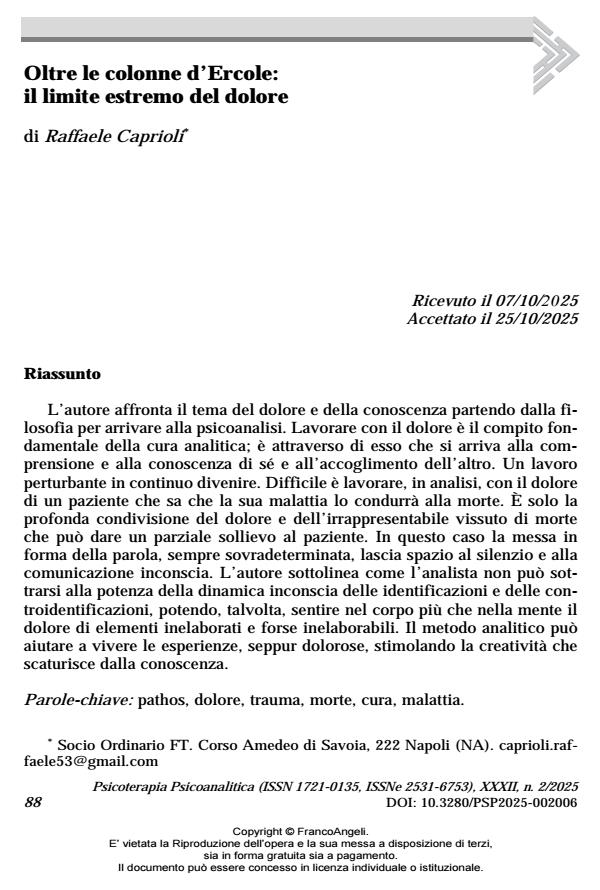
Below, you can see the article first page
If you want to buy this article in PDF format, you can do it, following the instructions to buy download credits
FrancoAngeli is member of Publishers International Linking Association, Inc (PILA), a not-for-profit association which run the CrossRef service enabling links to and from online scholarly content.
The author addresses the theme of pain and knowledge, starting from philosophy and moving on to psychoanalysis. Working with pain is the fundamental task of analytic treatment; it is through it that we arrive at understanding and self-knowledge, and at accepting others. This is a disturbing and constantly evolving task. Working with the pain of a patient who knows his illness will lead to death is difficult in analysis. Only a profound sharing of pain and the unrepresentable experience of death can provide partial relief to the patient. In this case, the formulation of words, always overdetermined, leaves room for silence and unconscious communication. The author emphasizes how the analyst cannot escape the power of the unconscious dynamic of identifications and counter-identifications, sometimes feeling the pain of unprocessed and perhaps intractable elements in the body rather than in the mind. The analytic method can help one live experiences, however painful, by stimulating the creativity that arises from knowledge.
Keywords: pathos, pain, trauma, death, cure, illness.
- Adorno T. (1954). Minima moralia: meditazioni della vita offesa. Torino: Einaudi, 2015.
- Adorno T., Horkheimer M. (1944). Dialettica dell’illuminismo. Torino: Einaudi, 1997.
- Beckett S. (1952). Teatro. Torino: Giulio Einaudi, 2014.
- Bion W. (1963). Gli elementi della psicoanalisi. Roma: Armando 2015
- Bion W. (1972). Apprendere dall’esperienza. Roma: Armando, 2009.
- Blanchot M. (1949). La follia del giorno. La letteratura e il diritto alla morte. Torino: Elitropia Edizioni, 1982.
- Blanchot M. (1955) Lo spazio letterario. Milano: Il Saggiatore Edizioni, 1982.
- Bollas C. Se il sole esplode. Milano: Raffaello Cortina, 2016.
- Cancrini T. (2002) Un tempo per il dolore. Eros, dolore e colpa. Torino: Bollati Boringhieri.
- Ferenczi S. (1933). La confusione tra le lingue tra l’adulto e il bambino. Opere, vol. IV. Milano: Raffaello Cortina, 2002.
- Freud S. (1892-97). Minute teoriche per Wilhelm Fliess. OSF, 2.
- Freud S. (1915). Il nostro modo di considerare la morte. OSF, 8.
- Freud S. (1917). Lutto e melanconia, OSF, 8.
- Freud S. (1925). Inibizione sintomo e angoscia. OSF 10.
- Freud S. (1930). Il disagio della civiltà. OSF, 10.
- Freud S. (1985). Progetto per una psicologia. OSF, 2.
- Klein M., Riviere J. (1937). Amore odio e riparazione. Roma: Astrolabio, 1978.
- Levinas E. (1947). Dall’esistenza all’esistente. Bologna, Marietti, 2000.
- Nietzsche F. (1872). Nascita della tragedia. Milano: Adelphi Edizioni, 1978.
- Nietzsche F. (1886). Al di là del bene e del male. Milano: Adelphi Edizioni, 1977.
- Pontalis J.B. (1977). Tra il sogno e il dolore. Roma, Borla, 1988.
- Pontalis J.B. Limbo. Milano, Raffaello Cortina, 2000.
- Preta L. (a cura di) (2023). Still life: ai confini tra il vivere e il morire. Udine: Mimesis.
- Rilke R. M. (1907-1926). Esperienza della morte. In Poesie. Torino: Einaudi, 2014.
- Romano Toscani R. (2021). Sigmund Freud: Le origini dell’angoscia. Milano: FrancoAngeli.
- Severino E. (1989). Il giogo, alle origini della ragione: Eschilo. Milano: Adelphi Edizioni.
- Severino E. (1995). Interpretazione e traduzione dell’Orestea di Eschilo. Milano: BUR.
- Severino E. (2004a). La filosofia dai greci al nostro tempo, la filosofia medievale. Milano: BUR.
- Severino E. (2004b). La filosofia dai greci al nostro tempo, la filosofia contemporanea. Milano: BUR.
- Weil S. (2008). L’attesa di Dio. Milano: Adelphi Edizioni.
- Weil S. (2012). La persona e il sacro. Milano: Adelphi Eduzioni.
- Winnicott D.W. (1963). Sviluppo affettivo e ambiente. Roma: Armando, 1970.
- Winnicott D.W. (1971). Gioco e realtà. Roma: Armando, 2020.
Raffaele Caprioli, Oltre le colonne d’Ercole: il limite estremo del dolore in "PSICOTERAPIA PSICOANALITICA" 2/2025, pp 88-104, DOI: 10.3280/PSP2025-002006