Behind the veil of appearances, the painful knowledge: the psychoanalytic proposal. The case of Eleonora
Journal title PSICOTERAPIA PSICOANALITICA
Author/s Luigi Antonio Perrotta
Publishing Year 2025 Issue 2025/2
Language Italian Pages 18 P. 124-141 File size 107 KB
DOI 10.3280/PSP2025-002008
DOI is like a bar code for intellectual property: to have more infomation
click here
Below, you can see the article first page
If you want to buy this article in PDF format, you can do it, following the instructions to buy download credits
FrancoAngeli is member of Publishers International Linking Association, Inc (PILA), a not-for-profit association which run the CrossRef service enabling links to and from online scholarly content.
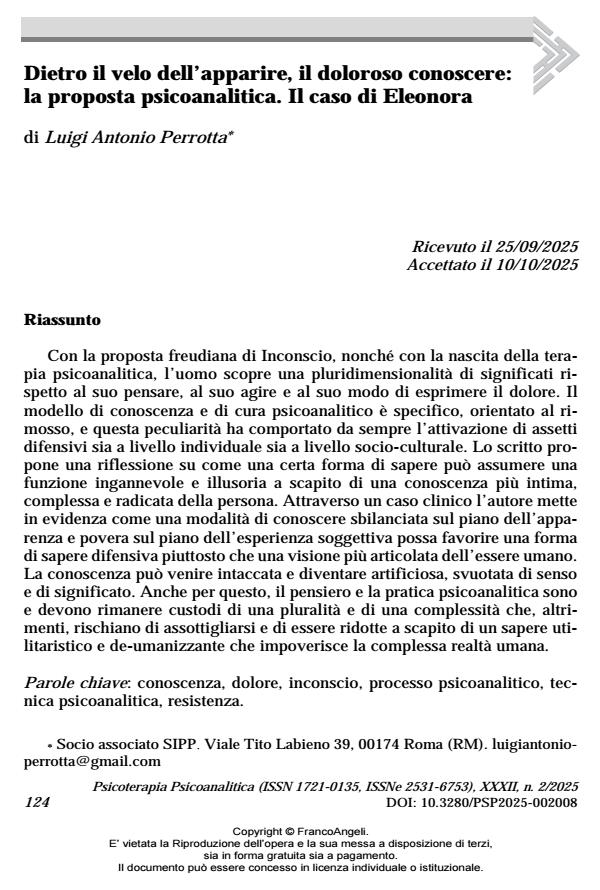
With the Freudian proposal of the Unconscious, as well as with the birth of psychoanalytic therapy, man discovers a multidimensionality of meanings with respect to his thinking, his acting and his way of expressing pain. The psychoanalytic model of knowledge and care is specific, oriented towards the repressed, and this peculiarity has always led to the activation of defensive structures both at an individual and at a socio-cultural level. The writing proposes a reflection on how a certain form of knowledge can assume a deceptive and illusory function to the detriment of a more intimate, complex and rooted knowledge of the person. Through a clinical case the author highlights a way of knowing that is unbalanced on the level of appearance and poor on the level of subjective experience. The form of knowledge that emerges is a defensive-resistive expression towards a more articulated vision of the human being. Knowledge can be affected and become artificial, emptied of sense and meaning. For this reason too, psychoanalytic thought and practice are and must remain custodians of a plurality and complexity that, otherwise, risk becoming thinner and reduced at the expense of a utilitarian and de-humanizing knowledge that impoverishes complex human reality.
Keywords: knowledge, pain, unconscious, psychoanalytic process, psychoanalytic technique, resistance.
- Bion W.R. (1962). Apprendere dall’esperienza. Roma: Armando, 1972.
- Bion W. R. (1963). Elementi della psicoanalisi. Roma: Armando, 1973.
- Bion W. R. (1970). Attenzione ed Interpretazione. Roma: Armando, 2010.
- Bodei R. (2001). Il dottor Freud e i nervi dell’anima. Filosofia e società a un secolo dalla nascita della psicoanalisi. Conversazione con Cecilia Albarella. Roma: Donzelli.
- Coltart N. (2017). Pensare l’impensabile e altre esplorazioni psicoanalitiche. Milano: Raffaello Cortina.
- Copernico N. (1543). De revolutionibus orbium caelestium. Opere. Torino: Utet, 1979.
- Darwin C. (1889). L’origine della specie. Torino: Boringhieri, 1982.
- Di Benedetto A. (1996). La musica segreta al confine corpo-mente. Ascolto e senso del non verbale. In: Ciambelli M., Oneroso F., Pulli G. Il segreto e la Psicoanalisi. Napoli: Gnocchi, 131-148.
- Di Chiara G., Pirillo N. (1997). Conversazioni sulla psicoanalisi. Napoli: Liguori.
- Freud S. (1915). L’inconscio. In: Metapsicologia. OSF, 8.
- Freud S. (1915-17). Introduzione alla psicoanalisi. OSF, 8.
- Freud S. (1916). Una difficoltà della psicoanalisi. OSF, 8.
- Freud S. (1919). Il Perturbante. OSF, 9.
- Freud S. (1938). Alcune lezioni elementari di psicoanalisi. OSF, 11.
- Giovenale D.G. (100-130). Satire. Milano: Mondadori, 2023.
- Jodorowsky A. (2007). La venditrice di lampade e nasi. In: Il passo dell’oca. Milano: Mondadori.
- Khan M. (1974). Lo spazio privato del sé. Torino: Bollati Boringhieri, 1979.
- Lemma A. (2015). Pensare il corpo. L’esperienza corporea in psicoanalisi e oltre. Roma: Giovanni Fioriti, 2018.
- Lombardi R. (2016). Metà prigioniero, metà alato. La dissociazione corpo-mente in psicoanalisi. Torino: Bollati Boringhieri.
- Ongaro Basaglia F. (a cura di) (2005). Franco Basaglia. L’utopia della realtà. Torino: Einaudi.
- Pouillon J. (1970). Malade et mèdecin: le même et/ou l’autre? Novelle Revue de Psychanalyse, I: 77-98. DOI: 10.1177/13634615700070020
- Quinodoz D. (2002). Le parole che toccano. Roma: Borla, 2004.
- Valerio G. (2009). Diabolico e Simbolico. Una riflessione sul male nel nostro tempo. In: Widmann C. (a cura di). Il male. Categoria morale, patologia psichica, realtà umana. Roma: Edizioni Magi, 37-49.
Luigi Antonio Perrotta, Dietro il velo dell’apparire, il doloroso conoscere: la proposta psicoanalitica. Il caso di Eleonora in "PSICOTERAPIA PSICOANALITICA" 2/2025, pp 124-141, DOI: 10.3280/PSP2025-002008