Incidere il dolore
Journal title PSICOTERAPIA PSICOANALITICA
Author/s Andrea Guidantoni
Publishing Year 2025 Issue 2025/2
Language Italian Pages 12 P. 169-180 File size 124 KB
DOI 10.3280/PSP2025-002011
DOI is like a bar code for intellectual property: to have more infomation
click here
Below, you can see the article first page
If you want to buy this article in PDF format, you can do it, following the instructions to buy download credits
FrancoAngeli is member of Publishers International Linking Association, Inc (PILA), a not-for-profit association which run the CrossRef service enabling links to and from online scholarly content.
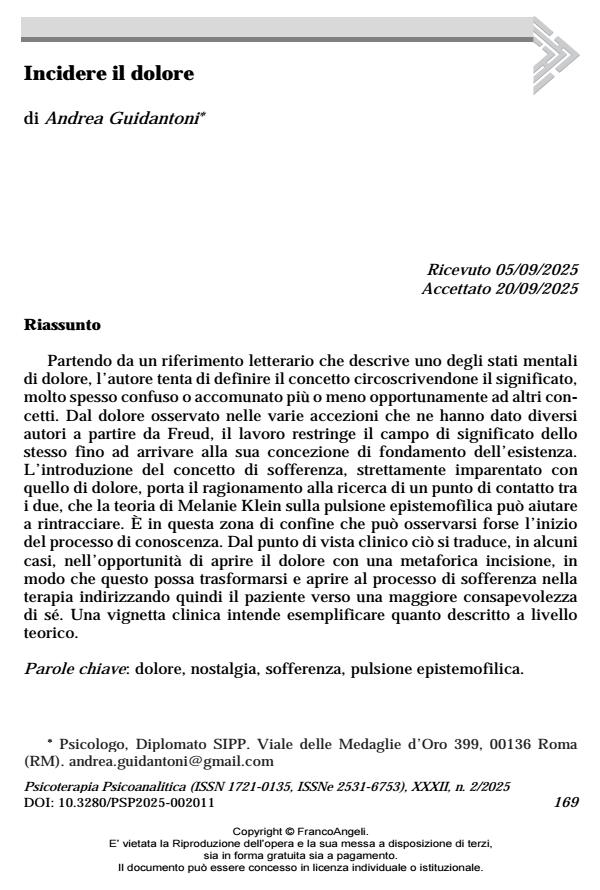
Drawing on a literary reference that illustrates one of the mental states associated with pain, the author aims to delineate the concept by narrowing its scope, often conflated with or improperly associated with other psychological constructs. By examining various conceptualizations of pain proposed by psychoanalysts, beginning with Freud, the analysis progressively refines its definition, ultimately framing pain as a foundational element of human existence. The subsequent introduction of the concept of suffering, closely related to pain, prompts an investigation into the points of contact between the two. Melanie Klein’s theory of the epistemophilic drive provides a useful framework for identifying this intersection. It is within this transitional space that the emergence of the process of knowledge may be observed. Clinically, this conceptualization implies that, in certain cases, pain could be metaphorically “incised” in order to initiate its transformation into suffering. This therapeutic process opens the way for deeper self-awareness within the patient. A clinical vignette is presented to exemplify and contextualize the theoretical propositions discussed.
Keywords: pain, nostalgia, suffering, epistemophilic drive.
- Baldini, T., Biondo, D., Cancrini, T., Galeota, M., Lupinacci, M. A. (2014). Intervento su “Il dolore dell’analista”. In Report Eventi SPI. Società Psicoanalitica Italiana (consultato il 2 luglio 2025 da https://www.spiweb.it/ eventi/baldini-t-biondo-d-cancrini-t-galeota-m-lupinacci-m-a/).
- Bion, W.R. (1965). Trasformazioni. Il passaggio dall’apprendimento alla crescita. Roma: Armando (1973).
- Bolognini, S. (2020). Paura, ansia, angoscia, panico nelle concettualizzazioni psicoanalitiche. Psicoterapia Psicoanalitica, 26(2): 15-33. DOI: 10.3280/PSP2020-00200
- Freud, S. (1895). Il progetto di una psicologia. OSF, 1.
- Freud, S. (1917). Lutto e melanconia. OSF, 8.
- Freud, S. (1920). Al di là del principio di piacere. OSF, 9.
- Freud, S. (1921). Psicologia delle masse e analisi dell’Io. OSF, 9.
- Freud, S. (1926). Inibizione, sintomo e angoscia. OSF, 10.
- Galimberti, U. (1992). Dizionario di psicologia. Milano: Garzanti.
- Hinshelwood, R.D. (1990). Dizionario di psicoanalisi kleiniana. Milano: Raffaello Cortina.
- Lewis, C.S. (1961). Diario di un dolore. Milano: Adelphi.
- Pontalis, J.-B. (1977). Tra il sogno e il dolore. Roma: Borla.
- Recalcati, M. (2019). Le nuove melanconie. Destini del desiderio nel tempo ipermoderno. Milano: Raffaello Cortina.
- Treccani (n.d.). Sofferenza. In Enciclopedia Italiana. Istituto della Enciclopedia Italiana. (consultato il 10 giugno 2025 da https://www.treccani.it/enciclopedia/sofferenza).
- Wittgenstein, L. (1983). Ricerche filosofiche. Torino: Einaudi (1953).
Andrea Guidantoni, Incidere il dolore in "PSICOTERAPIA PSICOANALITICA" 2/2025, pp 169-180, DOI: 10.3280/PSP2025-002011