Wounded Words, Living Words: the feeling of nostalgia between pain and knowledge
Journal title PSICOTERAPIA PSICOANALITICA
Author/s Davide Pattarozzi, Davide Zanin
Publishing Year 2025 Issue 2025/2
Language Italian Pages 10 P. 181-190 File size 80 KB
DOI 10.3280/PSP2025-002012
DOI is like a bar code for intellectual property: to have more infomation
click here
Below, you can see the article first page
If you want to buy this article in PDF format, you can do it, following the instructions to buy download credits
FrancoAngeli is member of Publishers International Linking Association, Inc (PILA), a not-for-profit association which run the CrossRef service enabling links to and from online scholarly content.
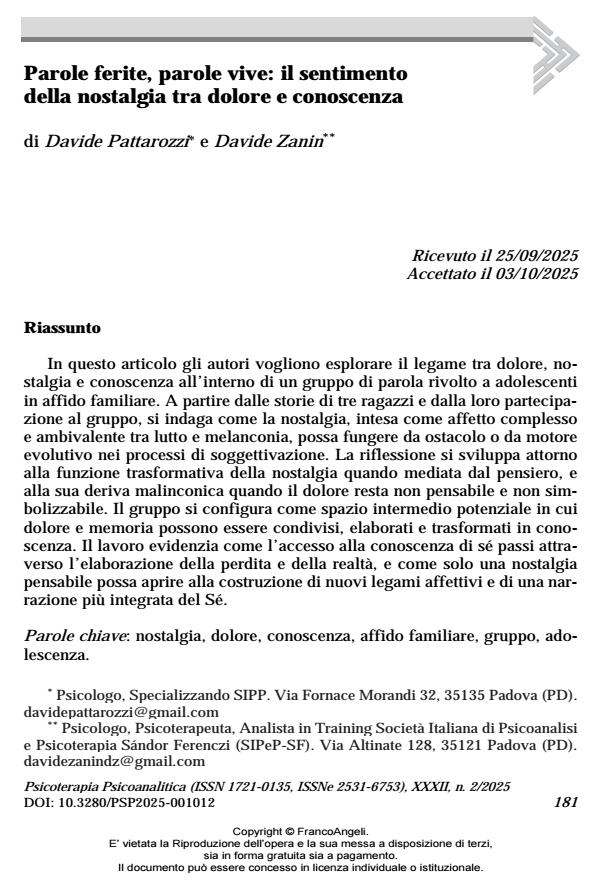
In this article, the authors aim to explore the connection between pain, nostalgia, and knowledge within a verbal processing group for adolescents in foster care. Drawing on the stories of three teenagers and their participation in the group, the paper investigates how nostalgia ‒ understood as a complex and ambivalent emotional experience situated between mourning and melancholy ‒ can act either as an obstacle or as a developmental driving force in the processes of subjectivation. The reflection centers on the transformative function of nostalgia when mediated by thought, and on its melancholic drift when pain remains unthinkable and unsymbolizable. The group is conceived as a potential transitional space where pain and memory can be shared, processed, and transformed into knowledge. The work highlights how access to self-knowledge passes through the elaboration of loss and confrontation with reality, and how only a thinkable form of nostalgia can open the way to the construction of new emotional bonds and a more integrated narrative of the Self.
Keywords: nostalgia, pain, knowledge, foster care, group, adolescence.
- Albrecht V.H. (1779). Supplément aux Dictionnaires des Sciences, des Arts et des Métiers, Tome quatrième. Livourne: L’Imprimerie des éditeurs. Tr. it. di Antonio Prete.
- Aulagnier P. (1975). La violenza dell’interpretazione. Milano: Mimesis, 2025.
- Bleger J. (1967). Simbiosi e ambiguità. Studio psicoanalitico. Roma: Armando, 2010.
- Blos P. (1971). L’adolescenza: una interpretazione psicoanalitica. Milano: FrancoAngeli. 1977.
- Deledda G. (1905). Nostalgie. Nuoro: Ilisso, 2011.
- Freud, S. (1914). Introduzione al narcisismo. In: Opere (Vol. 7). Torino: Boringhieri.
- Grassi L. (2025). Nostalgia. Spiweb. https://www.spiweb.it/la-ricerca/ricerca/nostalgia/
- Hofer J. (1688). Dissertatio medica de nostalgia. In: Prete A. (a cura di). Nostalgia. Storia di un sentimento. Milano: Raffaello Cortina, pp. 35-50.
- Jeammet P. (1989). Les assises narcissiques de la symbolisation. Revue française de psychanalyse, 53(6): 1763-1774.
- Kaës R. (1993). Il gruppo e il soggetto del gruppo. Roma: Borla, 1994.
- Luchetti A. (1994). Postfazione. Il “grado zero” della rappresentazione. In: Aulagnier P. La violenza dell’interpretazione. Milano: Mimesis, 2025.
- Maccioni S (2007). L’affidamento dei minori. Problematiche e prospettive. Richard e Piggle, 15, 1: 22-26. DOI: 10.1711/239.283
- Matte Blanco I. (1975). L’inconscio come insiemi infiniti. Saggio sulla bi-logica. Torino: Einaudi, 2000.
- Pellizzari, G. (2019). Opus Incertum. Psicoanalisi, Conoscenza, Spiritualità. Milano: Mimesis Edizioni.
- Pellizzari G. (2007). I dolori del giovane adulto. Alcune considerazioni sul finire dell’adolescenza. Adolescenza e psicoanalisi, 2(2): 45-60.
- Prete A. (a cura di) (1992). Nostalgia. Storia di un sentimento. Milano: Raffaello Cortina.
- Racamier P.C. (1992). Il genio delle origini. Milano: Raffaello Cortina, 1993.
- Rousseau J.J. (1763). Deux lettres à M. le Maréchal Duc de Luxembourg contenant une description du Val-de-Travers. Neuchâtel: Ides et Calendes. Tr. it. di Antonio Prete.
- Steiner J. (1996). I rifugi della mente. Torino: Bollati Boringhieri.
- Trivisani M., Boscato A., Benetti P. et al. (2020). Pensieri dalla costruzione della stanza rotonda: l’ambulatorio psicologico per bambini in un Servizio per l’Affido. Gli Argonauti, 164 (2): 77-90. DOI: 10.14658/PUPJ-ARGO-2022-2-6
- Winnicott D. (1986). Dal luogo delle origini. Milano: Raffaello Cortina, 1990.
Davide Pattarozzi, Davide Zanin, Parole ferite, parole vive: il sentimento della nostalgia tra dolore e conoscenza in "PSICOTERAPIA PSICOANALITICA" 2/2025, pp 181-190, DOI: 10.3280/PSP2025-002012