Transference and its implications in couple therapy
Journal title INTERAZIONI
Author/s Berniero Ragone, Elena Longo
Publishing Year 2025 Issue 2025/2
Language Italian Pages 11 P. 55-65 File size 70 KB
DOI 10.3280/INT2025-002006
DOI is like a bar code for intellectual property: to have more infomation
click here
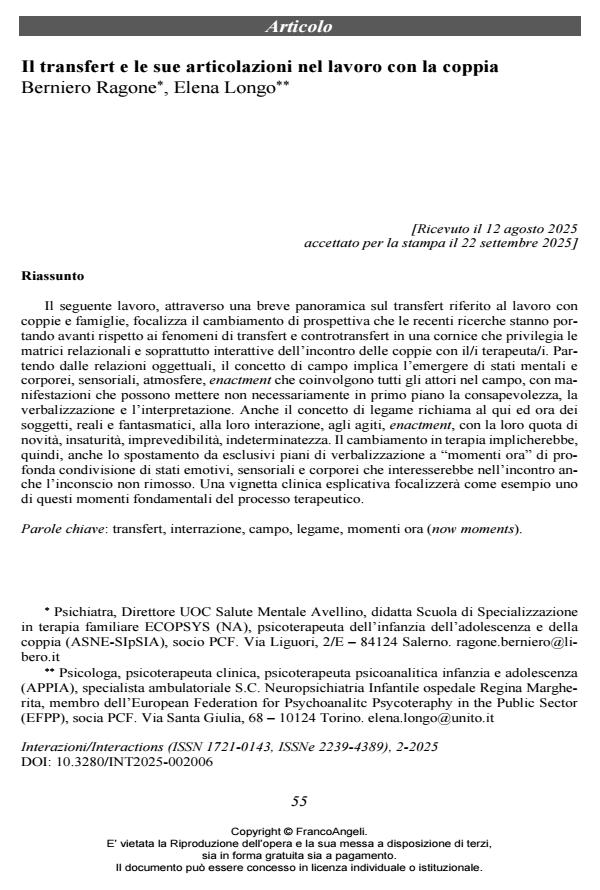
Below, you can see the article first page
If you want to buy this article in PDF format, you can do it, following the instructions to buy download credits
FrancoAngeli is member of Publishers International Linking Association, Inc (PILA), a not-for-profit association which run the CrossRef service enabling links to and from online scholarly content.
The following paper, through a brief overview of transference as it relates to work with couples and families, focuses on the current shift in perspective that recent research is bringing about when we view transference and countertransference phenomena within a framework that prioritizes the relational and, above all, interactive matrices of the couples’ encounter with their therapist(s). Starting from object relations, the concept of field implies the emergence of mental and bodily states, sensory states, atmospheres, and enactments that involve all actors in the field, with manifestations that may not necessarily foreground awareness, verbalization, and interpretation. The concept of bond also refers to the here and now of the subjects, both real and phantasmal, to their interactions, acting out, and enactments, with their share of novelty, insaturation, unpredictability, and indeterminacy. Change in therapy would therefore also imply a shift from exclusively verbalized planes to now moments of profound sharing of emotional, sensorial, and bodily states, which would also involve the unrepressed unconscious in the encounter. An explanatory clinical vignette will illustrate one of these key moments in the therapeutic process.
Keywords: transference, interaction, field, bond, now moments.
Berniero Ragone, Elena Longo, Il transfert e le sue articolazioni nel lavoro con la coppia in "INTERAZIONI" 2/2025, pp 55-65, DOI: 10.3280/INT2025-002006