No more “Medi-terranean”. Border materialities in the central Mediterranean Sea and their effects on encounters and solidarities

Journal title MONDI MIGRANTI
Author/s Enrico Fravega
Publishing Year 2025 Issue 2025/3
Language English Pages 25 P. 16-40 File size 442 KB
DOI 10.3280/MM2025-003002
DOI is like a bar code for intellectual property: to have more infomation click here

Below, you can see the article first page

If you want to buy this article in PDF format, you can do it, following the instructions to buy download credits
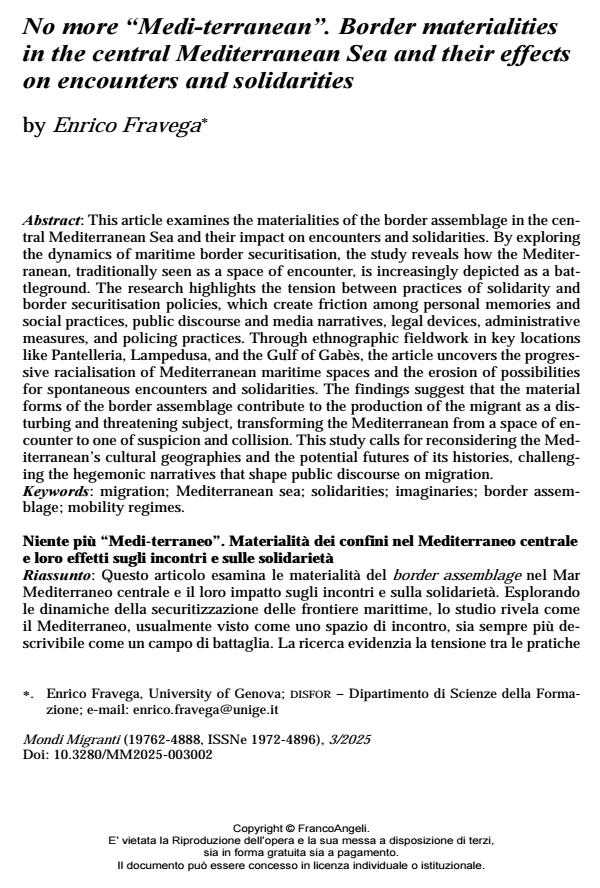
Article preview

FrancoAngeli is member of Publishers International Linking Association, Inc (PILA), a not-for-profit association which run the CrossRef service enabling links to and from online scholarly content.

This article examines the materialities of the border assemblage in the central Mediterranean Sea and their impact on encounters and solidarities. By exploring the dynamics of maritime border securitisation, the study reveals how the Mediterranean, traditionally seen as a space of encounter, is increasingly depicted as a battleground. The research highlights the tension between practices of solidarity and border securitisation policies, which create friction among personal memories and social practices, public discourse and media narratives, legal devices, administrative measures, and policing practices. Through ethnographic fieldwork in key locations like Pantelleria, Lampedusa, and the Gulf of Gabès, the article uncovers the progressive racialisation of Mediterranean maritime spaces and the erosion of possibilities for spontaneous encounters and solidarities. The findings suggest that the material forms of the border assemblage contribute to the production of the migrant as a disturbing and threatening subject, transforming the Mediterranean from a space of encounter to one of suspicion and collision. This study calls for reconsidering the Mediterranean’s cultural geographies and the potential futures of its histories, challenging the hegemonic narratives that shape public discourse on migration.

Keywords: migration; Mediterranean sea; solidarities; imaginaries; border assemblage; mobility regimes.

  1. Abulafia D. (2011). The great sea: A human history of the Mediterranean. Oxford: Oxford University Press.
  2. Alves M.T. (2022). Seeds of change (Kuoni C. and Lukatsch W., Eds.). Vera List Center for Art and Politics and Amherst College Press.
  3. Anderson B. (2017). Towards a new politics of migration? Ethnic and Racial Studies, 40, 9: 1527-1537; DOI: 10.1080/01419870.2017.1300297
  4. Bachtin M.M. (1979). Le forme del tempo e del cronotopo nel romanzo. Saggi di poetica storica. In: Janovic C.S., ed., Estetica e romanzo (pp. 1-198). Milano: Giulio Einaudi.
  5. Ben-Yehoyada N. (2017). The Mediterranean incarnate: region formation between Sicily and Tunisia since World War II. Chicago: University of Chicago Press.
  6. Ben-Yehoyada N. (2014). Transnational political cosmology: a central Mediterranean example. Comparative Studies in Society and History, 56, 4: 870-901; DOI: 10.1017/S0010417514000437
  7. Brambilla C. and Pötzsch H. (2022). In/visibility. In: Border Aesthetics (pp. 68-89). Oxford: Berghahn Books.
  8. Brighenti A.M. (2010). Visibility and social theory. In: Visibility in social theory and social research (pp. 37-70). London: Palgrave Macmillan UK.
  9. Burawoy M. (2000). Introduction: Reaching the global. In Global ethnography: Forces, connections, and imaginations in a postmodern world (pp. 1-40). Berkeley: University of California Press.
  10. Casaglia A. (2021). Borders and mobility injustice in the context of the COVID-19 pandemic. Journal of Borderlands Studies, 36, 4: 695-703.
  11. Chambers I. (2012). Mediterraneo blues. Milano: Bollati Boringhieri.
  12. Cuttitta P. (2012). Lo spettacolo del confine: Lampedusa tra produzione e messa in scena della frontiera. Millano: Mimesis.
  13. Danewid I. (2021). These walls must fall. In: Proglio G. et al., eds., cit.: 145-166.
  14. Danewid I. (2017). White innocence in the Black Mediterranean: Hospitality and the erasure of history. Third World Quarterly, 38, 7: 1674-1689; DOI: 10.1080/01436597.2017.1331123
  15. Dines N., Montagna N. and Ruggiero V. (2015). Thinking Lampedusa: Border construction, the spectacle of bare life and the productivity of migrants. Ethnic and Racial Studies, 38, 3: 430-445; DOI: 10.1080/01419870.2014.936892
  16. Elliott A. and Urry J. (2010). Mobile lives. Abingdon: Routledge.
  17. Equipaggio della Tanimar, a cura di Torre F. (2025). Controdizionario del confine. Parole alla deriva nel Mediterraneo Centrale. Napoli: Tamu-Tangerin.
  18. Equipaggio della Tanimar (Anderlini J. and Fravega E., eds.) (2023). Crocevia mediterraneo. Milano: Elèuthera.
  19. Ferrer-Gallardo X. and Kramsch O.T. (2016). Revisiting al-Idrissi: The EU and the (Euro)Mediterranean archipelago frontier. Tijdschrift Voor Economische En Sociale Geografie, 107, 2: 162-176;
  20. Fravega E. and Queirolo Palmas L. (2023). Trasformazioni Mediterranee. Migrazioni, incontri e barriere. Dialoghi Mediterranei, 60.
  21. Foucault M. (2013). L’archeologia del sapere. Milano: BUR.
  22. De Genova N. (2013). Spectacles of migrant ‘illegality’: The scene of exclusion, the obscene of inclusion. Ethnic and Racial Studies, 36, 7: 1180-1198; DOI: 10.1080/01419870.2013.783710
  23. De Genova N. (2018). The ‘migrant crisis’ as racial crisis: Do Black lives matter in Europe? Ethnic and Racial Studies, 41, 10: 1765-1782; DOI: 10.1080/01419870.2017.1361543
  24. Dobie M. (2014). For and against the Mediterranean: francophone perspectives. Comparative Studies of South Asia, Africa and the Middle East, 34, 2: 389-404; DOI: 10.1215/1089201X-2773923
  25. Gamble C.N., Hanan J.S. and Nail T. (2019). What is new materialism? Angelaki, 24, 111-134; DOI: 10.1080/0969725X.2019.1684704
  26. Giglioli I. (2019). Denaturalising borders through comparative ethnography. Etnografia e Ricerca Qualitativa, XII, 2/2019: 245-256; DOI: 10.3240/94700
  27. Gilroy P. (2019). The Black Atlantic: L’identità nera tra modernità e doppia coscienza. Milano: Meltemi.
  28. Glissant É. (2020). Introduction to a poetics of diversity. Liverpool: Liverpool University Press.
  29. Grechi G. (2021). Colonial cultural heritage and embodied representations. In: Proglio G. et al., eds., cit.: 83-98.
  30. Greene M. (2018). The Mediterranean Sea. Oceanic Histories: 134-155.
  31. Hamilakis Y. (2022). Border assemblages between surveillance and spectacle: What was Moria and what comes after? American Anthropologist, 124, 1: 212-220;
  32. Herzfeld M. (2005). Practical Mediterraneanism: Excuses for everything, from epistemology to eating. In: Harris W.V., ed., Rethinking the Mediterranean (pp. 45-63). Oxford: Oxford University Press.
  33. Hicks D. and Beaudry M.C. (2010). The Oxford Handbook of Material Culture Studies. Oxford: Oxford University Press.
  34. hooks b. (1998). Elogio del margine: Razza, sesso e mercato culturale. Milano: Feltrinelli.
  35. Horden P. and Purcell N. (2000). The corrupting sea: A study of Mediterranean history. Hoboken: Wiley Blackwell.
  36. Lake M. and Reynolds H. (2008). Drawing the global colour line: White men’s countries and racial equality. Melbourne: Melbourne University Publishing.
  37. Maio A.D. (2021). The Black Mediterranean: A view from Sicily. Transition, 132: 34-53.
  38. Marcus G.E. and Saka E. (2006). Assemblage. Theory, Culture & Society, 23, 2-3: 101-106; DOI: 10.1177/0263276406062573
  39. Massey D. (2013). Space, place and gender. Cambridge: Polity Press.
  40. Musil R. (1998). L’uomo senza qualità. Milano: Mondadori.
  41. Orsini G. (2019). Europe’s border vs. locals’ border: Scaling-down the border play/spectacle methodological notes from Lampedusa and beyond. Etnografia e Ricerca Qualitativa, 12, 2: 237-244; DOI: 10.3240/94699
  42. Proglio G. (2021). Fanon in the Black Mediterranean. In: Proglio G. et al., eds., cit.: 57-81.
  43. Proglio G., Hawthorne C., Danewid I., Saucier P.K., Grimaldi G., Pesarini A., Grechi G. and Gerrand V., eds. (2021). The Black Mediterranean: Bodies, borders and citizenship. London: Palgrave Macmillan.
  44. Proglio G. and Odasso L. (2017). Border Lampedusa: Subjectivity, visibility and memory in stories of sea and land. In: Border Lampedusa: Subjectivity, visibility and memory in stories of sea and land (pp. 1-190).
  45. Queirolo Palmas L. and Rahola F. (2022). Turismi di frontiera. In: Anderlini J., Filippi D. and Giliberti L., eds., Borderland Italia: Regime di frontiera e autonomia delle migrazioni (pp. 163-202). Milano: DeriveApprodi.
  46. Raeymaekers T. (2021). Impermanent territories: The Mediterranean crisis and the (re-)production of the Black subject. In: Proglio G. et al., eds., cit.: 117-144.
  47. Robinson C.J. (2023). Black Marxism: Genealogia della tradizione radicale nera. Roma: Edizioni Alegre.
  48. Said E.W. (2002). Orientalismo: L’immagine europea dell’Oriente. Milano: Feltrinelli.
  49. Sheller M. (2018). Mobility justice: The politics of movement in an age of extremes. London-New York: Verso.
  50. Shilliam R. (2023). Race and the undeserving poor. New York: Columbia University Press.
  51. Shryock A. (2012). Breaking hospitality apart: bad hosts, bad guests, and the problem of sovereignty. Journal of the Royal Anthropological Institute, 18, S20-S33;
  52. Sohn C. (2016). Navigating borders’ multiplicity: The critical potential of assemblage. Area, 48, 2: 183-189;
  53. Ticktin M. (2016). Thinking beyond humanitarian borders. Social Research: An International Quarterly, 83, 2: 255-271;
  54. Wiertz T. (2021). Biopolitics of migration: An assemblage approach. Environment and Planning C: Politics and Space, 39, 7: 1375-1388; DOI: 10.1177/2399654420941854

Enrico Fravega, No more “Medi-terranean”. Border materialities in the central Mediterranean Sea and their effects on encounters and solidarities in "MONDI MIGRANTI" 3/2025, pp 16-40, DOI: 10.3280/MM2025-003002