Nature and psychological wellbeing: Outdoor mindfulness experiences
Journal title RIVISTA SPERIMENTALE DI FRENIATRIA
Author/s Gaspare Palmieri
Publishing Year 2025 Issue 2025/3
Language Italian Pages 31 P. 43-73 File size 776 KB
DOI 10.3280/RSF2025-003004
DOI is like a bar code for intellectual property: to have more infomation
click here
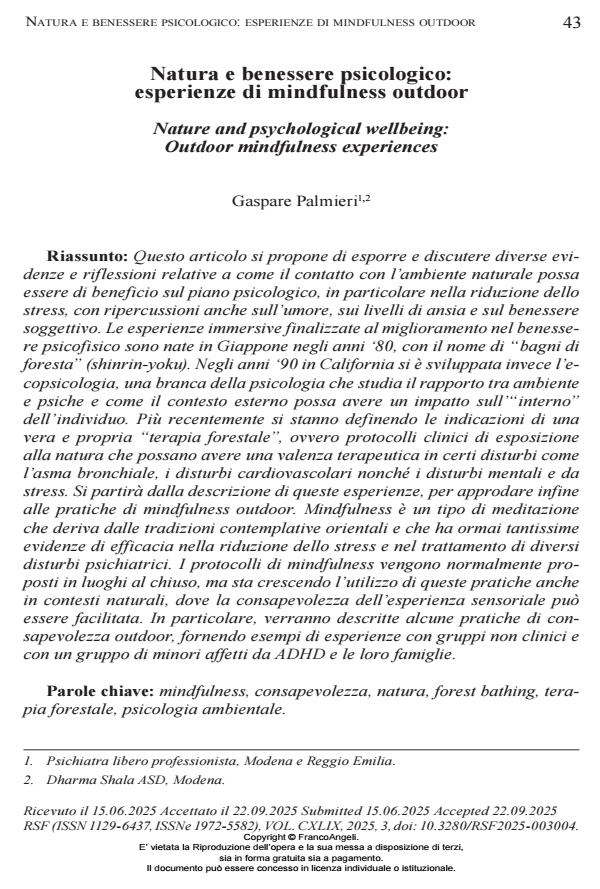
Below, you can see the article first page
If you want to buy this article in PDF format, you can do it, following the instructions to buy download credits
FrancoAngeli is member of Publishers International Linking Association, Inc (PILA), a not-for-profit association which run the CrossRef service enabling links to and from online scholarly content.
This article presents and discuss evidence and reflections regarding how the contact with the natural environment can provide psychological benefits, particularly in reducing stress, with positive effects also on mood, anxiety levels, and subjective wellbeing. Immersive experiences in nature aimed at improving psychophysical wellbeing originated in Japan in the 1980s, under the name “ forest bathing” (shinrinyoku). In the 1990s, ecopsychology emerged in California, a branch of psychology that studies the relationship between the environment and the mind, and how the external context can affect the individual’s inner world. More recently, formal guidelines have been developing around “ forest therapy,” consisting of clinical protocols for exposure to nature that may have therapeutic value in conditions such as bronchial asthma, cardiovascular disorders, as well as stressrelated and mental health disorders. The article begins by describing these approaches and then focuses on outdoor mindfulness practices developed by the author. Mindfulness is a form of meditation rooted in Eastern contemplative traditions, now widely supported by scientific evidence for its effectiveness in reducing stress and treating various psychiatric conditions. Although mindfulness is typically practiced indoors, its use in natural environments is growing, where sensory awareness may be more easily cultivated. The article describes specific outdoor mindfulness practices, including examples of experiences with nonclinical groups and with a group of minors diagnosed with ADHD and their families.
Keywords: mindfulness, awareness, nature, forest bathing, forest therapy, environmental psychology.
- [1.] Cognetti P. Le otto montagne. Torino: Einaudi. 2016.
- [2.] Frumkin H, Bratman GN, Breslow SJ, Cochran B, Kahn PH Jr, Lawler JJ, et al. Nature Contact and Human Health: A Research Agenda. Environ Health Perspect 2017;125(7):075001.
- [3.] Pergams OR, Zaradic PA. Evidence for a fundamental and pervasive shift away from naturebased recreation. Proc Natl Acad Sci USA 2008; 105(7):2295–2300.
- [4.] Klepeis NE, Nelson WC, Ott WR, Robinson JP, Tsang AM, Switzer P, et al. The National Human Activity Pattern Survey (NHAPS): A resource for assessing exposure to environmental pollutants. J Expo Anal Environ Epidemiol 2001; 11(3): 231–252.
- [5.] Cho Y, In H, Park M, Park EC, Kim SH. Association of smartphone use with abnormal social jetlag among adolescents in Korea before and after COVID19. Addict Behav 2023; 141:107629.
- [6.] G. Mattei, G. Venturi, S. Ferrari, G.M. Galeazzi. Mental health, work and care: the value of multidisciplinary collaboration in psychiatry and occupational medicine. JOURNAL OF PSYCHOPATHOLOGY 2018; 24:230236.
- [7.] McEachan RR, Prady SL, Smith G, Fairley L, Cabieses B, Gidlow C, et al.. The association between green space and depressive symptoms in pregnant women: Moderating roles of socioeconomic status and physical activity. J Epidemiol Community Health 2016; 70(3):253–259.
- [8.] Seymour V. The human–nature relationship and its impact on health: A critical review. Front Public Health 2016; 4:260.
- [9.] Ewert A, Chang Y. Levels of Nature and Stress Response. Behav Sci 2018; 17; 8(5):49.
- [10.] Kotera Y, Lyons M, Vione KC, Norton B. Effect of nature walks on depression and anxiety: a systematic review. Sustainability 2021; 13:4015.
- [11.] Sudimac S, Sale V, Kühn S. How nature nurtures: Amygdala activity decreases as the result of a onehour walk in nature. Mol Psychiatry 2022; 27(11):44464452.
- [12.] Mattei G, Salute mentale e cammini. Bollettino dell’Ordine Provinciale dei Medici Chirurghi e degli Odontoiatri di Modena 2023; 3, 1719.
- [13.] Louv R. L’ultimo bambino nei boschi. Milano: Rizzoli, 2006.
- [14.] Ulrich RS, Simons RF, Losito BD, Fiorito E, Miles MA, Zelson M. Stress recovery during exposure to natural and urban environments. J Environ Psychol 1991; 11: 201–230.
- [15.] Ulrich RS. View through a window may influence recovery from surgery. Science 1984; 224: 420–421.
- [16.] Kaplan R & Kaplan S. The experience of nature
- [17.] Song C, Ikei H, Igarashi M, Takagaki M, Miyazaki Y. Physiological and Psychological Effects of a Walk in Urban Parks in Fall. Int J Environ Res Public Health 2015; 9;12(11):1421628.
- [18.] Wilson EO. Biophilia. Boston: Harvard University Press, 1984.
- [19.] KabatZinn J. Full Catastrophe Living: Using the Wisdom of Your Body and Mind to Face Stress, Pain, and Illness. New York: Bantam Dell, 1990.
- [20.] Khoury B, Sharma M, Rush SE, Fournier C. Mindfulnessbased stress reduction for healthy individuals: A metaanalysis. J Psychosom Res. 2015 Jun;78(6):51928.
- [21.] Dawson AF, Brown WW, Anderson J, Datta B, Donald JN, Hong K, Allan S, Mole TB, Jones PB, Galante J. MindfulnessBased Interventions for University Students: A Systematic Review and MetaAnalysis of Randomised Controlled Trials. Appl Psychol Health Well Being 2020;12(2): 384410.
- [22.] Grossman P, Niemann L, Schmidt S, Walach H. Mindfulnessbased stress reduction and health benefits: A metaanalysis. Journal of Psychosomatic Research 2004; 57(1): 3543.
- [23.] GarciaCampayo J, López Del Hoyo Y, NavarroGil M. Contemplative sciences: A future beyond mindfulness. World J Psychiatry 2021; 19;11(4):8793.
- [24.] Hoge EA, Bui E, Mete M, Dutton MA, Baker AW, Simon NM. MindfulnessBased Stress Reduction vs Escitalopram for the Treatment of Adults With Anxiety Disorders: A Randomized Clinical Trial. JAMA Psychiatry 2023; 80(1):1321.
- [25.] Mukuria C, Brazier J, Barkham M, Connell J, Hardy G, Hutten R, Saxon D, DentBrown K, Parry G. Costeffectiveness of an improving access to psychological therapies service. Br J Psychiatry 2013; 202: 220227.
- [26.] Baer RA. Mindfulness training as a clinical intervention: A conceptual and empirical review. Clinical Psychology Science and Practice 2003; 10(2): 125143.
- [27.] KabatZinn J. Wherever you go, there you are. New York: Hyperion. 1994. [28.] Thoreau HD. Walden. Vita nel bosco. Milano: Oscar Mondadori, 2016. [29.] Bailey M, Cao R, Kuchler T, Stroebel J, Wong A. Social Connectedness: Measurement, Determinants, and Effects. J Econ Perspect 2018
- [30.] HoltLunstad J. Loneliness and Social Isolation as Risk Factors: The Power of Social Connection in Prevention. Am J Lifestyle Med 2021; 6;15(5):567573.
- [31.] Danon M. Ecopsicologia. Arezzo: Aboca, 2020.
- [32.] Roszak T. The voice of earth An exploration of ecopsychology. Boston: Phanes Press, 2001.
- [33.] Li Q. Effects of forest environment (Shinrinyoku/Forest bathing) on health promotion and disease prevention —the Establishment of “Forest Medicine”—. Environmental Health and Preventive Medicine 2022; 27:43.
- [34.] Li Q, Morimoto K, Nakadai A, Inagaki H, Katsumata M, Shimizu T, et al. Forest bathing enhances human natural killer activity and expression of anticancer proteins. Int J Immunopathol Pharmacol 2007; 20(S):3–8.
- [35.] Li Q, Otsuka T, Kobayashi M, Wakayama Y, Inagaki H, Katsumata M, et al. Acute effects of walking in forest environments on cardiovascular and metabolic parameters. Eur J Appl Physiol. 2011;111(11):2845–53.
- [36.] Ideno Y, Hayashi K, Abe Y, Ueda K, Iso H, Noda M, et al. Blood pressurelowering effect of Shinrinyoku (Forest bathing): a systematic review and metaanalysis. BMC Complement Altern Med. 2017;17(1):409.
- [37.] Furuyashiki A, Tabuchi K, Norikoshi K, Kobayashi T, Oriyama S. A comparative study of the physiological and psychological effects of forest bathing (Shinrinyoku) on working age people with and without depressive tendencies. Environ Health Prev Med. 2019;24(1):46.
- [38.] Morita E, Imai M, Okawa M, Miyaura T, Miyazaki S. A before and after comparison of the effects of forest walking on the sleep of a communitybased sample of people with sleep complaints. Biopsychosoc Med. 2011;5:13.
- [39.] Timko Olson ER, Hansen MM, Vermeesch A. Mindfulness and ShinrinYoku: Potential for Physiological and Psychological Interventions during Uncertain Times. Int J Environ Res Public Health. 2020 Dec 14;17(24):9340.
- [40.] Berman MG, Jonides J, Kaplan S. The cognitive benefits of interacting with nature. Psychol Sci. 2008;19(12):120712.
- [41.] Frumkin H, Bratman GN, Breslow SJ, Cochran B, Kahn PH Jr, Lawler JJ, et al. Nature Contact and Human Health: A Research Agenda. Environ Health Perspect 2017;125(7):075001.
- [42.] Li Q, Kobayashi M, Wakayama Y, Inagaki H, Katsumata M, Hirata Y, et al. Effect of phytoncide from trees on human natural killer function. Int J Immunopathol Pharmacol 2009; 22:951–9.
- [43.] White MP, Alcock I, Grellier J, Wheeler BW, Hartig T, Warber SL, et al. Spending at least 120 minutes a week in nature is associated with good health and wellbeing. Sci Rep 2019;13;9(1):7730.
- [44.] Clifford MA. Bagni di foresta. Il potere di guarigione della natura con l’arte dello Shinrinyoku. Milano: Armenia, 2018.
- [45.] Buckley R, Brough P, Hague L, Chauvenet A, Fleming C, Roche E, et al. Economic value of protected areas via visitor mental health. Nat Commun 2019; 10: 5005.
- [46.] Wu M, Zhu Y, Lv J, Guo Y, Yang L, Chen Y, et al. Association of anxiety with cardiovascular disease in a Chinese cohort of 0.5 million adults. J Affect Disord 2022; 15;315:291296.
- [47.] Yeon PS, Jeon JY, Jung MS, Min GM, Kim GY, Han KM et al. Effect of Forest Therapy on Depression and Anxiety: A Systematic Review and MetaAnalysis. Int J Environ Res Public Health 2021; 1;18(23):12685. [48.] Meneguzzo F, Zabini F. Terapia Forestale. Roma: Cnr Edizioni, 2020. [49.] Tugnoli M. Manuale pratico di terapia forestale. Massa Carrara: Ta kra, 2021.
- [50.] Masini L, Palmieri G, Tacchetto A, Benetti D, Cagnin A. Presenti sui monti: evento di montagnaterapia. Un percorso esperienziale in natura per il proprio benessere. Dislessia, Difficoltà in matematica e Disturbi di attenzione e iperattività 2023; 4: 26267.
- [51.] Scoppola G, Di Benedetto P. “Definizione di MONTAGNATERAPIA” 2\2007 tratta dal sito www.sopraimille.it
- [52.] Bertolini M. Montagnaterapia e Salute Mentale: Un’Analisi dei Benefici. Rivista di Psicologia della Salute 2021; 15(3): 245260.
- [53.] Snel E. Calmo e attento come una ranocchia. Milano: Red!, 2015.
- [54.] Lowen A & Lowen L. Espansione e integrazione del corpo in Bioenergetica. Manuale di esercizi pratici. Roma: Astrolabio, 1979.
- [55.] Lee YC, Chen CR, Lin KC. Effects of MindfulnessBased Interventions in Children and Adolescents with ADHD: A Systematic Review and MetaAnalysis of Randomized Controlled Trials. Int J Environ Res Public Health 2022; 17;19(22):15198.
- [56.] Candiani CL. Questo immenso non sapere. Torino: Einaudi, 2021. [57.] Pensa C. Intelligenza spirituale. Roma: Ubaldini Editore, 2002.
- [58.] U Pandita S. Proprio in questa vita. Roma: Astrolabio Ubaldini, 1998. [59.] Bergou N, Hammond R, Smythe M, Gibbons J, Davidson N, Tognin S, et al. The mental health benefits of visiting canals and rivers: An eco
- logical momentary assessment study. PLoS One 2022; 31:17(8). [60.] Hesse H. Il canto degli alberi. Milano: Guanda, 2018.
- [61.] Mancuso S, Viola A. Verde brillante. Sensibilità e intelligenza nel mondo vegetale. Milano: Giunti, 2013.
- [62.] Ivanovski B, Malhi GS. The psychological and neurophysiological concomitants of mindfulness forms of meditation. Acta Neuropsychiatr 2007; 19:76–91.
- [63.] Yavuz Sercekman M. Exploring the sustained impact of the MindfulnessBased Stress Reduction program: a thematic analysis. Front Psychol 2024; 19;15:1347336.
- [64.] Chen H, Meng Z, Luo J. Is forest bathing a panacea for mental health problems? A narrative review. Front Public Health 2025; 20;13:1454992.
Gaspare Palmieri, Natura e benessere psicologico: esperienze di mindfulness outdoor in "RIVISTA SPERIMENTALE DI FRENIATRIA" 3/2025, pp 43-73, DOI: 10.3280/RSF2025-003004