Adaptive skills improvement in naturalistic context for autism spectrum disorder in adulthood: From trekking to sailing
Journal title RIVISTA SPERIMENTALE DI FRENIATRIA
Author/s Federica Odello, Stefania Marengo, Roberto Keller
Publishing Year 2025 Issue 2025/3
Language Italian Pages 30 P. 107-136 File size 725 KB
DOI 10.3280/RSF2025-003006
DOI is like a bar code for intellectual property: to have more infomation
click here
Below, you can see the article first page
If you want to buy this article in PDF format, you can do it, following the instructions to buy download credits
FrancoAngeli is member of Publishers International Linking Association, Inc (PILA), a not-for-profit association which run the CrossRef service enabling links to and from online scholarly content.
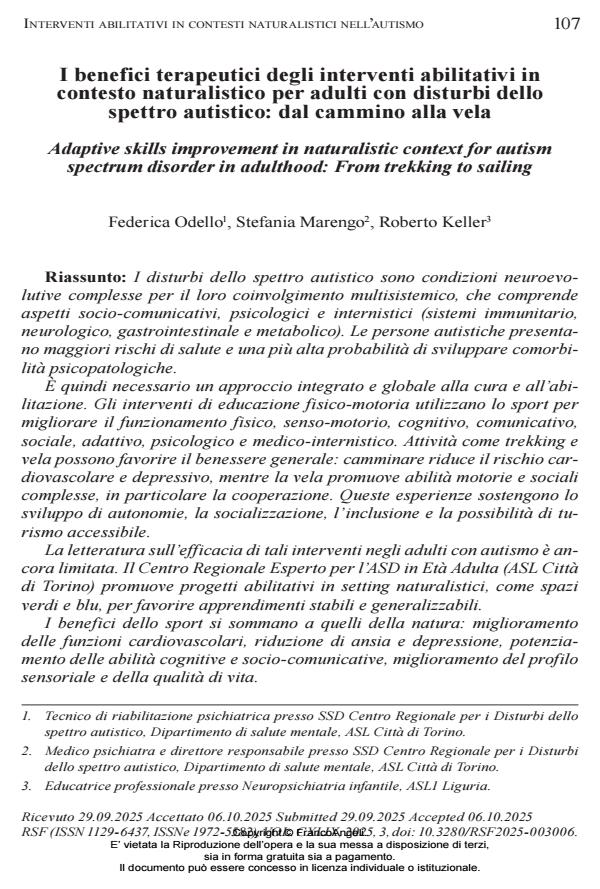
Autism spectrum disorders are complex neurodevelopmental conditions involving multiple systems, including sociocommunicative, psychological, and internistic domains (immune, neurological, gastrointestinal, and metabolic). Autistic people are at higher risk for health problems and psychopathological comorbidities. An integrated and holistic approach to care and habilitation is therefore essential. Physical and motor education interventions use sports to improve physical, sensorimotor, cognitive, communicative, social, adaptive, psychological, and medical functioning. Activities such as trekking and sailing promote overall wellbeing: walking reduces cardiovascular and depressive risks, while sailing enhances motor and social cooperation skills. These experiences support autonomy, socialization, inclusion, and accessible tourism. Evidence on the effectiveness of such programs for autistic adults remains limited. The Regional Center for Autism Spectrum Disorders in Adulthood (ASL Città di Torino) develops naturebased habilitation projects in green and blue spaces to promote stable and generalizable learning. The benefits of sport combine with those of nature, improving cardiovascular function, reducing anxiety and depression, enhancing cognitive and sociocommunicative skills, refining sensory profiles, and increasing quality of life. Based on these principles, projects such as CONTATTO®, Via Francigena for All – Francigena in Blu, and CONTATTO® VELA were developed for autistic adults, fostering adaptive growth through sport, shared experiences, and nature. The article outlines the principles, methods, and future directions of these interventions.
Keywords: Autism spectrum disorder, Adulthood, Treatments, Natural Contexts, Physical activities.
- [1.] American Psychiatric Association. Diagnostic and statistical manual of mental disorders (5th ed.). Washington, DC: Raffaello Cortina Editore; 2013.
- [2.] Grosprêtre S, Ruffino C, Derguy C, Gueugneau N. Sport and autism: what do we know so far? A review. Sports Medicine Open 2024; 10(1): 107. https://doi.org/10.1186/s4079802400765x
- [3.] Wang LAL, Petrulla V, Zampella CJ, Waller R, Schultz RT. Gross motor impairment and its relation to social skills in autism spectrum disorder: a systematic review and two metaanalyses. Psychological Bulletin 2022; 148(34): 273300. https://doi.org/10.1037/bul0000358
- [4.] Barrett LF, Satpute AB. Largescale brain networks in affective and social neuroscience: towards an integrative functional architecture of the brain. Current Opinion in Neurobiology 2013; 23(3): 36172. https:// doi.org/10.1016/j.conb.2012.12.012
- [5.] Bull FC, AlAnsari SS, Biddle S, et al. World Health Organization 2020 guidelines on physical activity and sedentary behaviour. British Journal of Sports Medicine 2020; 54(24): 145162. https://doi.org/10.1136/ bjsports2020102955
- [6.] Hillier A, Buckingham A, Schena D. Physical activity among adults with autism: participation, attitudes, and barriers. Perceptual and Motor Skills 2020; 127(5): 87490. https://doi.org/10.1177/0031512520927560
- [7.] Salar S, Jorgiæ BM, Olanescu M, Popa ID. Barriers to physical activity participation in children and adolescents with autism spectrum disorder. Healthcare 2024; 12(23): 2420. https://doi.org/10.3390/healthcare12232420
- [8.] Tan BW, Pooley JA, Speelman CP. A metaanalytic review of the efficacy of physical exercise interventions on cognition in individuals with autism spectrum disorder and ADHD. Journal of Autism and Developmental Disorders 2016; 46(9): 312643. https://doi.org/10.1007/s108030162854x
- [9.] Todd T, Reid G. Increasing physical activity in individuals with autism. Focus on Autism and Other Developmental Disabilities 2006; 21(3): 16776. https://doi.org/10.1177/10883576060210030501
- [10.] Bremer E, Crozier M, Lloyd M. A systematic review of the behavioural outcomes following exercise interventions for children and youth with autism spectrum disorder. Autism 2016; 20(8): 899915. https://doi. org/10.1177/1362361315616002
- [11.] Shahane V, Kilyk A, Srinivasan SM. Effects of physical activity and exercisebased interventions in young adults with autism spectrum disorder: a systematic review. Autism 2024; 28(2): 276300.
Federica Odello, Stefania Marengo, Roberto Keller, I benefici terapeutici degli interventi abilitativi in contesto naturalistico per adulti con disturbi dello spettro autistico: dal cammino alla vela in "RIVISTA SPERIMENTALE DI FRENIATRIA" 3/2025, pp 107-136, DOI: 10.3280/RSF2025-003006