Individual and group defense mechanisms in front of the environmental crisis
Journal title RIVISTA SPERIMENTALE DI FRENIATRIA
Author/s Cosimo Schinaia
Publishing Year 2025 Issue 2025/3
Language Italian Pages 17 P. 137-153 File size 629 KB
DOI 10.3280/RSF2025-003007
DOI is like a bar code for intellectual property: to have more infomation
click here
Below, you can see the article first page
If you want to buy this article in PDF format, you can do it, following the instructions to buy download credits
FrancoAngeli is member of Publishers International Linking Association, Inc (PILA), a not-for-profit association which run the CrossRef service enabling links to and from online scholarly content.
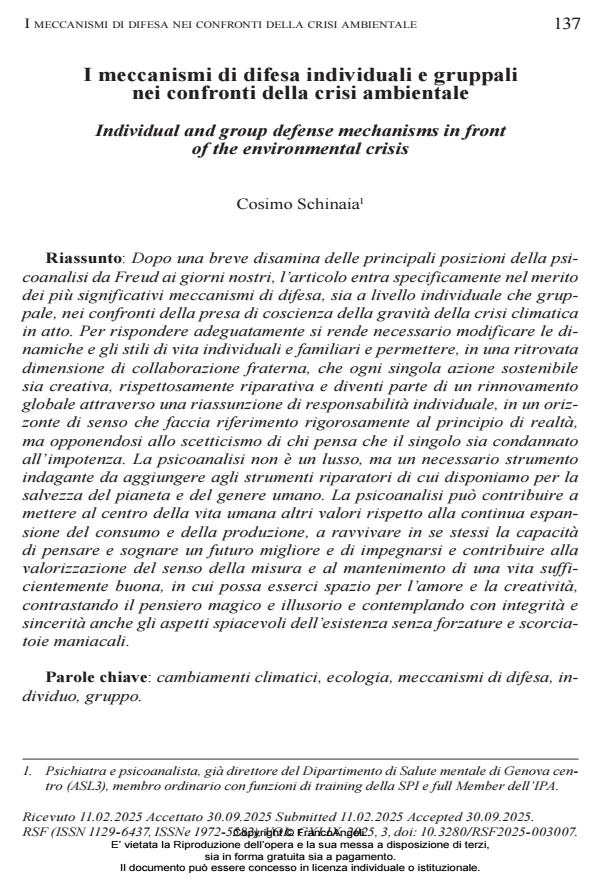
After a brief examination of the main positions of psychoanalysis from Freud to the present day, the article specifically addresses the most significant defense mechanisms, both at the individual and group level, against awareness of the severity of the current climate crisis. In order to respond adequately, it is necessary to change individual and family dynamics and lifestyles and allow, in a new dimension of fraternal collaboration, for every single sustainable action to be creative, respectfully restorative, and part of a global renewal through a resumption of individual responsibility, within a horizon of meaning that strictly refers to the reality principle, but opposes the skepticism of those who think that the individual is condemned to powerlessness. Psychoanalysis is not a luxury, but a necessary investigative tool to be added to the reparative tools we have at our disposal for the salvation of the planet and humankind. Psychoanalysis can help to place values other than the continuous expansion of consumption and production at the center of human life, to revive in ourselves the ability to think and dream of a better future, and to commit ourselves and contribute to the enhancement of a sense of moderation and the maintenance of a sufficiently good life, in which there can be room for love and creativity, countering magical and illusory thinking and contemplating with integrity and sincerity even the unpleasant aspects of existence without forcing ourselves or taking manic shortcuts.
Keywords: Climate change, ecology, defense mechanisms, individual, group.
- [11.] Trosman H., Simmons R.D. The Freud library. Journal of American Psychoanalytic Association 1973: 21(3): 646687.
- [1.] WHO. WHOconvened global study of origins of SARSCoV2: China part. 2021. https://www.who.int/publications/i/item/whoconvenedglobalstudyoforiginsofsarscov2chinapart (ultimo accesso: 23 settembre 2025).
- [2.] Quammen D. Spillover. L’evoluzione delle pandemie. Milano: Adelphi; 2014.
- [3.] Preta L. Recensione di Mindscapes, Psiche nel paesaggio di Vittorio Lingiardi. Rivista di psicoanalisi 2018; LXIV (1): 197201.
- [4.] Lacan J. Il Seminario. Libro VII. L’etica della psicoanalisi. Torino: Einaudi; 1994.
- [5.] Freud S. Lettera a Groddeck del 21 dicembre 1924. In: Honegger M., Carteggio FreudGroddeck. Milano: Adelphi; 1973.
- [6.] Puget J., Wender L. Analista y paciente en mundos superpuestos. Psicoanálisis 1982; 4(3): 503536.
- [7.] Freud S. Il disagio della civiltà. OSF, Vol. 10. Torino: Bollati Boringhieri; 1978.
- [8.] Freud S. L’avvenire di un’illusione. OSF, Vol. 10. Torino: Bollati Boringhieri; 1978.
- [9.] Freud S. Caducità. OSF, Vol. 8. Torino: Bollati Boringhieri; 1978.
- [10.] Arrhenius S. Die Vorstellung vom Weltgebäude im Wandel der Zeiten: Das Werden der Welten, neue Folge. Leipzig: Akademische Verlagsgesellschaft; 1908.
- [12.] Tansley A.J. The use and abuse of vegetational concepts and terms. Ecology 1935; 16(3): 284307.
- [13.] Freud S. L’Io e l’Es. OSF, Vol. 7. Torino: Bollati Boringhieri; 1978. [14.] Groddeck G. Il libro dell’Es. Milano: Adelphi; 1966.
- [15.] Ferenczi, S. Thalassa. Psicoanalisi delle origini della vita sessuale. Roma: Astrolabio; 1965.
- [16.] Freud S. (1933), Necrologio di Sándor Ferenczi. OSF, Vol. 11. Torino: Bollati Boringhieri; 1979.
- [17.] Searles H.F. L’ambiente non umano nello sviluppo normale e nella schizofrenia. Torino: Einaudi; 2004.
- [18.] Winnicott D.W.W. Il muro di Berlino. In Id. (ed.): Dal luogo delle origini. Milano: Cortina, 1990.
- [19.] Winnicott, D.W.W. La teoria del rapporto infante genitore. In Id. (ed.): Sviluppo affettivo e ambiente. Roma: Armando; 1970.
- [20.] Weintrobe S. On the love of nature and on human nature: Restoring split internal landscapes. In Id. (ed.): Engaging with the Climate Change: Psychoanalysis and Interdisciplinary Perspective. London & New York: Routledge; 2013.
- [21.] United States Environmental Protection Agency Clean Power Plan. Trump EPA Announces Reconsideration of BidenHarris Rule, “Clean Power Plan 2.0”, That Prioritized Shutting Down Power Plants While Raising Costs on American Families, 12 March 2025. https://www.epa. gov/newsreleases/trumpepaannouncesreconsiderationbidenharrisrulecleanpowerplan20prioritized (ultimo accesso: 23 settembre 2025).
- [22.] Worl Wildlife Found Australia. Australian Bushfires. https://wwf.org. au/whatwedo/australianbushfires/ (ultimo accesso: 23 settembre 2025).
- [23.] Dodds J. Psychoanalysis and Ecology at the Edge of Chaos. London & New York: Routledge; 2011.
- [24.] Guattari F., La Cecla F. Le tre ecologie. Dall’ecologia all’”ecosofia” eticopolitica. Sonda: Milano; 2019.
- [25.] Lertzman R.A. Environmental Melancholia: Psychoanalytic Dimensions of Engagement. London & New York: Routledge; 2015.
- [26.] Albrecht G. Solastalgia, a new concept in human health and identity. Philosophy Activism Nature 2015; 3: 4144.
- [27.] Pelissolo A., Massini C. Les émotions du dérèglement climatique. Paris: Flammarion ; 2021.
- [28.] Schinaia, C. Respect for the environment: Psychoanalytic reflections on the ecological crisis. International Journal of Psychoanalysis 2019; 100, 2: 272286.
- [29.] Preta L. La brutalità delle cose. Trasformazioni psichiche della realtà. Milano–Udine: Mimesis; 2015.
- [30.] Searles H.F. Processi inconsci relativi alla crisi ecologica. In Id. (ed.): Il controtransfert. Torino: Bollati Boringhieri; 1994.
- [31.] Fornari F. Psicoanalisi della guerra atomica. Milano: Ed. di Comunità; 1964.
- [32.] Zoja L. Nella mente di un terrorista. Conversazione con O. Bellicini. Torino: Einaudi; 2017.
- [33.] Weintrobe S. Psychological Roots of the Climate Crisis: Neoliberal Exceptionalism and the Culture of Uncare. New York & London: Bloomsbury; 2021.
- [34.] Segal H. Silence is the real crime. International Review of Psychoanalysis 1987; 14: 312.
- [35.] Fornari F. Psicoanalisi della guerra. Milano: Feltrinelli; 1966. [36.] Bion W.R. Attenzione e interpretazione. Roma: Armando; 1973.
- [37.] Calvino I. Le città invisibili. Milano: Mondadori; 1993.
- [38.] Castoriadis C. La montée de l’insignifiance. Les carrefours du labyrinthe. IV. Paris: Seuil; 2007.
- [39.] Marquez G. Discorso di accettazione del Premio Nobel. https://www. nobelprize.org/prizes/literature/1982/marquez/lecture/ (ultimo accesso: 23 settembre 2025).
Cosimo Schinaia, I meccanismi di difesa individuali e gruppali nei confronti della crisi ambientale in "RIVISTA SPERIMENTALE DI FRENIATRIA" 3/2025, pp 137-153, DOI: 10.3280/RSF2025-003007