Unintended consequences of tax incentives on the accounting quality of private firms
Journal title FINANCIAL REPORTING
Author/s Massimiliano Bonacchi, Luca Menicacci
Publishing Year 2025 Issue 2025/2
Language English Pages 22 P. 91-132 File size 342 KB
DOI 10.3280/fr202519445
DOI is like a bar code for intellectual property: to have more infomation
click here
Below, you can see the article first page
If you want to buy this article in PDF format, you can do it, following the instructions to buy download credits
FrancoAngeli is member of Publishers International Linking Association, Inc (PILA), a not-for-profit association which run the CrossRef service enabling links to and from online scholarly content.
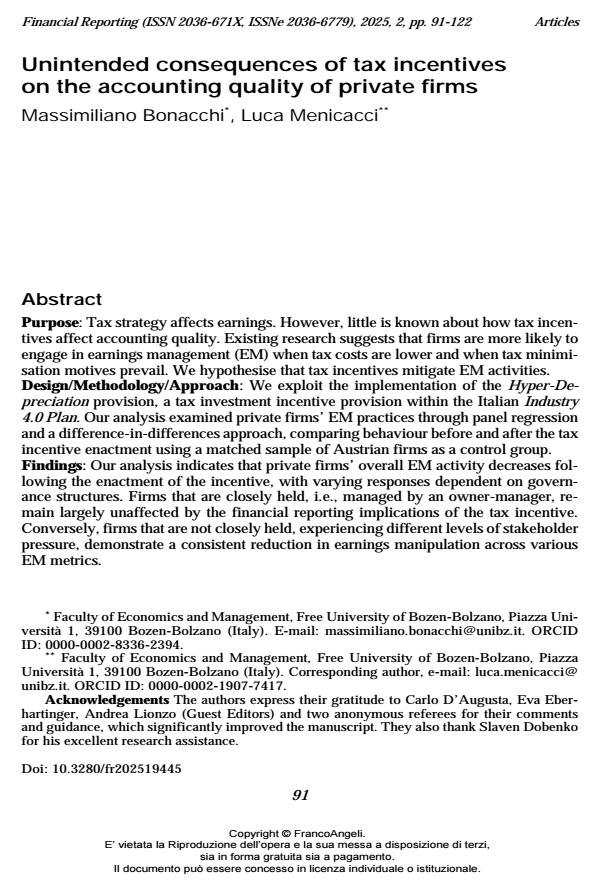
Purpose: Tax strategy affects earnings. However, little is known about how tax incen-tives affect accounting quality. Existing research suggests that firms are more likely to engage in earnings management (EM) when tax costs are lower and when tax minimi-sation motives prevail. We hypothesise that tax incentives mitigate EM activities. Design/Methodology/Approach: We exploit the implementation of the Hyper-De-preciation provision, a tax investment incentive provision within the Italian Industry 4.0 Plan. Our analysis examined private firms’ EM practices through panel regression and a difference-in-differences approach, comparing behaviour before and after the tax incentive enactment using a matched sample of Austrian firms as a control group. Findings: Our analysis indicates that private firms’ overall EM activity decreases fol-lowing the enactment of the incentive, with varying responses dependent on govern-ance structures. Firms that are closely held, i.e., managed by an owner-manager, re-main largely unaffected by the financial reporting implications of the tax incentive. Conversely, firms that are not closely held, experiencing different levels of stakeholder pressure, demonstrate a consistent reduction in earnings manipulation across various EM metrics. Originality/value: We provide novel insights into how tax incentives can influence accounting quality, an important yet understudied aspect of corporate taxation. We contribute to the accounting literature by demonstrating how governance structures can significantly influence firms’ responses to tax incentives in terms of EM. Practical implications: By highlighting the unintended consequences of tax invest-ment incentives, these findings have implications for policymakers when designing tax stimulus measures.
Keywords: tax incentives, earnings management, private firms, ownership structure
Jel codes: H25, H26, M41, M48, G32
Massimiliano Bonacchi, Luca Menicacci, Unintended consequences of tax incentives on the accounting quality of private firms in "FINANCIAL REPORTING" 2/2025, pp 91-132, DOI: 10.3280/fr202519445