Management control systems: Encouraging agility and resilience in the twin transition era

Journal title MANAGEMENT CONTROL
Author/s Antonio Corvino, Marika Intenza
Publishing Year 2026 Issue 2025/3
Language Italian Pages 10 P. 5-14 File size 86 KB
DOI 10.3280/MACO2025-003001
DOI is like a bar code for intellectual property: to have more infomation click here
Article preview

FrancoAngeli is member of Publishers International Linking Association, Inc (PILA), a not-for-profit association which run the CrossRef service enabling links to and from online scholarly content.

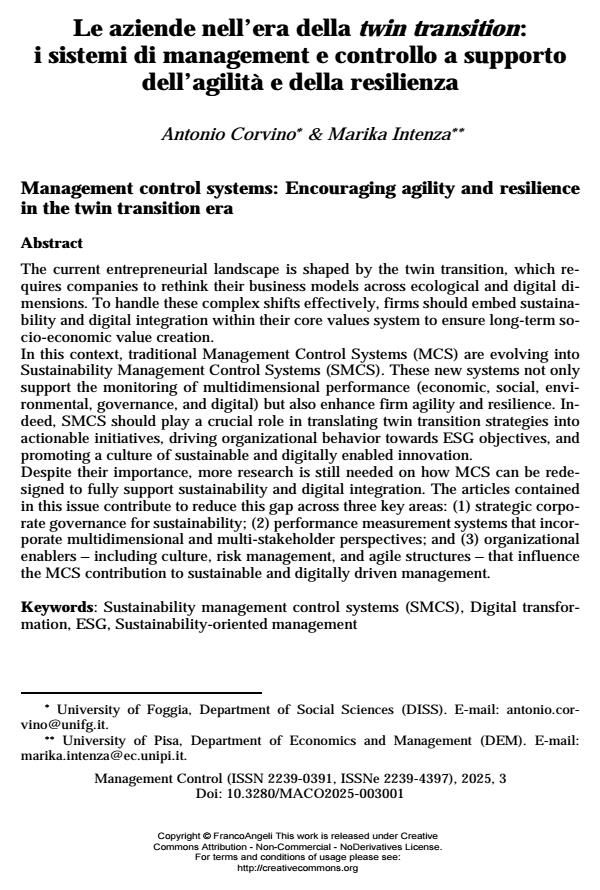
The current entrepreneurial landscape is shaped by the twin transition, which requires companies to rethink their business models across ecological and digital dimensions. To handle these complex shifts effectively, firms should embed sustainability and digital integration within their core values system to ensure long-term socio-economic value creation. In this context, traditional Management Control Systems (MCS) are evolving into Sustainability Management Control Systems (SMCS). These new systems not only support the monitoring of multidimensional performance (economic, social, environmental, governance, and digital) but also enhance firm agility and resilience. Indeed, SMCS should play a crucial role in translating twin transition strategies into actionable initiatives, driving organizational behavior towards ESG objectives, and promoting a culture of sustainable and digitally enabled innovation. Despite their importance, more research is still needed on how MCS can be redesigned to fully support sustainability and digital integration. The articles contained in this issue contribute to reduce this gap across three key areas: (1) strategic corporate governance for sustainability; (2) performance measurement systems that incorporate multidimensional and multi-stakeholder perspectives; and (3) organizational enablers - including culture, risk management, and agile structures - that influence the MCS contribution to sustainable and digitally driven management.

Keywords: Sustainability management control systems (SMCS), Digital transformation, ESG, Sustainability-oriented management

  1. Bertini U. (1990), Scritti di politica aziendale, Giappichelli, Torino.
  2. Bianchi Martini S. (2009), Introduzione all’analisi strategica dell’azienda, Giappichelli, Torino.
  3. Bianchi Martini S., Forconi, E., Branca, E. (2022), Management by values. La strategia aziendale orientata ai valori identitari, Giappichelli, Torino.
  4. Bianchi Martini, S., Corvino, A., Doni, F., Trecca, A. (2025), Exploring Biodiversity Disclosure and Financial Performance in the European Context: The Moderating Role of Board Experience, Business Strategy and the Environment.
  5. Borlatto, E., Truant, E., Giacosa, E., Manzi, L. M. (2024), Sustainable Performance: Unraveling the Nexus between ESG and Performance Management Systems, Management Control, 2, pp. 29-52. DOI: 10.3280/MACO2024-002-S1003.
  6. Broccardo, L., Giordino, D., Giacosa, E., Ballesio, E. (2025), Guiding the Algorithm: Harnessing artificial intelligence to nurture SMEs management control systems, Management Control, Suppl. 1, pp. 13-36. DOI: 10.3280/MACO2025-001-S1002.
  7. Capurro, R., Galeotti, M., Garzella, S. (2018), “Mondo reale-tradizionale” e “mondo digitale”, strategie aziendali e web intelligence: il futuro del controllo e della gestione delle informazioni, Management Control, Suppl. 2, 83-111. DOI: 10.3280/MACO2018-SU2005.
  8. Coda V. (2020), Lo scopo dell’impresa, Impresa progetto, pp. 1-26.
  9. Corvino A. (2024). Fenomeni ambientali e sistema d'azienda, in Anselmi L. Bianchi Martini S. Chirieleison C. Di Stefano G. Galeotti M. Garzella S. Marchi L. Talarico L. (a cura di), Scritti in Onore di Umberto Bertini, Vol. I, FrancoAngeli, Milano, pp. 527-536.
  10. Corvino, A., Bianchi Martini, S., Doni, F. (2021), Extinction accounting and accountability: Empirical evidence from the west European tissue industry, Business Strategy and the Environment, 30(5), pp. 2556-2570.
  11. Crovini, C., Ossola, G., Marchini, P. L. (2018), Cyber risk. The new enemy for risk management in the age of globalisation, Management Control, Suppl. 2, pp. 135-155. DOI: 10.3280/MACO2018-SU2007
  12. D’Onza, G. (2022), L’orientamento delle aziende ad uno sviluppo sostenibile: quale contributo da parte dei sistemi di management e controllo?, Management Control, 1, pp. 5-15. DOI: 10.3280/MACO2022-001001.
  13. Ferreira, J. J., Fernandes, C. I., Veiga, P. M., Caputo, A. (2022), The interactions of entrepreneurial attitudes, abilities and aspirations in the (twin) environmental and digital transitions? A dynamic panel data approach, Technology in Society, 71, 102121.
  14. Freeman, R.E. (1984), Strategic Management: A Stakeholder Approach. Pittman, Marshfield, MA.
  15. Galeotti, M., Lombardi, R., Paoloni, P., Roberto, F. (2022), Big data and sustainability reports: The current approach to non-accounting data management, Management Control, 2, pp. 95-116. DOI: 10.3280/MACO2022-002-S1005.
  16. Giannetti, R., Marelli, A. (2016), Il ruolo degli strumenti di cost management nello sviluppo di nuovi prodotti sostenibili, Management Control, 2, pp. 33-68. 10.3280/MACO2016-002003.
  17. Graf, L., Marques, M., Lambrechts, A. A. (2025), Skills Development for the Twin Transition: Building Transnational Skills Ecosystems Through Experimentalist Governance, Regulation & Governance.
  18. Intenza, M., Capobianco, N., Sarto, F., Saggese, S. (2025a), Opening the black box: Exploring innovation pathways from entrepreneurial ecosystems to financial performance in healthcare organisations, Journal of Business Venturing Insights, 24, e00586.
  19. Intenza, M., Turzo, T., Netti, A., Marzi, G. (2025b), Linking Responsible Innovation and Nonfinancial Reporting: Evidence From Manufacturing SMEs, Business Strategy and the Environment.
  20. Jensen, M.C., Meckling, W.H. (1979), Theory of the Firm: Managerial Behavior, Agency Costs, and Ownership Structure. In: Brunner, K. (Eds) Economics Social Institutions. Rochester Studies in Economics and Policy Issues, vol 1. Springer, Dordrecht. DOI: 10.1007/978-94-009-9257-3_8
  21. Mancini, D., Piedepalumbo, P., Lavorato, D. (2023), Il contributo di Management Control alla ricerca su tecnologie digitali e sostenibilità, Management Control, 2, pp. 5-18. DOI: 10.3280/MACO2023-002001
  22. Netti, A., Intenza, M., Favino, C., Saraò, C. P. (2025), How Stakeholder Engagement Drives Environmental Innovation to Mitigate Climate Change: Evidence From European Small Caps, Business Strategy and the Environment, 34 (8), pp. 10185-10206.
  23. Pizzi, S., Caputo, A., Corvino, A., Venturelli, A. (2020), Management research and the UN sustainable development goals (SDGs): A bibliometric investigation and systematic review. Journal of Cleaner Production, 276, 124033.
  24. Pizzi, S., Corbo, L., Caputo, A. (2021), Fintech and SMEs sustainable business models: Reflections and considerations for a circular economy, Journal of Cleaner Production, 281, p. 125217.
  25. Romano, M., Netti, A., Corvino, A., Intenza, M. (2024), Environmental innovation in healthcare industry: The moderating role of women on board in cost of debt, Corporate Social Responsibility and Environmental Management, 31(3), pp. 1921-1933.
  26. Tiscini, R., Martiniello, L., Lombardi, R. (2022), Circular economy and environmental disclosure in sustainability reports: Empirical evidence in cosmetic companies, Business Strategy and the Environment, 31(3), pp. 892-907.
  27. Zanin, F., Fasan, M., Costantini, A. (2019), Strategia, incertezza ambientale e balanced scorecard: quali impatti sulla performance aziendale?, Management Control, 2, pp. 39-65. DOI: 10.3280/MACO2019-002003.

Antonio Corvino, Marika Intenza, Le aziende nell’era della twin transition: i sistemi di management e controllo a supporto dell’agilità e della resilienza in "MANAGEMENT CONTROL" 3/2025, pp 5-14, DOI: 10.3280/MACO2025-003001