Becoming a Benefit Corporation in the Cosmetics Industry. An Italian case study

Journal title MANAGEMENT CONTROL
Author/s Chamochumbi Diaz Gail Denisse, Federica Palazzi, Massimo Ciambotti
Publishing Year 2026 Issue 2025/3
Language English Pages 24 P. 15-38 File size 205 KB
DOI 10.3280/MACO2025-003002
DOI is like a bar code for intellectual property: to have more infomation click here

Below, you can see the article first page

If you want to buy this article in PDF format, you can do it, following the instructions to buy download credits
Article preview

FrancoAngeli is member of Publishers International Linking Association, Inc (PILA), a not-for-profit association which run the CrossRef service enabling links to and from online scholarly content.

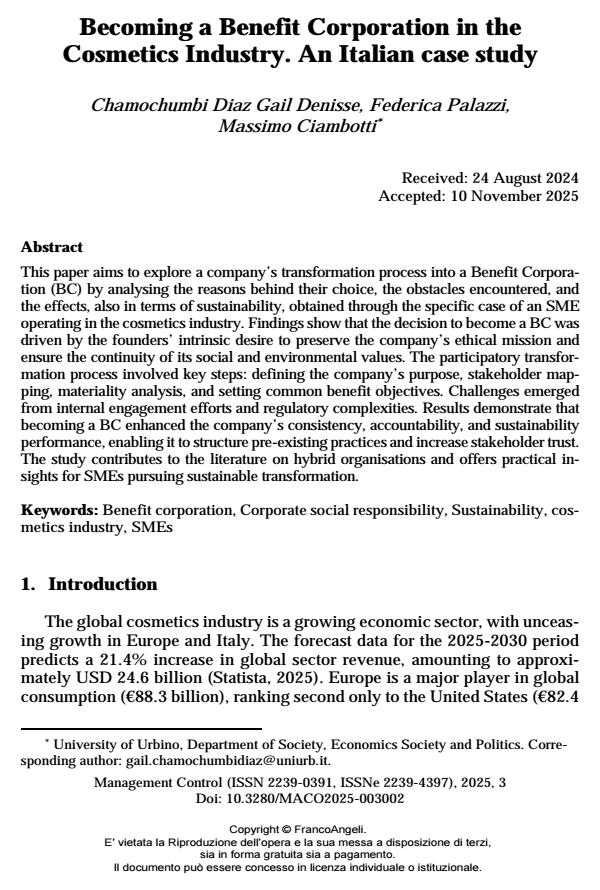
This paper aims to explore a company’s transformation process into a Benefit Corporation (BC) by analysing the reasons behind their choice, the obstacles encountered, and the effects, also in terms of sustainability, obtained through the specific case of an SME operating in the cosmetics industry. Findings show that the decision to become a BC was driven by the founders’ intrinsic desire to preserve the company’s ethical mission and ensure the continuity of its social and environmental values. The participatory transformation process involved key steps: defining the company’s purpose, stakeholder mapping, materiality analysis, and setting common benefit objectives. Challenges emerged from internal engagement efforts and regulatory complexities. Results demonstrate that becoming a BC enhanced the company’s consistency, accountability, and sustainability performance, enabling it to structure pre-existing practices and increase stakeholder trust. The study contributes to the literature on hybrid organisations and offers practical insights for SMEs pursuing sustainable transformation.

Keywords: Benefit corporation, Corporate social responsibility, Sustainability, cosmetics industry, SMEs

  1. Scott W. R. (2001), Institutions and organizations (2nd ed.). Thousand Oaks: Sage Publications.
  2. André R. (2012), Assessing the accountability of the benefit corporation: Will this new gray sector organization enhance corporate social responsibility?. Journal of business ethics, 110, pp. 133-150.
  3. Baudot L., Dillard J., Pencle, N. (2020), The emergence of benefit corporations: A cautionary tale. Critical Perspectives on Accounting, 67, 102073.
  4. Be´rdad J., Gendron Y. (2004), Qualitative research on accounting. Some thoughts on what occurs behind the scenes, in Humphrey C., Lee B. (eds.), The real-life guide to accounting research: A behind the scenes view of using qualitative research methods, Elsevier, Ams-terdam, pp. 191-206.
  5. Bom S., Jorge J., Ribeiro H. M., Marto J. (2019), A step forward on sustainability in the cosmetics industry: A review. Journal of cleaner production, 225, pp. 270-290.
  6. Cantele S., Campedelli B., Troisi, G. (2021), Le società Benefit in Italia: un'analisi sulla diffusione e sulle prassi di rendicontazione. Management Control, 2, pp. 107-126. DOI: 10.3280/MACO2021-002006
  7. Confindustria (2023), Cosmetica Italia. La cosmetica italiana: un’industria che fa bene al Paese. Available at https://www.cosmeticaitalia.it/conoscere-lindustria-cosmetica/La-cosmetica-italiana/.
  8. Cooper L. A., Weber J. (2021), Does benefit corporation status matter to investors? An exploratory study of investor perceptions and decisions. Business & Society, 60(4), pp. 979-1008. DOI: 10.1177/0007650319898462
  9. Cosmetica Italia (2024), Observatory on sustainability in the cosmetics sector in Italy. -- Full report available at: https://www.cosmeticaitalia.it/documenti/associazione/p/Report-di-sostenibilita-2023-V3-web.pdf.
  10. Cosmetica Italia (2025), National Association of Cosmetics Companies. -- Available at: https://www.cosmeticaitalia.it/conoscere-lindustria-cosmetica/La-cosmetica-italiana/.
  11. Cosmetics Europe (2019a), Environmental Sustainability. Eur. Cosmetics Industry Contribut. 2017-2019. -- Available at: https://www.cosmeticseurope.eu/files/3715/ 6023/8402/Environmental_Sustainability_Report_2019.pdf.
  12. Cosmetics Europe (2019b), Socio-economic contribution of the European Cosmetics Industry 2019. -- Available at: https://www.cosmeticseurope.eu/files/4715/6023/8405/Socio-Economic_Contribution_of_the_European_Cosmetics_Industry_Report_2019.pdf.
  13. Cosmetics Europe (2023), Cosmetic Europe: The Personal Care Association. Annual report 2023. -- Available at: https://cosmeticseurope.eu/files/5917/1878/4079/CE_Annual_Report_2023.pdf.
  14. Cosmetics Europe, (2012), Good Sustainability Practice (GSP) for the cosmetics industry. -- Available at: https://www.cosmeticseurope.eu/files/4214/6521/4452/GSP_Brochure.pdf.
  15. D’Onza G. (2022), L’orientamento delle aziende ad uno sviluppo sostenibile: quale contributo da parte dei sistemi di management e controllo?. Management Control, 1, pp. 5-15. DOI: 10.3280/MACO2022-001001
  16. Del Baldo M. (2019), Acting as a benefit corporation and a B Corp to responsibly pursue private and public benefits. The case of Paradisi Srl (Italy). International Journal of Corporate Social Responsibility, 4, pp. 1-18.
  17. Diez-Busto E., Sanchez-Ruiz L., Fernandez-Laviada A. (2022), B Corp certification: Why? How? and What for? A questionnaire proposal. Journal of Cleaner Production, 372, 133801.
  18. Donaldson T., Preston L. E. (1995) The stakeholder theory of the corporation: Concepts, evidence, and implications. Academy of Management Review, 20(1), pp. 65-91.
  19. Eisenhardt K. M., Graebner M. E. (2007), Theory building from cases: Opportunities and challenges. Academy of management journal, 50(1), pp. 25-32.
  20. Fortunati S., Martiniello L., Morea, D. (2020), The strategic role of the corporate social responsibility and circular economy in the cosmetic industry. Sustainability, 12(12), 5120.
  21. Garzella S., Capurro R. (2024), “Sostenibilità sostenibile” e creazione di valore: elementi di pianificazione, gestione, controllo e rendicontazione. Management Control, 2, pp. 5-14. DOI: 10.3280/MACO2024-002001
  22. Gazzola P., Grechi D., Ossola P., Pavione E. (2019), Certified Benefit Corporations as a new way to make sustainable business: The Italian example. Corporate Social Responsibility and Environmental Management, 26(6), pp. 1435-1445.
  23. Hemphill T. A., Cullari F. (2014), The benefit corporation: Corporate governance and the for-profit social entrepreneur. Business and Society Review, 119(4), pp. 519-536.
  24. Hickman L., Byrd J., Hickman K. (2014), Explaining the location of mission-driven businesses: An examination of B-Corps. Journal of Corporate Citizenship, 55, pp. 13-25.
  25. Hiller J. S. (2013), The benefit corporation and corporate social responsibility. Journal of Business Ethics, 118, pp. 287-301.
  26. Honeyman R., Jana, T. (2019), The B Corp handbook: How you can use business as a force for good (2nd edition). Berrett-Koehler Publishers.
  27. Kaur H., Baranidharan, S. (2024), A Comprehensive Evaluation of Assessment Tools for Detecting Corporate Greenwashing Practices in the Beauty and Cosmetics Industry. Presidency college (autonomous), 209.
  28. Kirst R. W., Borchardt M., de Carvalho M. N. M., Pereira G. M. (2021), Best of the world or better for the world? A systematic literature review on benefit corporations and certified B corporations contribution to sustainable development. Corporate Social Responsibility and Environmental Management, 28(6), pp. 1822-1839.
  29. Kolling C., Ribeiro J. L. D., de Medeiros J. F. (2022), Performance of the cosmetics industry from the perspective of Corporate Social Responsibility and Design for Sustainability. Sustainable Production and Consumption, 30, pp. 171-185.
  30. Kramer M. R., Porter M. (2011), Creating shared value (Vol. 17). Boston, MA, USA: FSG.
  31. Lyon T. P., Montgomery A. W. (2015), The means and end of greenwash. Organization & Environment, 28, pp. 223-249. DOI: 10.1177/1086026615575332
  32. Maak T. (2007), Responsible leadership, stakeholder engagement, and the emergence of social capital. Journal of business ethics, 74(4), pp. 329-343.
  33. Manetti G., Toccafondi S. (2012), The role of stakeholders in sustainability reporting assurance. Journal of business ethics, 107, pp. 363-377.
  34. Marchi L. (2019), Governo delle aziende e creazione di valore: da una prospettiva finanziaria ad una prospettiva economico-sociale. Management Control, 1, pp. 5-16. DOI: 10.3280/MACO2019-001001
  35. Marchini P. L., Tibiletti V., Fellegara A. M., Mazza, T. (2023), Pursuing a strategy of ‘common benefit’in business: The adoption of the benefit corporation model in Italy. Business Strategy and the Environment, 32(4), pp. 1481-1503.
  36. Miles M.B., Huberman A.M., Saldana J. (2014). Qualitative data analysis: A methods source- book, Thousand Oaks, Sage, London.
  37. Mion G., Loza Adaui C. R. (2020), Understanding the purpose of benefit corporations: an empirical study on the Italian case. International Journal of Corporate Social Responsibility, 5(1), pp. 4.
  38. Mion G., Adaui C. R. L., Bonfanti A., De Crescenzo V. (2023), Mission statements and financial and sustainability performance: An exploratory study of Benefit Corporations certified as B Corps. Journal of Business Research, 157, 113585.
  39. Mitchell R. K., Weaver G. R., Agle B. R., Bailey A. D., Carlson J. (2016), Stakeholder agency and social welfare: Pluralism and decision making in the multi-objective corporation. Academy of Management review, 41(2), pp. 252-275.
  40. Mondello A., Salomone R., Mondello, G. (2024), Exploring circular economy in the cosmetic industry: Insights from a literature review. Environmental Impact Assessment Review, 105, 107443.
  41. Morea D., Fortunati S., Martiniello L. (2021), Circular economy and corporate social responsibility: Towards an integrated strategic approach in the multinational cosmetics industry. Journal of Cleaner Production, 315, 128232.
  42. Nigri G., Del Baldo M., Agulini A. (2020), The Mondora method: Quantum leaders in benefit corporations. Entrepreneurship Research Journal, 10(4), pp. 1-25.
  43. Paelman V., Van Cauwenberge P., Vander Bauwhede, H. (2020), Effect of B Corp certification on short-term growth: European evidence. Sustainability, 12(20), 8459.
  44. Palazzi F., Sentuti A., Sgrò F., Ciambotti M. (2024), Italian Benefit Corporations: An investigation on the purposes. In: Place Based Approaches to Sustainability Volume II: Business, Economic, and Social Models (pp. 13-28). Cham: Springer Nature Switzerland. DOI: 10.1007/978-3-031-41610-1_2
  45. Panfilo S., Krasodosmka J., Sciascia S., Cortesi A. (2025), Sustainability Performance of B Corps and National Culture: Does Size Matter?. International Journal of Globalisation and Small Business, 14(4), pp. 408-434. DOI: 10.1504/IJGSB.2024.145739
  46. Patton M.Q. (2002), Qualitative Research & Evaluation Methods. Thousand Oaks, CA: Sage.
  47. Pollmeier T., Fisch C., Hirschmann, M. (2025). From profit to purpose: a systematic literature review and future research directions on B Corp certification. Management Review Quarterly, pp. 1-44.
  48. Rawhouser H., Cummings M., Crane, A. (2015), Benefit corporation legislation and the emergence of a social hybrid category. California Management Review, 57(3), pp. 13-35.
  49. Reich R. (2018), The common good. New York: Knoff.
  50. Richardson A., O’Higgins E. (2019), B corporation certification advantages? Impacts on performance and development. Business & Professional Ethics Journal, pp. 195-221.
  51. Rocca R., Acerbi F., Fumagalli L., Taisch, M. (2022), Sustainability paradigm in the cosmetics industry: State of the art. Cleaner Waste Systems, 3, 100057.
  52. Sahota A. (Ed.) (2014), Sustainability: how the cosmetics industry is greening up. John Wiley & Sons.
  53. Scott W. R. (1994), Institutions and organizations: Toward a theoretical synthesis. In W. R. Scott & J. W. Meyer (Eds.), Institutional environments and organizations: structural complexity and individualism, pp. 55-80. Thousand Oaks, CA: Sage.
  54. Statista (2025). Revenue of the cosmetics market worldwide from 2025 to 2030. -- Available at: https://www.statista.com/forecasts/1272313/worldwide-revenue-cosmetics-market-by-segment.
  55. Stecker M. J. (2016), Awash in a sea of confusion: Benefit corporations, social enterprise, and the fear of “greenwashing”. Journal of Economic Issues, 50(2), pp. 373-381. DOI: 10.1080/00213624.2016.1176481
  56. Villela M., Bulgacov S., Morgan G. (2021), B Corp certification and its impact on organizations over time. Journal of Business Ethics, 170, pp. 343-357.
  57. Wilburn K., Wilburn R. (2014), The double bottom line: Profit and social benefit. Business Horizons, 57(1), pp. 11-20.
  58. Yin R. K. (2009), Case study research: Design and methods (Vol. 5). Sage.

Chamochumbi Diaz Gail Denisse, Federica Palazzi, Massimo Ciambotti, Becoming a Benefit Corporation in the Cosmetics Industry. An Italian case study in "MANAGEMENT CONTROL" 3/2025, pp 15-38, DOI: 10.3280/MACO2025-003002