Measuring the Impact of Digitalization on the Performance of Long-Term Care Organizations: A Systematic Literature Review

Journal title MANAGEMENT CONTROL
Author/s Gabriele Palozzi, Marco Di Martino, Antonio Chirico, Gianluca Antonucci
Publishing Year 2026 Issue 2025/3
Language Italian Pages 25 P. 111-135 File size 577 KB
DOI 10.3280/MACO2025-003006
DOI is like a bar code for intellectual property: to have more infomation click here

Below, you can see the article first page

If you want to buy this article in PDF format, you can do it, following the instructions to buy download credits
Article preview

FrancoAngeli is member of Publishers International Linking Association, Inc (PILA), a not-for-profit association which run the CrossRef service enabling links to and from online scholarly content.

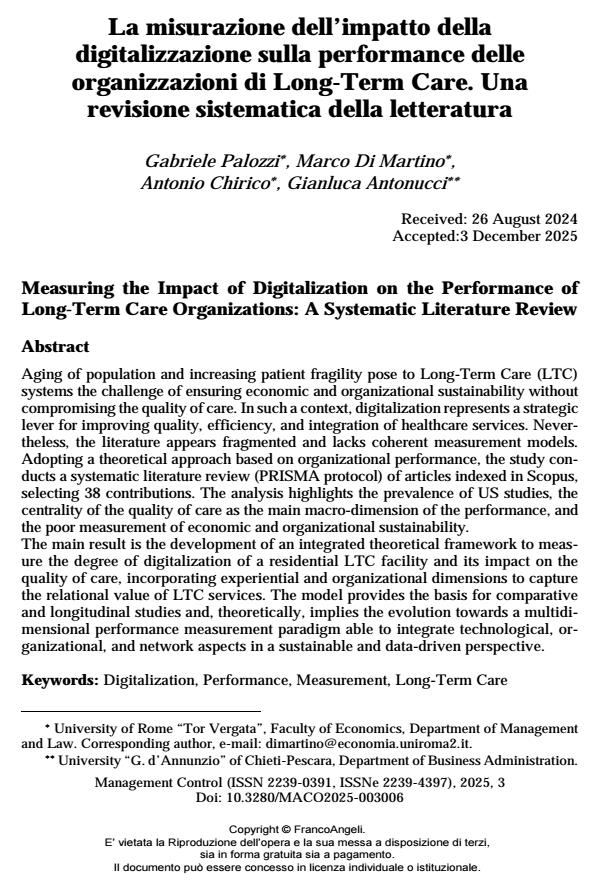
Aging of population and increasing patient fragility pose to Long-Term Care (LTC) systems the challenge of ensuring economic and organizational sustainability without compromising the quality of care. In such a context, digitalization represents a strategic lever for improving quality, efficiency, and integration of healthcare services. Nevertheless, the literature appears fragmented and lacks coherent measurement models. Adopting a theoretical approach based on organizational performance, the study conducts a systematic literature review (PRISMA protocol) of articles indexed in Scopus, selecting 38 contributions. The analysis highlights the prevalence of US studies, the centrality of the quality of care as the main macro-dimension of the performance, and the poor measurement of economic and organizational sustainability. The main result is the development of an integrated theoretical framework to measure the degree of digitalization of a residential LTC facility and its impact on the quality of care, incorporating experiential and organizational dimensions to capture the relational value of LTC services. The model provides the basis for comparative and longitudinal studies and, theoretically, implies the evolution towards a multidimensional performance measurement paradigm able to integrate technological, organizational, and network aspects in a sustainable and data-driven perspective.

Keywords: Digitalization, Performance, Measurement, Long-Term Care

  1. Alexander, G. L., Madsen, R. (2009). IT sophistication and quality measures in nursing homes. Journal of gerontological nursing, 35(7), 22-27. DOI: 10.3928/00989134-20090527-05
  2. Alexander, G. L. (2015). Nurse assistant communication strategies about pressure ulcers in nursing homes. Western Journal of Nursing Research, 37(7), 984-1004. DOI: 10.1177/0193945914555201
  3. Alexander, G. L., Steege, L. M., Pasupathy, K. S., Wise, K. (2015). Case studies of IT sophistication in nursing homes: a mixed method approach to examine communication strategies about pressure ulcer prevention practices. International Journal of Industrial Ergonomics, 49, 156-166.
  4. Alexander, G. L., Madsen, R. W., Miller, E., Wise, K. (2016). A national report of nursing home information technology adoption and quality measures. Journal of nursing care quality, 31(3), 201-206. DOI: 10.1097/NCQ.0000000000000187.
  5. Alexander, G. L., Madsen, R., Newton, M. (2017). Analyzing change in nursing home information technology sophistication: A 2-year survey. Journal of gerontological nursing, 43(1), 17-21. DOI: 10.3928/00989134-20161215-05
  6. Alexander, G. L., Deroche, C., Powell, K., Mosa, A. S. M., Popejoy, L., Koopman, R. (2020a). Forecasting content and stage in a nursing home information technology maturity instrument using a Delphi method. Journal of medical systems, 44, 1-8.
  7. Alexander, G. L., Madsen, R., Deroche, C. B., Alexander, R., Miller, E. (2020b). Ternary trends in nursing home information technology and quality measures in the United States. Journal of Applied Gerontology, 39(10), 1134-1143. DOI: 10.1177/0733464819862928
  8. Alexander, G. L., Madsen, R. W. (2021). A report of information technology and health deficiencies in US nursing homes. Journal of patient safety, 17(6), e483-e489. DOI: 10.1097/PTS.0000000000000390
  9. Alexander, G. L., Galambos, C., Rantz, M., Shumate, S., Vogelsmeier, A., Popejoy, L., Crecelius, C. (2022). Value propositions for health information exchange toward improving nursing home hospital readmission rates. Journal of Gerontological Nursing, 48(1), 15-20. DOI: 10.3928/00989134-20211207-03
  10. Ammenwerth, E. (2019). Technology acceptance models in health informatics: TAM and UTAUT. Stud Health Technol Inform, 263, 64-71. DOI: 10.3233/SHTI190111.
  11. Arah, O. A., Klazinga, N. S., Delnoij, D. M., Asbroek, A. T., Custers, T. (2003). Conceptual frameworks for health systems performance: a quest for effectiveness, quality, and improvement. International journal for quality in health care, 15(5), 377-398.
  12. Backhaus, R., Verbeek, H., van Rossum, E., Capezuti, E., Hamers, J. P. (2014). Nurse staffing impact on quality of care in nursing homes: a systematic review of longitudinal studies. Journal of the American Medical Directors Association, 15(6), 383-393.
  13. Baril, C., Gascon, V., St-Pierre, L., Lagacé, D. (2014). Technology and medication errors: impact in nursing homes. International Journal of Health Care Quality Assurance, 27(3), 244-258. DOI: 10.1108/IJHCQA-03-2013-0029
  14. Bassani, G., Cattaneo, C. (2017). Pratiche di controllo di gestione nel contesto sanitario italiano: i cambiamenti in atto nel Sistema Sociosanitario Lombardo. Management Control, (2017/3). DOI: 10.3280/MACO2017-003002
  15. Bradley, L., Shanker, S., Murphy, J., Fenge, L. A., Heward, M. (2023). Effectiveness of digital technologies to engage and support the wellbeing of people with dementia and family carers at home and in care homes: A scoping review. Dementia, 22(6), 1292-1313. DOI: 10.1177/14713012231178445
  16. Campion, F. X., Mathur, A., Konczewski, B. (2023). Impact of telehealth on hospitalization of skilled nursing facility patients during the COVID-19 pandemic. Telehealth and Medicine Today, 8(4).
  17. Capalbo, F., Sorrentino, M., Smarra, M., Ippolito, A. (2023). Il ruolo strategico dei Sistemi di Misurazione delle Performance nelle aziende sanitarie: un caso studio. Management Control: 1, 2023, 119-142. DOI: 10.3280/MACO2023-001006
  18. Castle, N. G., e Ferguson, J. C. (2010). What is nursing home quality and how is it measured?. The Gerontologist, 50(4), 426-442.
  19. Chiu, C. J., Wu, C. H. (2019). Information and communications technology as a health promotion method for older adults in assisted-living facilities: three-arm group-randomized trial. Journal of Medical Internet Research Aging, 2(1), e12633. DOI: 10.2196/12633
  20. Cifalinò, A., Lisi, I. E. (2016). L’utilizzo delle mappe strategiche nel governo dell’accesso ai servizi socio-sanitari. Azienda Pubblica(3), 311-330. http://hdl.handle.net/10807/97941.
  21. CMS (2024). Centers for Medicare e Medicaid Services. Design for Nursing Home Compare five-star quality rating system: Technical users guide. https://www.cms.gov/medicare/provider-enrollment-and-certification/certificationandcomplianc/downloads/usersguide.pdf
  22. Cristofaro, C. L., Melina, A. M., Ventura, M., Vesperi, W., Reina, R. (2021). The enabling conditions of electronic medical records: an empirical case. AZIENDA PUBBLICA, (1), 89-108. ISSN 1127-5812.
  23. De Felice, F., Petrillo, A. (2014). Critical success factors for e-healthcare: Integrated set of performance indicators system (ISPIS). In Ambient Assisted Living and Daily Activities: 6th International Work-Conference, IWAAL 2014, Belfast, UK, December 2-5, 2014. Proceedings 6 (pp. 398-401). Springer International Publishing. DOI: 10.1007/978-3-319-13105-4_58
  24. Donabedian, A. (1988). The quality of care: how can it be assessed?. Journal of the American Medical Association, 260(12), 1743-1748.
  25. Doran, D. M., Haynes, R. B., Kushniruk, A., Straus, S., Grimshaw, J., Hall, L. M., ... Jedras, D. (2010). Supporting evidence-based practice for nurses through information technologies. Worldviews on Evidence-Based Nursing, 7(1), 4-15.
  26. Dulal, R. (2018). Technical efficiency of nursing homes: do five-star quality ratings matter?. Health care management science, 21, 393-400.
  27. EU (2021). European Commission and Protection Committee (2021), Long-Term Care Report. Trends, Challenges and Opportunities in an Ageing Society. DOI: 10.2767/183997
  28. Fu, L., Sun, Z., He, L., Liu, F., Jing, X. (2019). Global long-term care research: A scientometric review. International Journal of Environmental Research and Public Health, 16(12), 2077.
  29. Fugini, M. G., Finocchi, J., Vitali, M., Locatelli, P., Gastaldi, L. (2016). Uso delle piattaforme ICT a supporto dei servizi socio-sanitari: il progetto Attiv@ bili. Mecosan: management ed economia sanitaria: 98, 2, 2016, 125-140. DOI: 10.3280/MESA2016-098007
  30. Gigli, S., Tieghi, M., Mariani, L. (2016). The efficacy of performance management system in healthcare: a literatur review and research perspectives. Management Control: 3, 2016, 97-116. DOI: 10.3280/MACO2016-003006
  31. Giordano, K., Lauer, N., Leusch, V., Kreiter, D., Corsten, S. (2024). Tablet-based biography work in long-term care homes to support quality of life and prevent depression. Educational Gerontology, 50(2), 100-113. DOI: 10.1080/03601277.2023.2225362
  32. Gonzalez-Aquines, A., Singh, S., Krol-Jankowska, A. G., Koziel, A. (2024). Defining Long-Term Care in European Union Countries: A Review of Policy Documents. Journal of Long-Term Care.
  33. Grindle, K. R. (2021). Impact of technology on community nursing during the pandemic. British Journal of Community Nursing, 26(3), 110-115.
  34. Gusenbauer, M., Haddaway, N. R. (2020). Which academic search systems are suitable for systematic reviews or meta-analyses? Evaluating retrieval qualities of Google Scholar, PubMed, and 26 other resources. Research Synthesis Methods, 11(2), 181-217.
  35. Hansen, K. E., Johs-Artisensi, J. L. (2019). Evaluating the implementation of technology in nursing homes. Journal of Health and Human Services Administration, 42(1), 58-92. DOI: 10.1177/1079373919042001
  36. Hitt, L. M., Tambe, P. (2016). Health care information technology, work organization, and nursing home performance. Industrial and Labor Relations Review, 69(4), 834-859. DOI: 10.1177/0019793916640493
  37. Institute of Medicine. 1991. Computer-Based Patient Record: An Essential Technology for Health Care. Washington, DC: The National Academies Press. DOI: 10.17226/18459
  38. Jacob, C., Lindeque, J., Klein, A., Ivory, C., Heuss, S., Peter, M. K. (2023). Assessing the quality and impact of eHealth tools: systematic literature review and narrative synthesis. JMIR Human Factors, 10, e45143. DOI: 10.2196/45143
  39. Jiang, T., Yu, P., Hailey, D., Ma, J., Yang, J. (2016). The impact of electronic health records on risk management of information systems in Australian residential aged care homes. Journal of medical systems, 40, 1-7.
  40. Karsan, Y., Anderson, C., Boyd, M. J., Thornley, T. (2021). Exploring barriers to the sustainability of an electronic administration system in long-term care facilities: a case study approach. Research in Social and Administrative Pharmacy, 17(6), 1066-1071.
  41. Khan, S. D., Hoodbhoy, Z., Raja, M. H. R., Kim, J. Y., Hogg, H. D. J., Manji, A. A. A., ... Sendak, M. P. (2024). Frameworks for procurement, integration, monitoring, and evaluation of artificial intelligence tools in clinical settings: A systematic review. PLOS Digital Health, 3(5), e0000514.
  42. Khowaja, A., Syed, N., Michener, K., Mechelse, K., Koning, H. (2023). Managers’ and administrators’ perspectives on digital technology use in regional long-term care homes during the COVID-19 pandemic. Gerontology and Geriatric Medicine, 9, 23337214221146665. DOI: 10.1177/23337214221146665
  43. Ko, C. H., Chou, C. M. (2020, April). Apply the SERVQUAL instrument to measure service quality for the adaptation of ICT technologies: A case study of nursing homes in Taiwan. In Healthcare (Vol. 8, No. 2, p. 108). MDPI.
  44. Kranz, A. M., Dalton, S., Damberg, C., Timbie, J. W. (2018). Using health IT to coordinate care and improve quality in safety-net clinics. The Joint Commission Journal on Quality and Patient Safety, 44(12), 731-740.
  45. Kruse, C. S., Mileski, M., Vijaykumar, A. G., Viswanathan, S. V., Suskandla, U., Chidambaram, Y. (2017). Impact of electronic health records on long-term care facilities: systematic review. JMIR Medical Informatics, 5(3), e7958.
  46. Langella, C., Mariani, A. (2020). Processi di esternalizzazione e reinternalizzazione nelle RSA: evidenze empiriche in Lombardia. Azienda Pubblica, (4), 379-401.
  47. Lettieri, E., Masella, C. (2009). Priority setting for technology adoption at a hospital level: Relevant issues from the literature. Health Policy, 90(1), 81-88.
  48. Lewis, K. L. (2007). Development of Indicators to Assess Quality of Life Within a Community: The 2006 Healthy Community Council Assessment. International Quarterly of Community Health Education, 27(2), 121-131.
  49. Longo, F., Cinelli, G. (2021). Un Servizio nazionale per gli anziani non autosufficienti. Mecosan: management ed economia sanitaria: 118, 2, 2021, 155-179. DOI: 10.3280/MESA2021-118008
  50. Lu, S. F., Rui, H., Seidmann, A. (2018). Does technology substitute for nurses? Staffing decisions in nursing homes. Management Science, 64(4), 1842-1859.
  51. Marti´n-Marti´n, A., Thelwall, M., Orduna-Malea, E., Lopez-Cozar, E. D. (2021). Google Scholar, Microsoft Academic, Scopus, Dimensions, Web of Science, and OpenCitations’ COCI: a multidisciplinary comparison of coverage via citations. Scientometrics 126(1), 871–906.
  52. McDonald, T., Russell, F. (2012). Impact of technology-based care and management systems on aged care outcomes in Australia. Nursing & health sciences, 14(1), 87-94.
  53. Mosca, I., van der Wees, P. J., Mot, E. S., Wammes, J. J., Jeurissen, P. P. (2016). Sustainability of long-term care: puzzling tasks ahead for policy-makers. International Journal of Health Policy and Management, 6(4), 195.
  54. Munyisia, E. N., Yu, P., Hailey, D. (2012). The impact of an electronic nursing documentation system on efficiency of documentation by caregivers in a residential aged care facility. Journal of clinical nursing, 21(19pt20), 2940-2948.
  55. Najjar, A., Amro, B., Macedo, M. (2021). The adoption level of electronic medical records in hebron hospitals based on the electronic medical record adoption model (EMRAM). Health Policy and Technology, 10(4), 100578.
  56. National Academies of Sciences, Engineering, and Medicine. (2022). The national imperative to improve nursing home quality: Honoring our commitment to residents, families, and staff. DOI: 10.17226/26526
  57. OECD (2020), Who Cares? Attracting and Retaining Care Workers for the Elderly, OECD Health Policy Studies, OECD Publishing, Paris.
  58. OECD (2023a), Health at a Glance 2023: OECD Indicators, OECD Publishing, Paris.
  59. OECD (2023b), Ready for the Next Crisis? Investing in Health System Resilience, OECD Health Policy Studies, OECD Publishing, Paris.
  60. Page, M. J., McKenzie, J. E., Bossuyt, P. M., Boutron, I., Hoffmann, T. C., Mulrow, C. D., ... Moher, D. (2021). The PRISMA 2020 statement: an updated guideline for reporting systematic reviews. British Medical Journal, 372.
  61. Pillemer, K., Meador, R. H., Teresi, J. A., Chen, E. K., Henderson Jr, C. R., Lachs, M. S., ... Eimicke, J. P. (2012). Effects of electronic health information technology implementation on nursing home resident outcomes. Journal of aging and health, 24(1), 92-112. DOI: 10.1177/0898264311408899
  62. Powell, K. R., Alexander, G. L., Madsen, R., Deroche, C. (2019). A national assessment of access to technology among nursing home residents: A secondary analysis. Journal of Medical Internet Research Aging, 2(1), e11449. DOI: 10.2196/11449
  63. Powell, K. R., Deroche, C. B., Carnahan, E. J., Alexander, G. L. (2020). Exploring Resident Care Information Technology Use and Nursing Home Quality. Journal of gerontological nursing, 46(4), 15-20. DOI: 10.3928/00989134-20200303-02
  64. Powell, K. R., Farmer, M., Liu, J., Alexander, G. L. (2024). A Survey of Technology Abandonment in US Nursing Homes. Journal of the American Medical Directors Association, 25(1), 6-11.
  65. Presti, C. (2022). L’azienda intelligente: opportunità e minacce per la creazione di valore. Management Control, (2022/3). DOI: 10.3280/MACO2022-003001
  66. Provan, K. G., Kenis, P. (2008). Modes of network governance: Structure, management, and effectiveness. Journal of public administration research and theory, 18(2), 229-252.
  67. Rantz, M. J., Hicks, L., Petroski, G. F., Madsen, R. W., Alexander, G., Galambos, C., ... Greenwald, L. (2010). Cost, staffing and quality impact of bedside electronic medical record (EMR) in nursing homes. Journal of the American Medical Directors Association, 11(7), 485-493.
  68. Rostad, H. M., Skinner, M. S., Wentzel-Larsen, T., Hellesø, R., Sogstad, M. K. R. (2023). Modes and models of care delivery in municipal long-term care services: a cross-sectional study from Norway. BMC Health Services Research, 23(1), 813.
  69. Steurer, B., Trukeschitz, B., Schneider, U. (2024). Applications of blockchain technology in long-term care: use cases, potentials, and barriers. BMC Health Services Research, 24(1), 1292.
  70. Thorpe, R., Holt, R., Macpherson, A., Pittaway, L. (2005). Using knowledge within small and medium-sized firms: A systematic review of the evidence. International Journal of Management Reviews, 7(4), 257-281.
  71. Tranfield, D., Denyer, D., Smart, P. (2003). Towards a methodology for developing evidence-informed management knowledge by means of systematic review. British journal of management, 14(3), 207-222. DOI: 10.1111/1467-8551.00375.
  72. Vendramini, E. A. (2024). Position paper Sanità territoriale. Mecosan, 2023(127), 154-155.
  73. Visser, M., Van Eck, N. J., Waltman, L. (2021). Large-scale comparison of bibliographic data sources: Scopus, Web of Science, Dimensions, Crossref, and Microsoft Academic. Quantitative science studies, 2(1), 20-41.
  74. Zarowitz, B. J., Resnick, B., Ouslander, J. G. (2018). Quality clinical care in nursing facilities. Journal of the American Medical Directors Association, 19(10), 833-839.
  75. WHO (2021). Global strategy on digital health 2020-2025. In Global strategy on digital health 2020-2025. https://iris.who.int/handle/10665/344249.
  76. WHO (2022). Rebuilding for sustainability and resilience: strengthening the integrated delivery of long-term care in the European Region. In Rebuilding for sustainability and resilience: strengthening the integrated delivery of long-term care in the European Region. https://iris.who.int/handle/10665/353912.
  77. Xavier Macedo de Azevedo, F., Heimgärtner, R.,Nebe, K. (2023). Development of a metric to evaluate the ergonomic principles of assistive systems, based on the DIN 92419. Ergonomics, 66(6), 821-848. DOI: 10.1080/00140139.2022.21279

Gabriele Palozzi, Marco Di Martino, Antonio Chirico, Gianluca Antonucci, La misurazione dell’impatto della digitalizzazione sulla performance delle organizzazioni di Long-Term Care. Una revisione sistematica della letteratura in "MANAGEMENT CONTROL" 3/2025, pp 111-135, DOI: 10.3280/MACO2025-003006