The evolution and role of diagnostic control systems in the “agile” context

Journal title MANAGEMENT CONTROL
Author/s Bruno De Rosa
Publishing Year 2026 Issue 2025/3
Language Italian Pages 24 P. 161-184 File size 133 KB
DOI 10.3280/MACO2025-003008
DOI is like a bar code for intellectual property: to have more infomation click here

Below, you can see the article first page

If you want to buy this article in PDF format, you can do it, following the instructions to buy download credits
Article preview

FrancoAngeli is member of Publishers International Linking Association, Inc (PILA), a not-for-profit association which run the CrossRef service enabling links to and from online scholarly content.

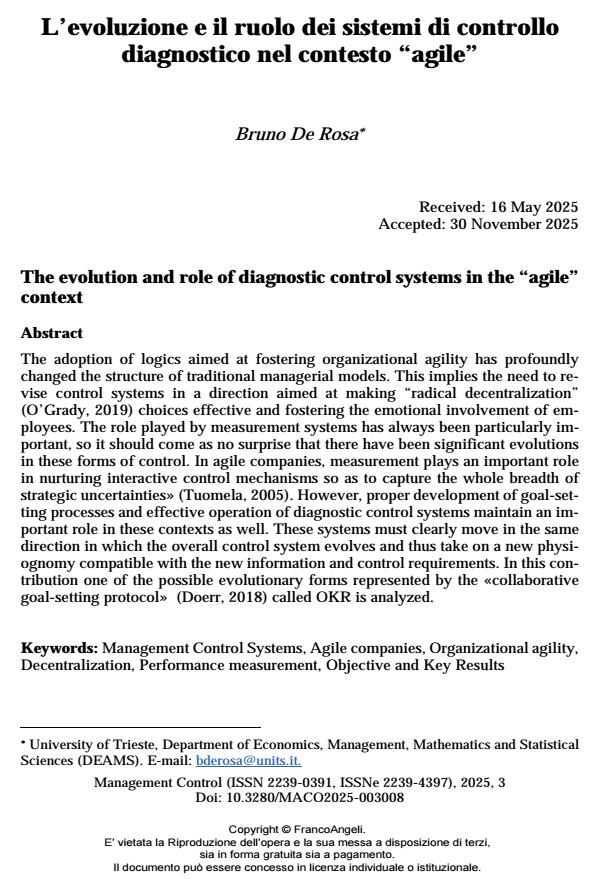
The adoption of logics aimed at fostering organizational agility has profoundly changed the structure of traditional managerial models. This implies the need to revise control systems in a direction aimed at making “radical decentralization” (O’Grady, 2019) choices effective and fostering the emotional involvement of employees. The role played by measurement systems has always been particularly important, so it should come as no surprise that there have been significant evolutions in these forms of control. In agile companies, measurement plays an important role in nurturing interactive control mechanisms so as to capture the whole breadth of strategic uncertainties» (Tuomela, 2005). However, proper development of goal-setting processes and effective operation of diagnostic control systems maintain an important role in these contexts as well. These systems must clearly move in the same direction in which the overall control system evolves and thus take on a new physiognomy compatible with the new information and control requirements. In this contribution one of the possible evolutionary forms represented by the «collaborative goal-setting protocol» (Doerr, 2018) called OKR is analyzed.

Keywords: Management Control Systems, Agile companies, Organizational agility, Decentralization, Performance measurement, Objective and Key Results

  1. Adler P.S., Chen C.X. (2011), Combining creativity and control: Understanding individual motivation in large-scale collaborative creativity, Accounting, organizations and society, 36, pp. 63-85.
  2. Aghina W., De Smet. A., Weerda K., (2015), Agility: It rhymes with stability, McKinsey Quarterly, 51, pp. 2-9.
  3. Ahrens T., Chapman C. (2004), Accounting for flexibility and efficiency: A field study of management control systems in a restaurant chain, Contemporary accounting research, 21, pp. 271-301.
  4. Aven T. (2015), The concept of antifragility and its implications for the practice of risk analysis, Risk analysis, 35, pp. 476-483.
  5. Balzano M., Bortoluzzi G. (2024), Strategic Agility: An Introduction, Strategic Agility in Dynamic Business Environments: Unveiling Foundations, Current Perspectives, and Future Directions, Springer.
  6. Barrett R. (2007), Planning and Budgeting for the Agile Enterprise: A driver-based budgeting toolkit, Elsevier.
  7. Bazigos M., De Smet A., Gagnon C. (2015), Why agility pays, McKinsey Quarterly, 4, pp. 28-35.
  8. Bedford D. S., Malmi T. (2015), Configurations of control: An exploratory analysis, Management Accounting Research, 27, pp. 2-26.
  9. Beer S. (1995), Brain of the Firm, New York, Wiley.
  10. Bellora-Bienengräber L., Derfuss K., Endrikat J. (2023), Taking stock of research on the levers of control with meta-analytic methods: Stylized facts and boundary conditions, Accounting, Organizations and Society, 106, 101414.
  11. Berry A.J., Broadbent J., Otley D. (1995), The domain of organisational control, Management control: theories, issues and practices, pp. 3-16.
  12. Bisbe J., Batista-Foguet J.M., Chenall R. (2007), Defining management accounting constructs: A methodological note on the risks of conceptual misspecification, Accounting, organizations and society, 32, pp. 789-820.
  13. Bisbe J., Kruise A.M., Madini P. (2019), Coercive, enabling, diagnostic, and interactive control: Untangling the threads of their connections, Journal of Accounting Literature, 43, pp. 124-144.
  14. Bisbe J., Malaguero R. (2009), The choice of interactive control systems under different innovation management modes, European Accounting Review, 18, pp. 371-405.
  15. Bisbe J., Otley D. (2004), The effects of the interactive use of management control systems on product innovation, Accounting, organizations and society, 29, pp. 709-737.
  16. Bogsnes B. (2016), Implementing beyond budgeting: Unlocking the performance potential, John Wiley & Sons.
  17. Bogsnes B. (2023), Beyond Budgeting and dynamic resource allocation, Controlling & Management Review, 67, pp. 8-17.
  18. Bonner J.M., Ruekert R.W. , Walker Jr O.C. (2002), Upper management control of new product development projects and project performance, Journal of Product Innovation Management: An International Publication of the Product Development & Management Association, 19, pp. 233-245.
  19. Bossert O., Kretzberg A., Laartz J. (2018). Unleashing the power of small, independent teams, McKinsey Quarterly, 18, pp. 67-75.
  20. Chenall R. H. (2003), Management control systems design within its organizational context: findings from contingency-based research and directions for the future, Accounting, organizations and society, 28, pp. 127-168.
  21. Chong K.M., Mahama H. (2014), The impact of interactive and diagnostic uses of budgets on team effectiveness, Management Accounting Research, 25, pp. 206-222.
  22. Cinquini L., Mitchell F., Norreklit H., Tenucci A. (2022a), Metodologie sistemiche vs metodi centrati sull’attore nella gestione delle misure di performance, Gestire la performance con il costruttivismo pragmatic: Un approccio Actor-based. FrancoAngeli.
  23. Cinquini L., Norreklit H. (2024), Performance measurement for a better future. Available: http://digital.casalini.it/10.3280/MACO2024-001002.
  24. Cinquini L., Norreklit H. (2022), Gestire la performance con il costruttivismo pragmatico: un approccio Actor-Based, FrancoAngeli.
  25. Cinquini L., Norreklit H., Norreklit L. (2022b), Gli attori e la realta: Il costruttivismo pragmatico per il governo e controllo nelle aziende. Gestire la performance con il costruttivismo pragmatic: Un approccio Actor-based. FrancoAngeli.
  26. Cinquini L., Revellino S., Chiucchi M.S. (2023), La prospettiva della performatività e gli strumenti di misurazione e gestione della performance, Management Control, 3, pp 5-24, DOI: 10.3280/MACO2023-003001
  27. Collins J.C., Porras J.I. (1996), Building your company's vision, Harvard business review, 74, pp. 65-78.
  28. Cooper R., Slagmulder R. (1998), Micro-profit centers. Management Accounting (USA), 79, pp. 16-18.
  29. Curtis E., Lillis A.M., Sweeney B. (2017), Simons’ levers of control framework: commensuration within and of the framework, Advances in Management Accounting. Emerald Publishing Limited.
  30. Darino L., Sieberer M., Vos A., Williams O. (2019), Performance management in agile organizations, New York.
  31. Davila A., Ditillo A. (2013), Convergent creativity and management control systems: Managing stylistic innovation in fashion companies, Seminar, IESEG School of Management, Lille.
  32. Davila A, T. 2005. The promise of management control systems for innovation and strategic change, Controlling strategy: Management, accounting, and performance measurement, pp. 37-61.
  33. De Smet A. (2018), The agile manager, The McKinsey Quarterly, 3, pp. 76-81.
  34. Dehaene S. (2011), The number sense: How the mind creates mathematics, OUP USA.
  35. Di Berardino D., Anees F. (2024), Creatività organizzativa ed individuale nelle piccole e medie imprese: il ruolo del sistema di controllo, Management Control, 1, pp 227-249, DOI: 10.3280/MACO2024-001011
  36. Doerr J. (2018), Measure What Matters: The Simple Idea that Drives 10x Growth, Penguin UK.
  37. Drucker P. (2012), The practice of management, Routledge.
  38. Ferreira A., Otley D. (2009), The design and use of performance management systems: An extended framework for analysis, Management accounting research, 20, pp. 263-282.
  39. Flamholtz E. (1996), Effective organizational control: A framework, applications, and implications, European Management Journal, 14, pp. 596-611.
  40. Ghoshal S. (2005), Bad management theories are destroying good management practices, Academy of Management learning & education, 4, pp. 75-91.
  41. Hackman J.R. (2002), Leading teams: Setting the stage for great performances, Harvard Business Press.
  42. Hamel G., Zanini M. (2020), Humanocracy: Creating organizations as amazing as the people inside them, Harvard Business Press.
  43. Henry, J.F. (2006), Management control systems and strategy: A resource-based perspective, Accounting, organizations and society, 31, pp. 529-558.
  44. Hillson D. (2023), Beyond resilience: towards antifragility?, Continuity & Resilience Review, 5, pp. 210-226.
  45. Hope J. (2007), Beyond budgeting to the adaptive organization, Business performance measurement: Unifying theories and integrating practice, pp.163-178.
  46. Hoper J., Fraser R. (1997), Beyond budgeting... breaking through the barrier to the ‘third wave’, Management Accounting (London), 75, pp. 20-23.
  47. Hope J., Hope, T. (1997), Competing in the third wave: the ten key management issues of the information age, Boston, Massachusetts, Haravard Business School Press.
  48. Hopwood A.G. (1996), Looking across rather than up and down: on the need to explore the lateral processing of information. Accounting, Organizations and Society, 6, pp. 589-590.
  49. Kahneman D. (2013), Think, Fast and Slow (Farrar, Straus and Giroux, New York).
  50. Kaplan R.S. (2009), Conceptual foundations of the balanced scorecard, Handbooks of management accounting research, 3, pp. 1253-1269.
  51. Khani, A., Varma A. (2023), Simons levers of control disentangled: A quasi-experiment into the competitiveness of hybrid firms.,Management Control, 2, pp. 19-41.
  52. Kreutzer M., Walter J. (2025), Reconceptualizing organizational control: Managing in the age of hybrid workplaces, artificial intelligence, and the gig economy, Cambridge, Cambridge University Press.
  53. Langfield-Smith K. (1997), Management control systems and strategy: a critical review, Accounting, organizations and society, 22, pp. 207-232.
  54. Lee M.Y., Edmondson A.C. (2017), Self-managing organizations: Exploring the limits of less-hierarchical organizing, Research in organizational behavior, 37, pp. 35-58.
  55. Leonardi P., Contractor N. (2018), Better people analytics, Harvard business review, 96, pp. 70-81.
  56. Lewin R. (1999), Complexity: Life at the edge of chaos, University of Chicago Press.
  57. Lopez-Valeiras E., Gonzalez-Sanchez, M.B., Gomez-Conde J. (2016), The effects of the interactive use of management control systems on process and organizational innovation, Review of Managerial Science, 10, pp. 487-510.
  58. McGrath R.G. (2013), The end of competitive advantage: How to keep your strategy moving as fast as your business, Harvard Business Review Press.
  59. McKinsey A.T. (2017), The 5 trademarks of agile organizations. New York: McKinsey.
  60. Merchant K.A. (1982), The control function of management. Sloan Management Review, 23, p. 43.
  61. Mintzberg H. (1987), The strategy concept I: Five Ps for strategy. California management review, 30, pp. 11-24.
  62. Mintzberg H. (2023), Understanding organizations... Finally!: Structuring in sevens, Berrett-Koehler Publishers.
  63. Moe N.B., Šmite D., Paasivaara M., Lassenius C. (2021), Finding the sweet spot for organizational control and team autonomy in large-scale agile software development, Empirical Software Engineering, 26, p. 101.
  64. Moreira M.E. (2017), The Agile Enterprise: Building and Running Agile Organizations, Winchester, Massachusetts, USA, Apress.
  65. Morgan G. (1998), Images of organization: The executive edition, Sage Publications.
  66. Morlidge S., Player S. (2010), Future ready: How to master business forecasting, John Wiley & Sons.
  67. Müller-Stewens B., Widener S.K., Möller K., Steinmann J.C. (2020), The role of diagnostic and interactive control uses in innovation. Accounting, Organizations and Society, 80, 101078.
  68. Mundra S. (2018), Enterprise Agility: Being Agile in a Changing World, Birmingham, Packt Publishing.
  69. Mundy J. (2010), Creating dynamic tensions through a balanced use of management control systems, Accounting, Organizations and society, 35, pp. 499-523.
  70. Newman W.H. (1975), Constructive control: Design and use of control systems. (No Title).
  71. Nieto M. (2003), From R&D management to knowledge management: An overview of studies of innovation management, Technological Forecasting and Social Change, 70, pp. 135-161.
  72. Niven P.R., Lamorte B. (2016). Objectives and key results: Driving focus, alignment, and engagement with OKRs, John Wiley & Sons.
  73. Nørreklit H. (2017), A philosophy of management accounting: A pragmatic constructivist approach, Taylor & Francis.
  74. Nørreklit L. (2006), The construction of truth: truth as integration and learning-a contribution to pragmatic constructivism.
  75. Nørreklit L., Nørreklit H., Israelsen P. (2006), The validity of management control topoi: towards constructivist pragmatism. Management Accounting Research, 17, pp. 42-71.
  76. O’Grady W. (2019), Enabling control in a radically decentralized organization, Qualitative Research in Accounting & Management, 16, pp. 224-251.
  77. Park Y., Kim S. (2005), Linkage between knowledge management and R&D management, Journal of knowledge management, 9, pp. 34-44.
  78. Porter M.E. (2008), Competitive advantage: Creating and sustaining superior performance, Simon and Schuster.
  79. Ramos C., Pavhlichenko I. (2022), Creating Agile Organizations: A Systemic Approach, Addison-Wesley Professional.
  80. Rigby D., Elk S., Berez S. (2020), Doing agile right: Transformation without chaos, Harvard Business Press.
  81. Roberts J. (2007), The modern firm: Organizational design for performance and growth, Oxford University Press, USA.
  82. Rompho N. (2024), Do objectives and key results solve organizational performance measurement issues? Benchmarking: An International Journal, 31, pp. 669-682.
  83. Roussel P.A., Saad K.N., Erickson T.J. (1991), Third generation R&D: managing the link to corporate strategy, Boston Harvard Business Review Press.
  84. Rumelt R.P. (2011), Good strategy, bad strategy : the difference and why it matters, New York, Crown Business.
  85. Schüll M., Hofmann P., Philipp P., Urbach N. (2023), Reporting in large-scale agile organizations: insights and recommendations from a case study in software development, Information Systems and e-Business Management, 21, pp. 571-601.
  86. Seal W. (2017), Researching performance management: An actor-reality perspective, The Routledge Companion to Performance Management and Control, Routledge.
  87. Senge P., Von Ameln F. (2019), We are not in control-embrace uncertainty and trust in what emerges. Peter Senge on the legacy and future of Change Management. Gruppe. Interaktion. Organisation. Zeitschrift für Angewandte Organisationspsychologie (GIO), 50, 123-127.
  88. Simons R. (1991), Strategic orientation and top management attention to control systems, Strategic management journal, 12, pp. 49-62.
  89. Simons R. (1994), How new top managers use control systems as levers of strategic renewal, Strategic management journal, 15, pp. 169-189.
  90. Simons R. (1995), Levers of control : how managers use innovative control systems to drive strategic renewal, Boston, Mass., Harvard Business School Press.
  91. Simons R. (2005), Levers of organization design : how managers use accountability systems for greater performance and commitment, Boston, Mass., Harvard Business School Press.
  92. Simons R. (2008), Control in an age of empowerment, Boston, Mass., Harvard Business Press.
  93. Smith A. (1937), The wealth of nations [1776], na.
  94. Taleb, N.N. (2014), Antifragile: Things that gain from disorder, Random House Trade Paperbacks.
  95. Tarakci M., Heyden M.L., Rouleau L., Raes A., Floyd S.W. (2023), Heroes or villains? Recasting middle management roles, processes, and behaviours, Journal of Management Studies, 60, pp. 1663-1683.
  96. Taylor F.W. (2004), Scientific management, Routledge.
  97. Tessier S., Otley D. (2012), A conceptual development of Simons’ Levers of Control framework. Management accounting research, 23, 171-185.
  98. Tessier S., Otley D. (2012b), From management controls to the management of controls, Accounting, Auditing & Accountability Journal, 25, pp. 776-805.
  99. Trenca M., Nørreklit H. (2017), Actor-based performance management, A Philosophy of Management Accounting, Routledge.
  100. Tuomel T.S. (2005), The interplay of different levers of control: A case study of introducing a new performance measurement system. Management accounting research, 16, pp. 293-320.
  101. Wageman R., Fisher C. (2014), Who’s in Charge Here? The Team Leadership Implications of Authority Structure. The Oxford handbook of leadership and organizations, chapter 21.
  102. Walter A.T. (2021), Organizational agility: ill-defined and somewhat confusing? A systematic literature review and conceptualization, Management Review Quarterly, 71, pp. 343-391.
  103. Widener S.K. (2007), An empirical analysis of the levers of control framework, Accounting, organizations and society, 32, pp. 757-788.
  104. Wowerath C. (2025), Engaging the entire organization: how OKRs enhance integrative strategy implementation, Journal of Business Strategy, pp. 1-19.
  105. Wowerath C. (2026), Objectives and key results as a tool for middle managers to enhance the process of strategy implementation, Journal of Business Research, 202, 115774.
  106. Yu A. (1998), Creating the digital future: The secrets of consistent innovation at Intel, Simon & Schuster Trade.

Bruno De Rosa, L’evoluzione e il ruolo dei sistemi di controllo diagnostico nel contesto “agile” in "MANAGEMENT CONTROL" 3/2025, pp 161-184, DOI: 10.3280/MACO2025-003008