Reframing Budgeting in Dynamic Environments: Unveiling the Invisible Behind the Visible

Journal title MANAGEMENT CONTROL
Author/s Antonio Leotta, Carmela Rizza, Daniela Ruggieri
Publishing Year 2026 Issue 2025/3
Language Italian Pages 24 P. 185-208 File size 204 KB
DOI 10.3280/MACO2025-003009
DOI is like a bar code for intellectual property: to have more infomation click here

Below, you can see the article first page

If you want to buy this article in PDF format, you can do it, following the instructions to buy download credits
Article preview

FrancoAngeli is member of Publishers International Linking Association, Inc (PILA), a not-for-profit association which run the CrossRef service enabling links to and from online scholarly content.

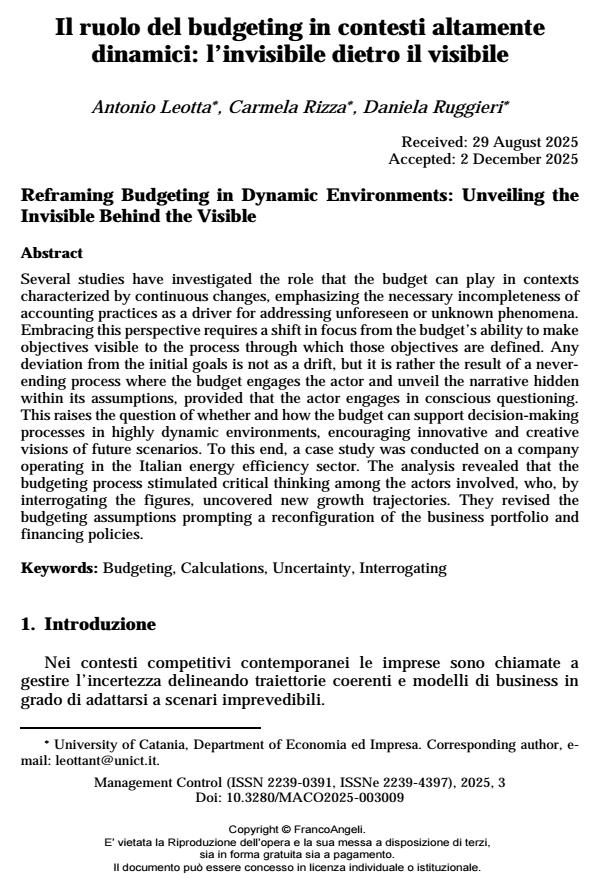
Several studies have investigated the role that the budget can play in contexts characterized by continuous changes, emphasizing the necessary incompleteness of accounting practices as a driver for addressing unforeseen or unknown phenomena. Embracing this perspective requires a shift in focus from the budget’s ability to make objectives visible to the process through which those objectives are defined. Any deviation from the initial goals is not as a drift, but it is rather the result of a never-ending process where the budget engages the actor and unveil the narrative hidden within its assumptions, provided that the actor engages in conscious questioning. This raises the question of whether and how the budget can support decision-making processes in highly dynamic environments, encouraging innovative and creative visions of future scenarios. To this end, a case study was conducted on a company operating in the Italian energy efficiency sector. The analysis revealed that the budgeting process stimulated critical thinking among the actors involved, who, by interrogating the figures, uncovered new growth trajectories. They revised the budgeting assumptions prompting a reconfiguration of the business portfolio and financing policies.

Keywords: Budgeting, Calculations, Uncertainty, Interrogating

  1. Adler P.S., Boris B. (1996), Two types of bureaucracy: Enabling and coercive, Administrative Science Quarterly, 41, pp. 61-89. DOI: 10.2307/2393986
  2. Amaduzzi A. (1949), Conflitto ed equilibrio di interessi nel bilancio dell'impresa, Francesco Cacucci.
  3. Bassani S., Lee Y.K., Campagnari V., Eccher A., Monzani D., Nocini R., ... Molteni G. (2023), From hype to reality: a narrative review on the promising role of artificial intelligence in larynx cancer detection and transoral microsurgery, Critical Reviews™ in Oncogenesis, 28(3).
  4. Burns J., Scapens R.W. (2000), Conceptualizing management accounting change: an institutional framework, Management accounting research, 11(1), pp. 3-25.
  5. Busco C., Quattrone P. (2018), In Search of the “Perfect One”: How accounting as a maieutic machine sustains inventions through generative ‘in-tensions’, Management Accounting Research, 39, pp.1-16.
  6. Callon M., Muniesa F. (2005), Peripheral vision: Economic markets as calculative collective devices, Organization studies, 26(8), pp. 1229-1250. DOI: 10.1177/0170840605056393
  7. Cinquini L., Braico N., Tenucci A., Pigatto G. (2024), Un modello sistemico delle relazioni tra azienda, biodiversità ed ecosistemi per gestire la performance ambientale, Management Control, 2, pp. 161-185. DOI: 10.3280/MACO2024-002008
  8. Cinquini L., Revellino S., Chiucchi M.S. (2024), La prospettiva della performatività e gli strumenti di misurazione e gestione della performance, Management Control, (3), pp. 5-24. DOI: 10.3280/MACO2023-003001
  9. Dumay J.C. (2010), A critical reflective discourse of an interventionist research project. Qualitative Research in Accounting & Management, 7(1), pp. 46-70. DOI: 10.1108/11766091011034271
  10. Giamporcaro S., Gond J.P. (2016), Calculability as politics in the construction of markets: The case of socially responsible investment in France, Organization Studies, 37(4), pp. 465-495. DOI: 10.1177/0170840615604498
  11. Giovannoni E., Begkos C., Mouritsen J., Kornberger M. (2025), Why and how counting counts: Perspectives on calculative practices for organization studies, Organization Studies, 46(6), pp. 881-902. DOI: 10.1177/01708406251314597
  12. Grandori A. (1996), Disegni di ricerca in organizzazione, Manuale di organizzazione aziendale, 5.
  13. Hansen S. C., Otley D.T., Van der Stede W.A. (2003), Practice developments in budgeting: an overview and research perspective, Journal of management accounting research, 15(1), pp. 95-116.
  14. Jönsson S., Lukka K. (2007), There and back again: doing interventionist research in management accounting, Handbooks of management accounting research, 1, pp. 373-397. DOI: 10.1016/S1751-3243(06)01015-7
  15. Jordan S., Messner M. (2012), Enabling control and the problem of incomplete performance indicators, Accounting, Organizations and Society, 37(8), pp. 544-564.
  16. Lavorato D., Lardo A., Lamboglia R. (2025), Mapping and measuring IC in Knowledge-Intensive Organizations: An interventionist study, Management Control, (1). DOI: 10.3280/MACO2025-001002
  17. Leotta A., Messina M. (2024), A narrative perspective on controlling new product development, Collana di Studi e Ricerche in Economia Aziendale, Aracne Editrice.
  18. Libby T., Lindsay R.M. (2010), Beyond budgeting or budgeting reconsidered? A survey of North-American budgeting practice, Management accounting research, 21(1), pp. 56-75.
  19. Lukka K., Wouters M. (2022), Towards interventionist research with theoretical ambition, Management Accounting Research, 55, 100783.
  20. Mancini D. (2016), Accounting information systems in an open society: Emerging trends and issues, Management Control, 1, pp. 5-16. DOI: 10.3280/MACO2016-001001
  21. Marasca S. (2018), Sistemi avanzati per il controllo di gestione, Arezzo, Knowità.
  22. Marchi L. (Ed.) (2014), Introduzione all’economia aziendale: Il sistema delle operazioni e le condizioni di equilibrio aziendale, Nona edizione (Vol. 1), G Giappichelli Editore.
  23. Marchi L., Marasca S., Chiucchi M. S. (2018), Controllo di gestione. G. Giappichelli Editore.
  24. Neely A., Bourne M., Adams C. (2003), Better budgeting or beyond budgeting?, Measuring business excellence, 7(3), pp. 22-28. DOI: 10.1108/13683040310496471
  25. Nguyen D.H., Weigel C., Hiebl M.R. (2018), Beyond budgeting: Review and research agenda, Journal of Accounting & Organizational Change, 14(3), pp. 314-337. DOI: 10.1108/JAOC-03-2017-0028
  26. Nørreklit L. (2017), Actor-reality construction. In A philosophy of management accounting (pp. 23-71). Routledge.
  27. Nørreklit L., Nørreklit H., Israelsen P. (2006), The validity of management control topoi: towards constructivist pragmatism, Management Accounting Research, 17(1), pp.42-71.
  28. Onida P. (1974), Natura e limiti della politica di bilancio, Giuffrè.
  29. Petruzzelli S., Lippolis S. (2022), L’impatto della digitalizzazione sulla funzione Amministrazione, Finanza e Controllo (AFC). Evidenze da un’indagine esplorativa, Rivista Italiana di Ragioneria e di Economia Aziendale, (9, 10, 11, 12), pp. 329-355.
  30. Puyou F.R., Quattrone, P. (2018), The visual and material dimensions of legitimacy: Accounting and the search for societies, Organization Studies, 39(5-6), pp. 721-746. DOI: 10.1177/0170840618765013
  31. Quattrone P. (2015), Governing social orders, unfolding rationality, and Jesuit accounting practices: A procedural approach to institutional logics, Administrative science quarterly, 60(3), pp. 411-445. DOI: 10.1177/0001839215592174
  32. Quattrone P. (2016), Management accounting goes digital: Will the move make it wiser?, Management accounting research, 31, pp. 118-122.
  33. Quattrone P., Hopper T. (2001), What does organizational change mean? Speculations on a taken for granted category, Management accounting research, 12(4), pp. 403-435.
  34. Quattrone P., Ronzani M., Jancsary D., Höllerer M.A. (2021), Beyond the visible, the material and the performative: Shifting perspectives on the visual in organization studies, Organization Studies, 42(8), pp. 1197-1218. DOI: 10.1177/01708406211033678
  35. Seal W., Mattimoe R. (2016), The role of narrative in developing management control knowledge from fieldwork: A pragmatic constructivist perspective, Qualitative Research in Accounting & Management, 13(3), pp. 330-349. DOI: 10.1108/QRAM-06-2015-0055
  36. Scapens R.W. (2006), Understanding management accounting practices: A personal journey. The British Accounting Review, 38(1), pp. 1-30.
  37. Simons, R. (1994). Levers of control: How managers use innovative control systems to drive strategic renewal. Harvard Business Press.
  38. Tiitola V., Jalonen T., Rantanen-Flores M., Korhonen T., Ruusuvuori J., Laine, T. (2024), Disourse analysis on sustaining the maieutic role “when management accounting goes digital”, Qualitative Research in Accounting & Management, 21(2), pp. 140-164. DOI: 10.1108/QRAM-11-2022-0198

Antonio Leotta, Carmela Rizza, Daniela Ruggieri, Il ruolo del budgeting in contesti altamente dinamici: l’invisibile dietro il visibile in "MANAGEMENT CONTROL" 3/2025, pp 185-208, DOI: 10.3280/MACO2025-003009