The balance between clinical and research
Journal title RIVISTA DI PSICOTERAPIA RELAZIONALE
Author/s Enrico Visani
Publishing Year 2026 Issue 2025/62
Language Italian Pages 8 P. 28-35 File size 99 KB
DOI 10.3280/PR2025-062004
DOI is like a bar code for intellectual property: to have more infomation
click here
Below, you can see the article first page
If you want to buy this article in PDF format, you can do it, following the instructions to buy download credits
FrancoAngeli is member of Publishers International Linking Association, Inc (PILA), a not-for-profit association which run the CrossRef service enabling links to and from online scholarly content.
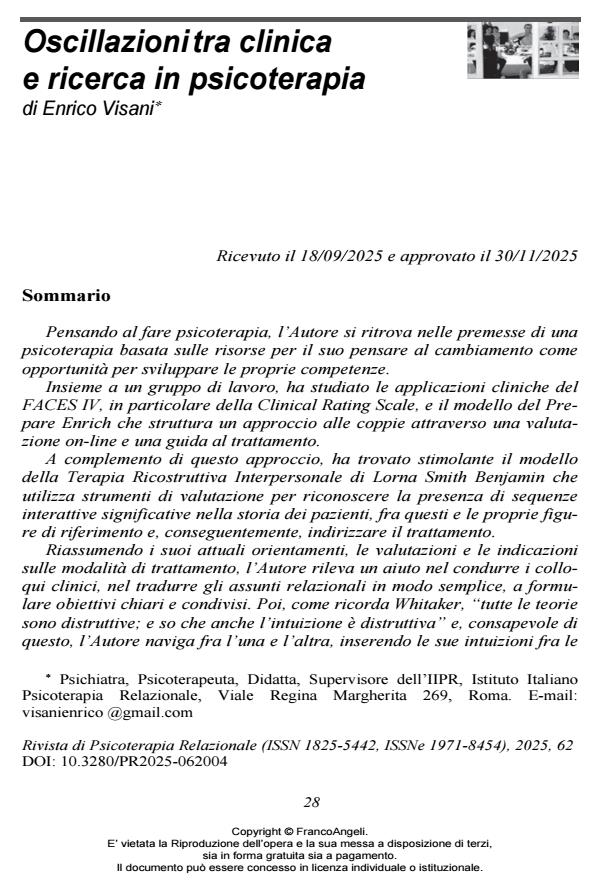
Thinking about doing psychotherapy, the Author finds himself in the premises of a resource-based psychotherapy for its thinking of change as an opportunity to develop one’s skills. Together with a working group, he studied the clinical applications of FACES IV, in particular the Clinical Rating Scale, and the Prepare Enrich model that structures an approach to couples through an online assessment and treatment guide. Complementing this approach, the Author founds Lorna Smith Benjamin’s Interpersonal Reconstructive Therapy model stimulating, which uses assessment tools to recognize the presence of significant interactive sequences in patients’ history between them and their reference figures and, consequently, direct treatment. Summarizing his current orientations, the evaluations and indications on treatment modalities help him to conduct clinical interviews, to translate relational assumptions in a simple way, to formulate clear and shared objectives. Then, as Whitaker reminds us, “all theories are destructive; and I know that intuition is also destructive” and, aware of this, the Author navigates between one and the other, inserting his intuitions among the “evaluations” and surprises of the stories that people, families bring to therapy.
Keywords: psychotherapy, research, Prepare-Enrich, Interpersonal Reconstructive Therapy, Faces IV.
- Benjamin L.S. (2004). Terapia ricostruttiva interpersonale. Promuovere il cambiamento in coloro che non reagiscono Roma: Editrice LAS.
- Benjamin L.S. (2019). Terapia ricostruttiva interpersonale per la rabbia, l’ansia e la depressione. Milano: Raffaello Cortina.
- Fife S.S.T., Whiting J.B., Bradford K., Davis S. (2014). The therapeutic pyramid: A common factors synthesis of techniques, alliance, and way of being. Journal of Marital and Family Therapy, 40: 20-33.
- Fruggeri L. Balestra F., Venturelli E. (2020). Le competenze terapeutiche. Bologna: il Mulino.
- Loriedo C. (2005). Resilienza e fattori di protezione nella psicoterapia familiare sistemica. Rivista di Psicoterapia Relazionale, 21: 5-28.
- Olson D.H. (2000). Circumplex Model of Marital and Family Systems. Journal of Family Therapy, 22, 2: 144-167. DOI: 10.1111/1467-6427.0014
- Olson D.H. (2023). 10 ways couple assessment can improve any relationship education program in testo disponibile al sito: https://www.prepare-enrich.com/ about/research/
- Olson D.H., Olson A.K., Larson, P.J. (2012). Prepare-Enrich program: Overview and new discoveries about couples. Journal of Family and Community Ministries, 25, 1: 30-44.
- Olson D.H., Waldvogel L., Schlieff M. (2019). Circumplex model of marital and family systems: An update. Journal of FamilyTheory & Review, 11, 2: 199-211.
- Sackett D.L. (1997). Evidence-based medicine. Semin. Perinatol. Feb. 21, 1: 3-5.
- Sluzki C. (1991). La trasformazione delle trame narrative. Terapia Familiare, 36: 5-19.
- Visani E., Loriedo C., Di Nuovo S. (a cura di) (2014). Il Faces IV. Il modello circonflesso di Olson nella clinica e nella ricerca. Milano: FrancoAngeli.
- Visani E. (2014). Un contributo per una psicoterapia familiare basata sulle risorse. Rivista di Psicoterapia Relazionale, 40, 2: 21-38.
- Visani E. (2014). Utilizzazione clinica del modello circonflesso. In Visani E., Loriedo C., Di Nuovo S. (a cura di) (2014). Il Faces IV. Il modello circonflesso di Olson nella clinica e nella ricerca. Milano: FrancoAngeli.
- Visani E., Iannò R. (2025). Il Prepare/Enrich: un percorso semistrutturato per le coppie. In Mariotti M., Loriedo C., Saba G., Sluzki C., Stratton P. (a cura di), [(2025)] Evidenze e creatività in psicoterapia sistemica e relazionale. Milano: FrancoAngeli.
- Whitaker C.A (1984). L’intralcio della teoria nell’attività clinica. In Whitaker C.A., Il gioco e l’assurdo. La terapia esperienziale della famiglia. Roma: Astrolabio Ubaldini.
Enrico Visani, Oscillazionitra clinica e ricerca in psicoterapia in "RIVISTA DI PSICOTERAPIA RELAZIONALE " 62/2025, pp 28-35, DOI: 10.3280/PR2025-062004