The symptom as an ally: the functions of the symptom
Journal title RIVISTA DI PSICOTERAPIA RELAZIONALE
Author/s Carmelo Panebianco, Lidia Manganaro, Paola Siracusano, Michela Panebianco
Publishing Year 2026 Issue 2025/62
Language Italian Pages 9 P. 91-99 File size 79 KB
DOI 10.3280/PR2025-062012
DOI is like a bar code for intellectual property: to have more infomation
click here
Below, you can see the article first page
If you want to buy this article in PDF format, you can do it, following the instructions to buy download credits
FrancoAngeli is member of Publishers International Linking Association, Inc (PILA), a not-for-profit association which run the CrossRef service enabling links to and from online scholarly content.
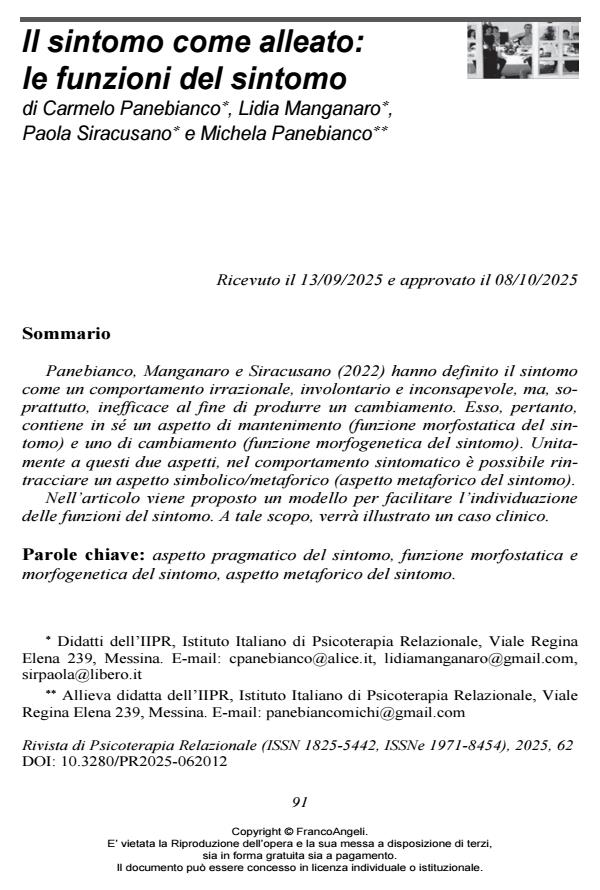
Panebianco, Manganaro and Siracusano defined the symptom as irrational, involuntary, and unaware behaviour, but, above all, ineffective in producing a change. It, therefore, contains within itself an aspect of maintenance (morphostatic function of the symptom) and one of change (morphogenetic function of the symptom). Together with these two aspects, symptomatic behaviour allows for the identification of a symbolic/metaphorical aspect (the metaphorical aspect of the symptom). The article proposes a model to facilitate the identification of the functions of the symptom. To this end, a clinical case will be illustrated.
Keywords: pragmatic aspect of the symptom, morphostatic and morphogenetic function of the symptom, metaphorical aspect of the symptom.
Carmelo Panebianco, Lidia Manganaro, Paola Siracusano, Michela Panebianco, Il sintomo come alleato: le funzioni del sintomo in "RIVISTA DI PSICOTERAPIA RELAZIONALE " 62/2025, pp 91-99, DOI: 10.3280/PR2025-062012