Systemic therapy and LGBTQIA+ population

Journal title RIVISTA DI PSICOTERAPIA RELAZIONALE
Author/s Federica Seravelli, Cecilia Caravaggi, Maria Luisa Iervolino
Publishing Year 2026 Issue 2025/62
Language Italian Pages 8 P. 121-128 File size 122 KB
DOI 10.3280/PR2025-062016
DOI is like a bar code for intellectual property: to have more infomation click here

Below, you can see the article first page

If you want to buy this article in PDF format, you can do it, following the instructions to buy download credits
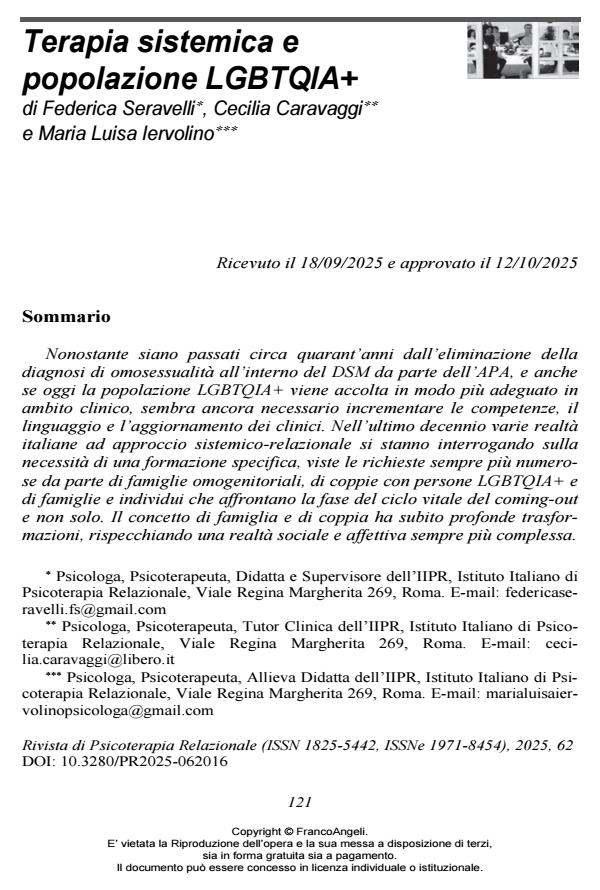
Article preview

FrancoAngeli is member of Publishers International Linking Association, Inc (PILA), a not-for-profit association which run the CrossRef service enabling links to and from online scholarly content.

Although approximately forty years have passed since the American Psychiatric Association (APA) removed homosexuality from the DSM, and despite the fact that the LGBTQIA+ population is now more appropriately received within clinical settings, there remains a clear need to expand clinicians’ competencies, language, and ongoing training. Over the past decade, various Italian institutions that adopt a systemic-relational approach have begun to reflect on the necessity of specific training, given the increasing number of requests from same-sex parent families, couples including LGBTQIA+ individuals, and families and individuals navigating the coming-out phase and other stages of the life cycle. The concepts of family and couplehood have undergone profound transformations, reflecting an increasingly complex social and emotional reality. These changes inspire who study family systems to further explore and, above all, update their understanding of new family and couple configurations and the emerging relational dynamics. Recent studies emphasize that key protective factors for the psychological well-being of LGBTQIA+ individuals include family support and social acceptance. Therefore, the intervention of the systemic therapist appears both necessary and essential in promoting the mental health of individuals within the community and the systems to which they belong.

Keywords: LGBTQIA+ population, minority stress, coming-out, new families, Queer family, homoparental family.

  1. Addison S.M., Coolhart D. (2015). Expanding the therapy paradigm with queer couples: A relational intersectional lens. Family Process, 54: 435-453.
  2. Baiocco R., Marasco B., Astuto A., Lonigro A. (2012). Qualità della relazione con i propri genitori, funzionamento familiare e coming out in giovani gay e lesbiche. Counseling. Giornale italiano di ricerca e applicazioni, 5: 193-206.
  3. Baiocco R., Salvati M., Carone N., Ioverno S., Nappa M. R., Pistella J. (2018). Identità positiva in persone lesbiche, gay e bisessuali: Un contributo alla validazione italiana della Lesbian, Gay, and Bisexual Positive Identity Measure (LGB-PIM). Il giornale italiano di psicologia e di educazione prenatale, 45: 953-978.
  4. Baiocco R., Pezzella A., Pistella J., Kouta C., Rousou E., Rocamora-Perez P., Papadopoulos I. (2021). LGBT+ training needs for health and social care professionals: A cross-cultural comparison among seven European countries. Sexuality research and social policy, 1-15.
  5. Bos H.M.W., van Balen F., van den Boom D.C. (2004). Experience of parenthood, couple relationship, social support, and child-rearing goals in planned lesbian mother families. Journal of Child Psychology and Psychiatry, 45: 755-764.
  6. Cass V.C. (1979). Homosexual identity formation: A theoretical model. Journal of homosexuality, 4: 219-235.
  7. Coolhart D. (2023). Therapy with queer couples. In J. L. Lebow e D. K. Snyder (eds.), Clinical handbook of couple therapy (6th ed., pp. 512–529). New York: Guilford Press.
  8. Ferrari F. (2015). La famiglia inattesa: i genitori omosessuali e i loro figli. Milano: Mimesis.
  9. Golombok S. (2020). We are family: The modern transformation of parents and children. New York: PublicAffairs.
  10. Green R. J. (2000). “Lesbians, gay men, and their parents”: A critique of LaSala and the prevailing clinical “wisdom”. Family Process, 39: 257-266.
  11. La Mesa A., Rago N., Daniele A. (2016). Se un figlio dichiara la propria omosessualità. Cinque ipotesi di lavoro con le famiglie. Milano: FrancoAngeli.
  12. LaSala M.C. (2000). Gay male couples: The importance of coming out and being out to parents. Journal of Homosexuality, 39: 47-71.
  13. LaSala M.C. (2010). Coming Out, Coming Home: Helping Families Adjust to a Gay or Lesbian Child. New York: Columbia University Press.
  14. Lingiardi V., Nardelli N. (2007). Spazio zero. Minority stress e identità omosessuali. Omosapiens 2. Studi e ricerche sugli orientamenti sessuali, 2: 3-17.
  15. Lingiardi V., Baiocco R. (2015). Adolescenza e omosessualità in un’ottica evolutiva. In Quagliata E., Di Ceglie E., Lo sviluppo dell’identità sessuale e l’identità di genere. Roma: Astrolabio.
  16. Lingiardi V., Nardelli N., Giovanardi G., Speranza A.M. (2023). Consulenza psicologica e psicoterapia con persone lesbiche, gay, bisessuali, transgender, non binarie. Milano: Raffaello Cortina.
  17. Lorber J. (1995). L’invenzione dei sessi. Milano: Il saggiatore.
  18. Meyer I.H., Frost D.M. (2013). Minority stress and the health of sexual minorities. In Patterson C.J., D’Augelli A.R. (eds), Handbook of psychology and sexual orientation (pp 252-266). Oxford: Oxford University Press.
  19. Montano A. (2000). Psicoterapia con clienti omosessuali. McGraw-Hill Libri Italia.
  20. Murgia M. (2022). God save the queer. Catechismo femminista. Torino: Einaudi.
  21. Puckett J.A., Brown N.C., Dunn T., Mustanski B., Newcomb M.E. (2020). Perspectives from Transgender and Gender Diverse People on How to Ask About Gender. LGBT HealtH, 7: 305-311.
  22. Teh Y.Y., Lask J., Stratton P. (2017). From family to relational SCORE-15: an alternative adult version of a systemic self-report measure for couples and LGB people. Journal of Family Therapy, 39: 21-40. DOI: 10.1111/1467-6427.1210
  23. Vaughan M. D., Waehler C. A. (2010). Coming out growth: Conceptualizing and measuring stress-related growth associated with coming out to others as a sexual minority. Journal of adult development, 17: 94-109.
  24. Willoughby B.L., Malik N.M., Lindahl K.M. (2006). Parental reactions to their sons’ sexual orientation disclosures: The roles of family cohesion, adaptability, and parenting style. Psychology of Men & Masculinity, 7(1), 14. DOI: 10.1037/1524-9220.7.1.1

Federica Seravelli, Cecilia Caravaggi, Maria Luisa Iervolino, Terapia sistemica e popolazione LGBTQIA+ in "RIVISTA DI PSICOTERAPIA RELAZIONALE " 62/2025, pp 121-128, DOI: 10.3280/PR2025-062016